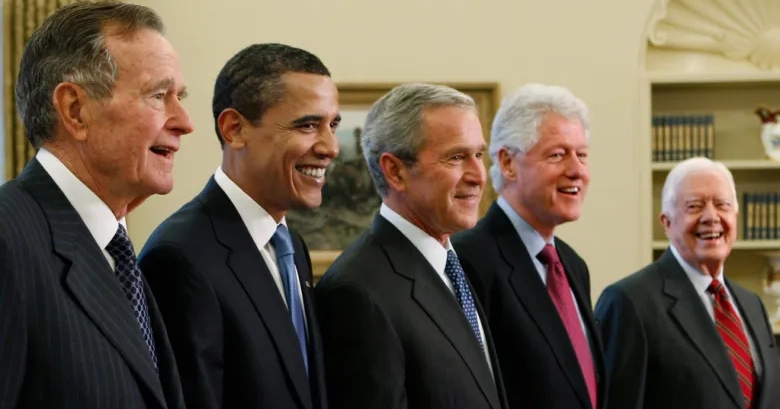
Former US presidents George W. Bush, Barack Obama and Bill Clinton have contributed essays to a major 250th-anniversary project on American presidents, carefully avoiding direct mention of President Donald Trump.
The three former presidents are among historians, writers and other prominent figures taking part in the “In Pursuit” project, in which contributors write about a US president or first lady.
Although the project was designed to stay above current political debates, several essays touch on issues that have gained renewed attention during Trump’s presidency, including the limits of presidential power, the strength of democracy and respect for constitutional institutions.
The project is curated by Colleen Shogan, the former US archivist who was fired by Trump in 2025 without an explanation. She asked contributors to avoid partisan or ideological arguments.
“Everybody took those instructions and that guidance very seriously,” Shogan told The Associated Press.
She said the project aims to help Americans learn from the country’s successes and failures over the past 250 years and apply those lessons to the present and future.
The essays cover 43 presidents — excluding Trump and former President Joe Biden — as well as 30 first ladies. They are being published weekly in chronological order through December.
Trump and Biden were left out because their presidencies are considered too recent for history to properly assess them.
Bush highlights Washington’s decision to give up power
Bush’s essay focuses on George Washington and his decision to voluntarily give up power.
The former Republican president praises Washington for establishing limits on presidential authority. Washington stepped down as commander of the Continental Army after the Revolutionary War and later served only two presidential terms.
Bush says Washington’s willingness to surrender power became one of the most important examples for future presidents.
The essay, published on Presidents Day as the first installment of the series on Substack, attracted significant attention.
Another widely discussed contribution came from retired Gen. Stanley McChrystal, who wrote about Ulysses S. Grant.
‘Law over loyalty’
McChrystal portrays Grant as a leader who placed principles above personal ambition and resisted pressure on military leaders to support political factions or individuals instead of the Constitution.
The theme of personal loyalty has particular relevance during Trump’s presidency, as Trump has repeatedly demanded loyalty from members of his administration.
McChrystal writes that the pressure to turn public institutions toward personal political power is not limited to one period in history, adding that the country’s future depends on leaders choosing “law over loyalty.”
In the latest installment this month, Clinton writes about Theodore Roosevelt. He focuses on Roosevelt’s efforts to broaden the meaning of “we the people” while challenging powerful corporate interests.
Clinton also addresses Roosevelt’s discriminatory views toward Black and Indigenous Americans.
Many of the essays discuss both the achievements and failures of presidents, unlike approaches that portray US history mainly through a patriotic lens.
Obama, Hillary Clinton and Michelle Obama among contributors
Other contributors include Chief Justice John Roberts, who writes about William Howard Taft, the only US president who later served on the Supreme Court.
Hillary Clinton writes about Eleanor Roosevelt, Michelle Obama about Jacqueline Kennedy, Republican strategist Karl Rove about William McKinley, filmmaker Ken Burns about Franklin D. Roosevelt and historian Michael Beschloss about Lyndon Johnson.
Barack Obama contributes an essay on Abraham Lincoln.
The project is organised by More Perfect, a nonpartisan coalition of presidential centres, academics and organisations working to strengthen democracy.
Shogan now works with the project after Trump removed her as US archivist in February 2025. She said she has never been told why she was dismissed, and Congress apparently has not been given an explanation either.
Federal law requires Congress to be notified about the removal, although it does not set a specific deadline.
Shogan said the archivist’s position has traditionally been nonpartisan, similar to the roles of the Librarian of Congress and the secretary of the Smithsonian.
The White House did not respond to questions about why Trump fired Shogan or whether Congress would be informed of the reason.
Trump has previously criticised the National Archives for referring allegations over his handling of classified documents to the Justice Department after he left office following his first term. Shogan was not leading the agency at that time.
Public interest in history grows
Shogan said the strong public response to the project shows that many Americans are interested in learning about history without a partisan slant.
The essays have received more than 1 million combined views on Substack, while the project’s podcast has recorded about 160,000 audio downloads and nearly 64,000 YouTube views, according to the latest figures.
A documentary on the project is scheduled to air on PBS in October.
The essays also explore lesser-known aspects of presidents who receive less attention.
Millard Fillmore, for example, is described by former New York congressman Steve Israel as a president often remembered mainly for being forgotten.
Franklin Pierce is portrayed as a pro-slavery president who was also shaped by the alcohol-heavy political culture of Washington at the time.
Yale history professor David W. Blight writes about how Pierce won the presidency for the Democrats in 1852 despite harsh attacks from the Whigs.
His opponent, Mexican-American War veteran Gen. Winfield Scott, was used by the Whigs to mock Pierce, who had also served in the war, with a sarcastic reference to him as a “hero of many a well-fought bottle.”