
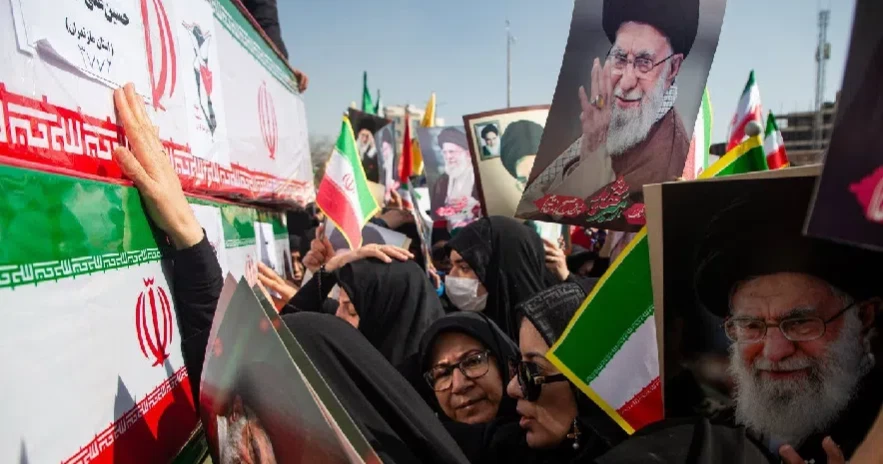
US President Donald Trump has said he wants to be involved in selecting Iran’s next supreme leader as the war involving the United States, Israel and Iran entered its sixth day, with the conflict spreading across the Middle East.
In an interview with the news website Axios, Trump dismissed Mojtaba Khamenei, the son of slain Iranian leader Ayatollah Ali Khamenei, as a potential successor. Mojtaba Khamenei has been seen as a leading contender to replace his father, who was killed during the opening wave of US-Israeli strikes on Iran.
Trump described the 56-year-old cleric as “a lightweight” and said Washington wants a leader who would bring stability to Iran.
“We want someone that will bring harmony and peace to Iran,” Trump said, adding that he hoped to be involved in the appointment process “like with Delcy in Venezuela,” referring to Delcy Rodríguez, who assumed leadership there following a US-backed operation earlier this year that led to the detention of President Nicolás Maduro.
Trump’s remarks are likely to intensify speculation about whether Washington and Israel ultimately seek regime change in Iran or simply a shift in Tehran’s policies.
Meanwhile, the conflict continued to widen, affecting at least 14 countries across the region and beyond. Iran continued launching missile and drone attacks against Israel, US military installations and other targets in the Middle East, while American and Israeli forces carried out widespread airstrikes across Iran targeting military facilities, leadership figures and parts of the country’s nuclear programme.
Casualties from the war have continued to rise. Officials say at least 1,230 people have been killed in Iran, more than 100 in Lebanon and about a dozen in Israel. Six US service members have also been killed.
Iran’s retaliation has also disrupted oil supplies and international air travel, while several neighbouring Arab countries reported attacks or interceptions of missiles and drones.
Iranian Foreign Minister Abbas Araghchi accused the US Navy of committing an “atrocity at sea” after an Iranian warship, the IRIS Dena, was sunk earlier in the week in the Indian Ocean, killing at least 87 crew members. The vessel had been returning from naval exercises hosted by India and also attended by the United States.
Araghchi warned that Washington would “bitterly regret” the incident. Sri Lankan authorities said 32 sailors had been rescued from the vessel.
Amid rising tensions, an Iranian cleric, Ayatollah Abdollah Javadi Amoli, called on state television for violence against Israel and Trump — a rare statement from a senior Shiite cleric.
The regional conflict has also intensified militarily. Israel reported fresh missile attacks targeting Tel Aviv and Jerusalem, while its forces launched strikes on Iranian ballistic missile launch sites.
In the United Arab Emirates, a drone was intercepted near Al Dhafra Air Base, which hosts US forces, leaving six people injured by falling debris. Qatar evacuated residents near the US Embassy in Doha as a precaution and later reported a missile attack on the city.
Saudi Arabia said it destroyed a drone near its border with Jordan, while Bahrain reported that an Iranian missile struck a state-run oil refinery, triggering a fire that was later extinguished without casualties. Bahraini authorities said their forces have intercepted dozens of Iranian missiles and drones since the conflict began.
Azerbaijan also accused Iran of launching drone attacks after one drone crashed near the airport in the Nakhchivan region and another fell close to a school, injuring four airport workers. President Ilham Aliyev described the incident as an act of aggression and said his country was preparing retaliatory measures. Iran denied launching drones toward Azerbaijan.
The war has also disrupted shipping routes in the Gulf of Oman and the Strait of Hormuz, a critical global oil transit route, pushing oil prices higher.
As tensions expanded further, Israel issued a mass evacuation warning to residents of Beirut’s southern suburbs, signalling the possibility of large-scale bombardment against Hezbollah positions.
The Israeli military said it had struck several Hezbollah command centres in the area. UN peacekeepers reported clashes, including ground combat, in southern Lebanon as Israeli forces moved deeper across the border.
UNIFIL spokesperson Tilak Pokharel said peacekeepers observed ground fighting near the border village of Kfar Kila and witnessed airstrikes, flares and explosions in nearby towns overnight as the conflict continued to escalate.