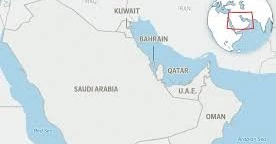
The United Arab Emirates hopes diplomatic efforts led by Qatar can help prevent another confrontation between the United States and Iran, a senior adviser to the UAE president said Sunday, warning that military action would only deepen the crisis.
The war, which began on February 28 with joint US-Israeli strikes on Iran, followed by Iranian attacks on Gulf countries, has made this a turning point for the region and the world, presidential adviser Anwar Gargash said at a security forum in Bahrain.
"We don't really want to see another round of confrontation in the region," Gargash told the Manama Dialogue, an annual security summit organised by the International Institute for Strategic Studies (IISS). The event brings together regional and international government, defence and foreign affairs officials and experts.
Iranian Foreign Minister Abbas Araghchi said Iranian negotiators were in Qatar discussing a proposal that could lead to the reopening of the Strait of Hormuz soon. He said no direct talks were taking place with Washington and that progress depended on the US response to Iran's questions.
In an interview shared on his Telegram channel, Araghchi said Tehran hoped Washington would choose diplomacy over other options, adding that Iran was prepared for both defence and diplomatic engagement.
Escalation fears dominate security forum
The possibility of renewed conflict overshadowed the three-day gathering in Bahrain's capital.
Gargash said the crisis required political wisdom and diplomatic engagement, warning that military solutions would further complicate the situation without providing a quick way out.
He acknowledged that Washington and Tehran remained far apart in their positions, adding that failure to bridge the differences could lead to serious consequences.
He said another war would serve neither the interests of Iran nor those of the wider region.
Egyptian Foreign Minister Badr Abdelatty expressed similar concerns at the forum a day earlier, warning that another escalation would be more dangerous and destructive and would achieve nothing.
Gargash, however, said the UAE and other regional countries were preparing for the possibility of renewed hostilities.
According to the IISS, the UAE faced the highest number of Iranian aerial attacks before a ceasefire was reached in April, with more than 3,000 drones and ballistic missiles targeting airports, military installations and oil facilities. Most were intercepted.
Gulf countries have since spent billions of dollars strengthening their defence capabilities.
Gargash said the conflict had further strengthened relations between the UAE and the United States, making the partnership even more important to the country's defence.
Bahrain calls for regional cooperation
Bahraini Foreign Minister Abdullatif bin Rashid Al Zayani said his country welcomed all efforts to ease tensions, prevent further escalation and create opportunities for dialogue.
He accused Iran of following a pattern of attacks and threats against maritime, aviation and data infrastructure, putting regional and global stability at risk.
Al Zayani said such threats had continued even after the ceasefire, including concerns over underwater data cables last month. He also referred to attacks by Iran-backed Houthi rebels on neighbouring Saudi Arabia.
"These attacks are part of one continued pattern," he said. "The hands may change, the approach doesn't."
The IISS said Iran fired around 500 drones and nearly 200 ballistic missiles towards Bahrain, which hosts the US Navy's 5th Fleet, during the height of the war. The attacks struck the naval base, residential buildings, the financial district and a water desalination facility.
Houthi rebels also intensified attacks on Saudi oil infrastructure and airports during the summer, saying they were responding to Saudi airstrikes on Sanaa airport. Their attacks hit key oil pipelines and disrupted air traffic.
The forum also highlighted the lack of a coordinated defence mechanism among the six members of the Gulf Cooperation Council — Saudi Arabia, the UAE, Kuwait, Bahrain, Qatar and Oman.
During the conflict, Gulf countries largely responded to Iranian attacks individually, coordinating with US command centres in the region. The IISS said this sometimes weakened their collective defensive efforts.
Gargash openly criticised the lack of joint action, saying Gulf countries had responded to the crisis at national and bilateral levels but had failed to meet the challenge collectively.