British Prime Minister Andy Burnham has expressed willingness to issue a formal apology for the United Kingdom's role in the trans-Atlantic slave trade, signalling a significant shift in the country's longstanding position on addressing its historical involvement in slavery.
Ahead of his meeting with Commonwealth leaders in the Caribbean this week, Burnham said Britain should openly discuss the lasting consequences of slavery rather than avoid confronting its past.
However, he rejected demands for financial reparations, proposing instead to lead an initiative on debt restructuring to help the poorest Commonwealth countries.
His position has received a cautious welcome from Caribbean nations, although disagreements over compensation remain unresolved.
"An apology is an essential first step," the Caribbean Community (Caricom), a regional trade bloc, said in a statement on Saturday. "But an apology without repair is incomplete."
The Netherlands formally apologised for its role in the slave trade in 2022, but no country has paid financial reparations to nations affected by slavery or to formerly enslaved people and their descendants.
The UK has never issued a formal apology for its involvement in the trade, although some British institutions, including the Church of England, have begun acknowledging their historical roles.
Britain's role in the slave trade and its abolition
Britain entered the trans-Atlantic slave trade in the mid-16th century, following Portugal and Spain. At its peak, it became the world's largest slave-trading nation, transporting more than three million Africans across the Atlantic.
Captured Africans were traded for goods in West Africa and then transported to British sugar and tobacco plantations in the Caribbean and the Americas. Products from those plantations were subsequently shipped back to England.
In the 17th century, the Royal African Company, established under King Charles II and managed by his brother, who later became King James II, trafficked around 80,000 African men, women and children into slavery in the Americas. About 20,000 of them died before the company's monopoly on the English slave trade ended in 1698, allowing other English traders to enter the business.
An abolitionist movement emerged in England in the late 18th century, backed by Quakers, some politicians and formerly enslaved people.
British politicians have traditionally highlighted the country's role in abolishing the slave trade in 1807 and outlawing slavery throughout the British Empire in 1833, arguing that these moves helped inspire abolitionist movements elsewhere.
Burnham, however, said Britain must also acknowledge its involvement in the trade in human lives.
In an article published in The Guardian on Friday, he wrote that while Britain was home to courageous people who led the campaign to abolish slavery, it was also a country that participated in the slave trade.
Burnham rejects compensation, proposes debt restructuring
Caribbean countries have been seeking reparations from Britain for decades. Various studies estimate that the compensation owed could range from hundreds of millions to trillions of dollars.
Burnham rejected the demands, maintaining that present-day British citizens should not be held responsible for historical injustices committed under different laws and circumstances.
"I do not think that British people today can be held liable for historical wrongs, however heinous, that happened in a different age under different laws and in which they played no personal part," he said.
Instead, he proposed working with other wealthy countries and investors to help poorer nations manage their debt burdens by extending repayment periods and reducing interest rates.
He said former Prime Minister Gordon Brown would assist him in the initiative.
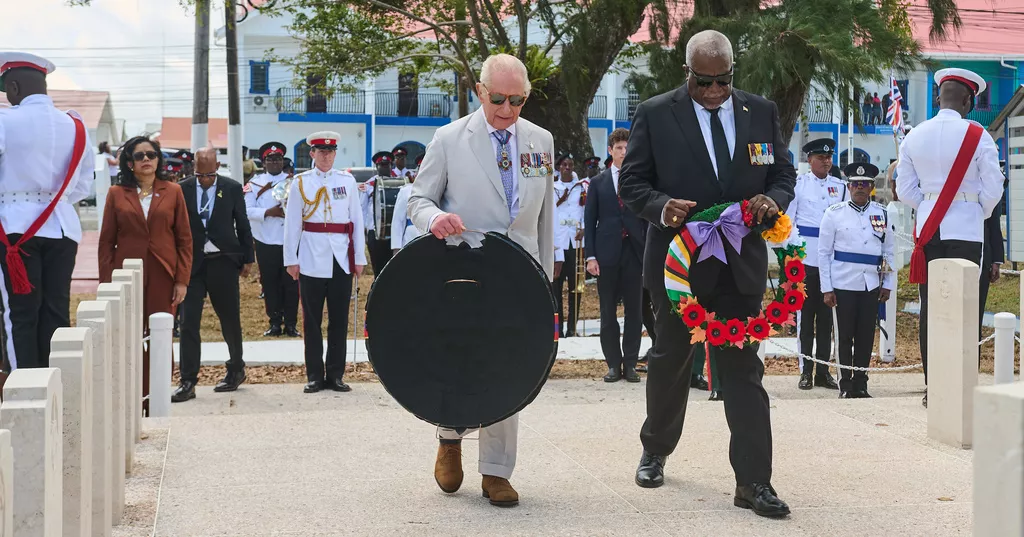
King Charles III, who is currently on a nine-day visit to the Caribbean, acknowledged the "great suffering and injustices of the past" during his visit this week.
However, the King, who remains the head of state of several Caribbean countries, did not directly address regional leaders' demands for an apology and reparations.
Meanwhile, opposition Conservative Party leader Kemi Badenoch argued that Britain should not apologise for its historical role in slavery.
She said Burnham did not need to apologise, arguing that such an apology could open the door to demands for financial compensation.
Caribbean nations welcome apology prospect but insist on reparations
Philip J Pierre, Prime Minister of Saint Lucia and chair of Caricom, welcomed Burnham's willingness to consider a formal apology and his proposal for structured dialogue with countries affected by slavery.
He said no previous British prime minister had gone as far as Burnham in considering such a step and that Caribbean nations were ready to engage in discussions.
However, Pierre stressed that a dialogue excluding reparations from the outset could not be considered complete.
He reiterated that Caribbean countries were seeking improvements in education and public health, development programmes for Indigenous communities, repatriation and resettlement opportunities for those wishing to return to their ancestral homelands, debt cancellation and financial compensation, among other measures.
"Debt relief, however welcome, cannot be offered as a substitute for reparatory justice," he said.