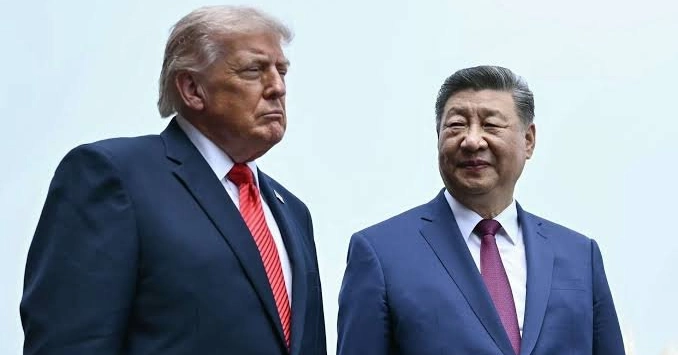
US President Donald Trump and Chinese President Xi Jinping are expected to meet this week as their countries compete for leadership in artificial intelligence while also facing growing concerns about the technology’s potential risks.
The two nations are seeking an advantage in AI, but both have raised concerns about how the technology could be used by the other side. As China continues to narrow the gap with the United States, hopes for cooperation on global AI safety remain complicated by broader tensions between Washington and Beijing.
“The U.S.-China conversation in AI is getting caught in the ups and downs in the broader U.S.-China relationship,” said Scott Singer, co-director of the China AI Initiative at the Carnegie Endowment for International Peace.
US Treasury Secretary Scott Bessent said Sunday that Washington and Beijing had discussed creating a mechanism for AI dialogue during talks in New York with Chinese Vice Premier He Lifeng. The US also proposed a “notification mechanism” for AI-related incidents that could affect national security.
AI emergencies could offer room for cooperation
The two sides could discuss risks such as AI-powered cyberattacks, biological misuse, major failures of AI systems and situations in which humans lose control over advanced AI, said Sun Chenghao, a senior fellow at Tsinghua University’s Center for International Security and Strategy.
“There is still meaningful room for cooperation,” Sun said, adding that China is also paying increasing attention to AI-related risks, including cyber threats, malicious use and loss of control.
Bessent said the proposed notification system would allow the two countries to alert each other about AI incidents that reach the level of a national security threat.
“We want a shared vision of common goals and common threats,” he told reporters.
Michael Kratsios, Trump’s science and technology adviser, also said discussions with China were important, particularly to reduce risks that could affect both countries.
Both governments are concerned about AI being used against critical infrastructure. Chinese AI governance documents identify finance, electricity, telecommunications and transportation as sectors that could face risks from advanced AI, Sun said.
Samm Sacks, a senior fellow at Johns Hopkins University, said China has shown interest in discussing issues such as sharing information about AI and cyber incidents with US experts.
If Washington and Beijing can agree on how to report and communicate during an AI emergency, it could gradually build technical confidence between the two countries, said Xiao Qian, vice dean of Tsinghua University’s Institute for AI International Governance.
US chip restrictions remain a major issue
Trump has repeatedly said that “whoever wins AI, wins” and has stressed the need for the US to maintain its technological lead over China. Beijing has accused Washington of seeking an AI monopoly by restricting China’s access to advanced technologies, including high-end computer chips.
Any major easing of US export controls on advanced AI-related technology is unlikely to be discussed at the meeting, said Alfredo Montufar-Helu of consultancy Ankura.
With Washington and Beijing competing across multiple areas, the scope for cooperation on AI remains “quite narrow,” he said.
Despite US restrictions, Chinese AI models have increasingly challenged leading American systems. Models developed by companies including Moonshot AI and DeepSeek have shown capabilities comparable in some areas to systems from US companies such as Anthropic and OpenAI, often at lower costs.
“Export controls have not stopped China from developing frontier-competitive models, but they slow its rate of expansion by limiting the compute it can use to serve users,” said Will Cong, a professor at Nanyang Technological University in Singapore.
Chinese chip developers have also been making progress, while domestic companies are increasingly using locally produced chips. This has strengthened Beijing’s position in talks with Washington, said George Chen of The Asia Group.
Dispute over AI technology sharing
Another source of tension is US accusations that Chinese companies are improperly using technology from American AI developers.
The US government and AI companies have accused Chinese firms of “distillation,” a process in which capabilities from advanced AI models are extracted and used to improve other systems. Chinese officials have rejected the allegations.
Anthropic has accused Chinese AI companies DeepSeek and Moonshot of sending some user requests to its Claude AI models. Rebecca Arcesati of the Mercator Institute for China Studies said Chinese companies may be seeking to benefit from the infrastructure developed by their US competitors as American restrictions limit China’s computing capacity.
Chinese officials and some technology analysts, however, argue that distillation is common across the AI industry and does not fully explain the progress of Chinese AI models.
Beijing has also expressed concern about the potential impact of American AI on China’s critical infrastructure, including risks linked to Anthropic’s Claude system. It has further raised concerns about AI being used to spread political misinformation and potentially challenge its governance.
“We cannot expect meaningful cooperation on AI safety if one side increasingly treats the other side’s technological progress as a national security threat,” Xiao said.
She added that disagreements between the two countries make dialogue on AI safety even more important.