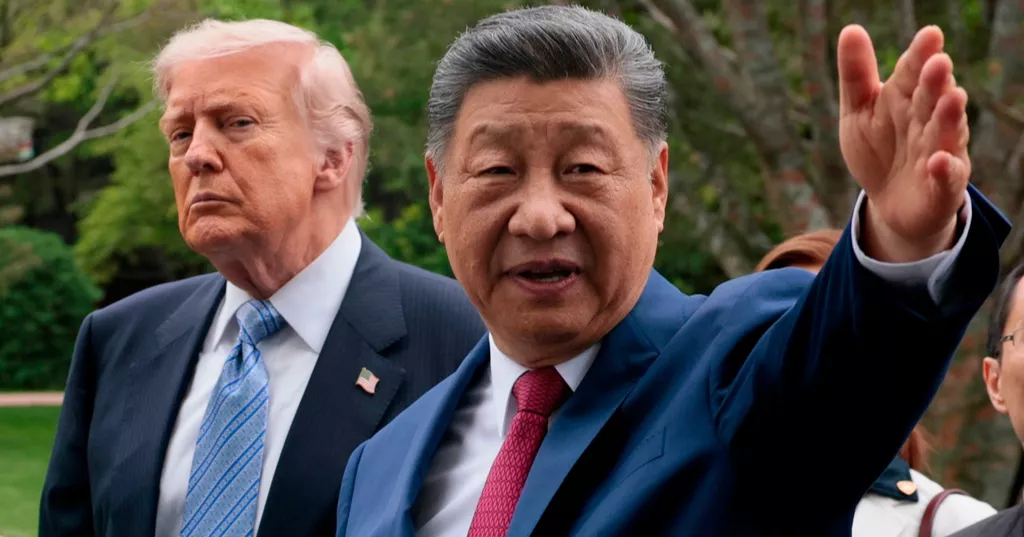
The United States and China have made uneven progress in implementing trade commitments reached after US President Donald Trump and Chinese President Xi Jinping met in Beijing in May.
As Trump and Xi prepare to meet again in Washington this week, attention is turning to whether their second face-to-face meeting of the year can push their governments to make progress on issues ranging from US beef and Boeing aircraft to artificial intelligence.
Analysts expect some modest progress but do not anticipate any major breakthroughs from Xi's visit, which begins Wednesday.
"Instead, the main deliverable really is that the trip is happening, and the symbolism and the optics of that," said Sara Schuman, a former senior US negotiator for China trade and an adjunct fellow at the Washington-based Center for a New American Security.
The two countries agreed in May on a framework of "constructive strategic stability," under which they would seek to prevent disagreements from escalating. The framework also aims to identify areas of cooperation despite fundamental differences between the two sides.
Positive signs on Board of Trade
Much of the attention surrounding this week's meeting has focused on the possible creation of a Board of Trade and reciprocal tariff reductions covering $30 billion worth of goods in each direction. Both measures were agreed upon in May.
A Chinese Commerce Ministry spokesperson said earlier this month that the two countries hoped to implement the tariff reductions "at an early date."
Analysts expect an announcement, although some believe the eventual agreement could cover less than $30 billion in goods.
Experts at the World Economic Forum wrote last week that around 10 product categories are under discussion, but the two sides remain divided over the scope of the initiative.
The tariff reductions would apply only to nonsensitive products. Analysts said those could include toys, holiday decorations and other low-end manufactured goods from China. For US farmers, the reductions could involve Chinese tariffs on American agricultural exports.
"I think for the president, he wants to be able to demonstrate, just before the midterms, that this approach is working and that it benefits voters," Schuman said, referring to the US congressional elections in November.
Chinese farm purchases may fall short
The White House said in May that China had agreed to purchase at least $17 billion worth of US agricultural products annually, in addition to an earlier commitment to buy 25 million metric tons of soybeans each year.
That would put China's total annual purchases of US farm products at about $30 billion, according to Luke Lindberg, the US undersecretary of agriculture for trade.
However, it remains uncertain whether that level will be reached. The US Department of Agriculture forecast last month that China would import $21.5 billion worth of American agricultural products during the 12-month period beginning Oct. 1.
The two countries also agreed in May to work actively to remove barriers affecting Chinese exports of dairy products, seafood and potted bonsai, as well as US exports of beef and poultry.
China has renewed registrations for US beef processing plants, but negotiators are still working on technical issues needed to clear American shipments through Chinese ports, said Joe Schuele of the US Meat Export Federation.
"Hopefully it will get worked out soon," he said.
Boeing still waiting for orders
China, one of the world's major commercial aviation markets, promised in May to purchase 200 Boeing aircraft. Four months later, however, those orders have yet to materialize.
Boeing CEO Kelly Ortberg said last week that Chinese airlines would announce their orders according to their own schedules.
"We're progressing nicely," he told analysts. "And I'm confident that we will be receiving orders."
The Chinese side has raised concerns about access to aircraft parts, said Craig Allen, a nonresident fellow at the Asia Society Policy Institute.
AI finally draws attention
There had been little progress on an agreement to establish a dialogue on artificial intelligence until a recent surge of activity driven by concerns within the industry over potential misuse of the technology.
"AI is now on people's minds," said Alvin Graylin, a senior fellow at the Asia Society Policy Institute.
However, although the world's two leading AI powers share concerns about the risks associated with the technology, they also regard each other as competitors, making cooperation more difficult.
"They see little reason to collaborate in areas where they believe a competitive advantage is key, regardless of what they say about wanting to get along," said Ja Ian Chong, a political scientist at the National University of Singapore.
A smaller potential step would be the establishment of a channel for crisis communications.
"Given how low the trust is between these two countries, it's really important that people know who their counterparts are and can call them when there's a crisis," said Schuman, the former US trade negotiator.
Little prospect for Board of Investment
An agreement to establish a Board of Investment, also announced in May, has proven more difficult to advance than the trade-related measures.
While Trump has welcomed new factories being built in the United States, Chinese investment is facing scrutiny from the US Congress because of security and strategic concerns amid growing competition between Washington and Beijing.
China is similarly cautious about exporting its technology to the United States and remains uncertain about whether investing there is safe, said Kurt Tong, a former US diplomat who is now with consultancy The Asia Group.
"It kind of sets up a parameter on how far the relationship might be able to improve, given the levels of suspicion between the US and China," he said.