
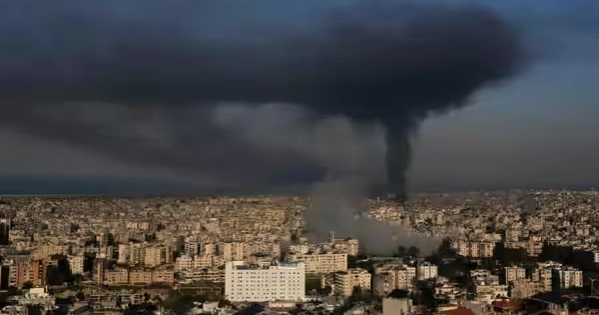
The United States launched a new wave of airstrikes against Iran early Sunday, saying the attacks were intended to "swiftly punish" Iran's Revolutionary Guard after a drone and missile strike on a military base in Jordan killed two American service members, left another missing and injured four others.
The U.S. Central Command (CENTCOM) said the strikes targeted locations linked to Iran's military operations near the Strait of Hormuz, aiming to further weaken Tehran's ability to disrupt maritime traffic through the strategic waterway.
The latest military action followed Friday's attack on a U.S. base in Jordan, marking the first direct combat deaths of American troops from Iranian fire since the early days of the conflict. CENTCOM did not release the identities of the two service members killed.
According to the U.S. military, 16 American personnel have been killed and more than 430 wounded since the conflict between the United States, Israel and Iran began on February 28.
Iranian state media reported that several locations in the southern province of Hormozgan were struck, including areas near Sirik, Hajiabad, Bandar Abbas and Qeshm Island. Explosions were reported across parts of the province, which overlooks the Strait of Hormuz.
The previous day, Iranian authorities said U.S. airstrikes had damaged an electricity and desalination facility, as well as bridges and tunnels in Hormozgan, disrupting a key highway leading to Bandar Abbas, Iran's largest commercial port.
President Donald Trump has repeatedly threatened to target Iran's infrastructure, including power stations and bridges, in an effort to pressure Tehran to ease its restrictions on shipping through the Strait of Hormuz. The U.S. has also reinstated a naval blockade on Iranian ports to curb crude oil exports. CENTCOM said it had redirected five vessels and disabled another since the blockade resumed.
Iranian officials said U.S. strikes over the past three weeks have killed at least 50 people and injured more than 500, including eight people killed in a bridge attack on Friday.
The conflict also spilled into neighboring Iraq, where a drone struck a base of the Kurdistan Freedom Party near Irbil, wounding eight members of the Iranian Kurdish opposition group, according to a military official. Air defense systems were activated in Irbil after additional explosions were heard.
The Kurdish regional capital has experienced repeated drone attacks over the past several days, coinciding with Iraqi Prime Minister Ali al-Zaidi's recent visit to Washington and heightened tensions between Washington and Tehran.
No group claimed responsibility for the attacks, although Iran and Iran-backed militias have previously targeted sites in Iraq's Kurdish region, where U.S. troops and Iranian Kurdish opposition groups are present.
Meanwhile, Iran's supreme leader, Mojtaba Khamenei, warned that continued U.S. attacks would bring "unforgettable lessons" for Washington and its allies. In remarks broadcast on state television, he also dismissed President Trump's authority, calling his signature "worthless and invalid."
Iran's Deputy Foreign Minister Kazem Gharibabadi announced that Tehran was suspending its commitments under the interim agreement reached about a month ago to reduce hostilities, accusing Washington of violating the deal.
The conflict has increasingly centered on control of the Strait of Hormuz, a vital global energy corridor. Before the war, the waterway handled about one-fifth of the world's oil shipments. The widening military campaign has also raised concerns over growing civilian casualties and damage to critical infrastructure, including desalination plants that provide drinking water across the Gulf region.
Iranian missile and drone attacks continued to threaten neighboring countries. Kuwait reported damage to an oil facility and a desalination plant, with several people injured and fires breaking out at key installations. The country temporarily closed its airspace because of missile threats, while its national carrier rescheduled most flights.
Jordan said its air defense systems intercepted Iranian missiles, while Bahrain and Saudi Arabia also activated air raid alerts.
The Secretary-General of the Gulf Cooperation Council (GCC), Jasem Mohamed Al-Budaiwi, condemned Iran's attacks on civilian infrastructure, accusing Tehran of committing war crimes by targeting facilities essential to public services.