
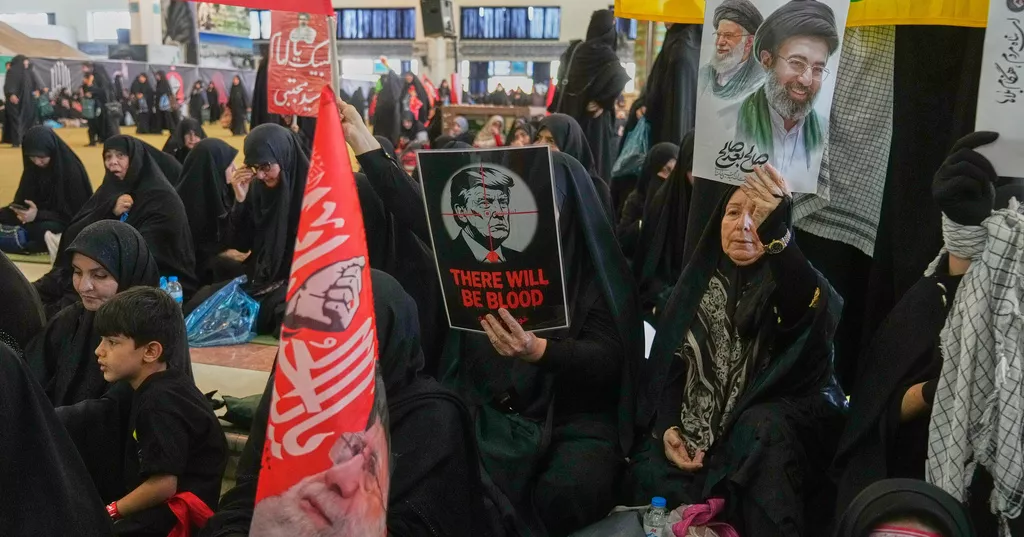
The United States early Wednesday reimposed a blockade on Iranian ports following Tehran's attacks on ships passing through the Strait of Hormuz, triggering fresh strikes on countries hosting American forces as an interim peace deal continued to unravel.
Days of retaliatory attacks by Iran and the United States, along with both sides' efforts to assert control over the strategic waterway through which about one-fifth of the world's oil and natural gas passes during peacetime, have raised fears of a return to full-scale war in the Middle East.
The US first imposed the blockade in mid-April and lifted it in mid-June, a day after signing an interim agreement that allowed a 60-day period for negotiations on issues including Iran's nuclear programme. However, talks have stalled as fighting around the Strait of Hormuz has intensified.
When US President Donald Trump announced the return of the blockade on Monday, he also proposed imposing a 20% fee on ships passing through the strait. Hours later, however, he dropped the plan, saying Gulf allies had requested an alternative approach.
Fresh attacks after blockade resumes
Ahead of reimposing the blockade, the US military launched another wave of strikes, according to US Central Command.
Missile alerts were issued in Bahrain and Kuwait early Wednesday as Iranian missiles targeted the two countries, continuing a pattern of daily attacks that has further strained the fragile ceasefire.
Hours after the blockade was reinstated, Iranian state media reported an exchange of fire in the Strait of Hormuz without providing further details.
Adm. Brad Cooper, commander of US Central Command, said Iran had launched dozens of missiles and drones at neighbouring Gulf Arab countries.
"US forces are holding Iran accountable for unwarranted aggression that continues to endanger innocent lives," Cooper said.
The US currently has at least 19 warships in the Arabian Sea, including two aircraft carriers and an amphibious assault ship carrying more than 1,000 Marines. Central Command also said hundreds of military aircraft are operating across the Middle East.
Since the war between the US, Israel and Iran began on Feb. 28, Tehran has repeatedly targeted and threatened commercial vessels, disrupting shipping through the Strait of Hormuz and driving up global prices for oil, fertiliser and other goods.
More recently, Iran has attacked ships travelling through a US-monitored shipping route near Oman, outside Tehran's control, fuelling the latest escalation. The US has warned it could reopen the strait by force, although experts say such an operation would require a much larger military deployment.
Iran's ambassador to the United Nations, Amir Saeid Iravani, accused Washington of being the aggressor.
"The US is the aggressor, not the victim," he wrote to the UN chief, according to Iran's state-run IRNA news agency.
Trump drops shipping fee proposal
Trump said Tuesday that Gulf leaders had urged him to replace the proposed shipping fees with increased investments in the United States.
"They said we'd love to do it a different way. We'd love to invest in the United States with billions and billions of dollars," Trump told reporters in the Oval Office.
He said he preferred that arrangement because "I don't think anybody should be able to charge a fee for the strait."
It remains unclear whether the proposed investments would be in addition to commitments announced during Trump's visit to the region last year.
Trump's proposal to charge ships for using the strait would have marked a major shift from longstanding US policy supporting free navigation through the waterway.
In an interview with Fox News on Tuesday night, Trump warned that additional US strikes on Iran would continue over the next two days, with bridges and power plants among possible future targets unless negotiations resumed.
"You better make a deal, or you're not going to have anything left," he said.
Strikes continue across the region
US Central Command said it carried out strikes at several locations in Iran on Tuesday. Iranian authorities acknowledged the attacks but did not provide an overall assessment of casualties or damage.
Hours after the US announced the end of its operations, Iran's Bushehr city on the Persian Gulf was struck at four locations, according to IRNA. Explosions were also reported in Ahvaz in southwestern Iran and the southern port city of Bandar Abbas.
The attacks have raised speculation that Gulf Arab states may be responding militarily to Iran without publicly acknowledging it.
Kuwait separately said an Iranian strike wounded four members of its navy on Tuesday and set a building on fire.
Interim peace deal under pressure
Under the interim agreement, Iran pledged to allow free passage through the Strait of Hormuz for 60 days. However, the deal did not address what would happen afterward. Tehran maintains it has the right to regulate shipping through the strait and potentially charge fees, a position disputed by Washington.
Brent crude oil briefly rose above $87 a barrel on Tuesday before falling to around $78 after Trump withdrew his shipping fee proposal.
Meanwhile, regional mediators are continuing efforts to bring the United States and Iran back to the negotiating table.
Two regional officials, speaking on condition of anonymity because of the sensitive diplomatic efforts, said Pakistan-led mediation is working around the clock to restore the ceasefire.