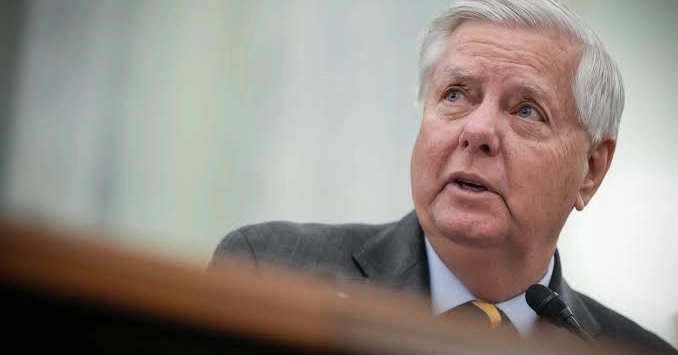
The US Senate on Friday overwhelmingly passed a broad package of sanctions targeting Russia, advancing legislation that the late Sen. Lindsey Graham had spent a year negotiating in an effort to strengthen US backing for Ukraine and pressure Russian President Vladimir Putin to reconsider the prolonged war.
The bipartisan measure passed by a vote of 86-11. It would punish countries that continue purchasing Russian oil, natural gas and other exports, aiming to reduce the revenues Moscow uses to finance the war.
The vote came after Ukrainian President Volodymyr Zelenskyy visited Capitol Hill last week following Graham’s funeral. He met with senators from both parties and observed from the Senate gallery as lawmakers held the first procedural votes on the legislation.
“Today, President Zelenskyy is watching from Ukraine — and Putin is watching from Moscow,” said Democratic Sen. Richard Blumenthal of Connecticut, who worked with Graham on the bill.
“I would like to think Lindsey Graham is watching, too,” Blumenthal said, adding that the Senate was sending a message that Ukraine would not stand alone and that Russia would not be allowed to conquer the country.
The Senate action represents the strongest congressional effort so far during President Donald Trump’s second term to influence the course of the war, which has continued for more than four years.
Congress has faced difficulties maintaining consistent US military and financial assistance to Ukraine. Trump, however, has expressed support for the sanctions package, which also incorporates measures targeting Iran. He has urged the House to approve the legislation and send it to him for his signature.
Graham and Blumenthal announced an agreement with the White House on the bill July 10 after more than a year of negotiations. Graham, who had recently returned from Ukraine, died unexpectedly the following day, apparently from an aortic tear.
Under the legislation, the president would have authority to impose tariffs on the five largest buyers of Russian oil or natural gas, including China and India. Countries importing less than 15% of their natural gas from Russia and taking measures to reduce their dependence would be eligible for exemptions.
The package would also impose sanctions on Putin, senior Russian political and military officials, financial institutions and energy projects. It would expand US sanctions to older oil tankers operating under different flags that Russia uses to bypass restrictions and continue generating energy revenues.
The White House would also be able to waive sanctions or other restrictions if the president certifies to Congress that doing so serves the national interest.
Some Democrats and Republicans have expressed concern about giving Trump extensive tariff powers, particularly because tariffs can increase prices and add to inflationary pressure on American consumers. Most senators voting against the legislation were progressive Democrats.
Sen. Darline Graham, a Republican from South Carolina who was appointed to fill her late brother’s Senate seat, said she was proud to continue his efforts.
“This legislation hits Putin where it hurts,” she said.
Bill sends message of support to Ukraine
During a private meeting with senators last week, Zelenskyy said Ukrainian forces were making progress but still required additional US assistance. He also publicly welcomed the Senate’s move on the sanctions legislation.
Republican Sen. Todd Young of Indiana, who attended the meeting, described the bill as an important moral message to Ukraine, saying the country has endured a long and exhausting conflict while continuing to defend itself.
Sen. Jeanne Shaheen of New Hampshire, the leading Democrat on the Senate Foreign Relations Committee, said moving forward with the sanctions before Russia’s own elections could increase pressure on Putin to seriously consider a negotiated peace.
She also warned that whenever Washington retreats from tougher measures, Russia responds by intensifying its attacks.
“If we can’t shut down the funding for the war machine that Russia is using against Ukraine, then they’re going to keep at it,” Shaheen said.
Ukrainian Foreign Minister Andrii Sybiha thanked the Senate in a social media post, saying continued US support could help bring a lasting peace closer.
Critics warn of excessive tariff authority
The Senate rejected an amendment proposed by Republican Sen. Rand Paul of Kentucky and Democratic Sen. Ron Wyden of Oregon that sought to remove the bill’s new tariff powers for Trump.
Paul argued that the authority could impose excessive costs on US taxpayers, while Wyden and other Democrats opposed giving Trump additional power to impose tariffs.
“We’ve got folks who are walking an economic tightrope here in America,” Wyden said.
Democratic Sen. Raphael Warnock of Georgia had previously delayed the bill over concerns about the tariff provisions. He said he obtained a written commitment from the Trump administration, through US Trade Representative Jamieson Greer, outlining safeguards on how the authority would be used.
According to Warnock, tariffs could be removed once targeted countries stop buying Russian oil and gas or assisting efforts to circumvent sanctions.
“We should not have to choose between putting a check on Putin’s aggression and putting a check on this president’s tariffs regime,” Warnock said, adding that Trump could face legal action if he exceeded his authority.
Bill heads to House
The Senate vote is expected to increase pressure on the House to take up the legislation when lawmakers return from recess at the end of August. However, senior House Democrats continue to oppose giving Trump broad tariff powers through the sanctions bill.
Rep. Gregory Meeks, the top Democrat on the House Foreign Affairs Committee, said the current version gives Trump excessive authority that could allow him to use tariffs for purposes unrelated to deterring Russia while increasing costs for Americans.
He argued that the bill could enable Trump to avoid holding Russia accountable while expanding his trade policies, ultimately leaving American consumers to bear the cost.
Meeks also pointed to the 32-64 vote rejecting the Paul-Wyden amendment as evidence that lawmakers still want changes to the legislation.
The House had already approved a separate measure in June that would provide assistance to Ukraine and impose sanctions on important parts of Russia’s economy. The bill, led by Meeks and other Democrats, received bipartisan Republican backing despite opposition from GOP leadership.