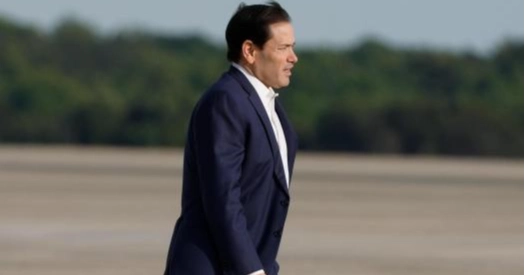
Marco Rubio, the US Secretary of State, is set to travel this week to a meeting of NATO foreign ministers in Sweden as European allies express growing concern over US troop levels in Europe and President Donald Trump’s shifting positions on the alliance, especially as the impact of the Iran war and rising energy prices continues to be felt.
The US State Department said on Tuesday that Rubio will attend the NATO gathering in Helsingborg on Friday. The meeting comes ahead of a major NATO summit in Ankara, Turkey, scheduled for July.
After Sweden, Rubio will travel to India for a multi-city visit covering Kolkata, Agra, Jaipur and New Delhi. He is expected to meet Indian officials and also join discussions with counterparts from Australia and Japan under the Indo-Pacific “Quad” grouping.
In Sweden, Rubio is expected to repeat US calls for NATO members to increase defense spending and share more of the alliance’s security burden, according to the State Department. He will also take part in discussions on Arctic security and economic interests with NATO’s northern members.
Although Greenland was not mentioned in the statement, tensions over the Danish territory have added to European unease. Donald Trump has repeatedly spoken about US interest in Greenland, which has drawn criticism in Europe. Trump’s special envoy for Greenland recently visited the island.
Greenland’s Prime Minister Jens-Frederik Nielsen said after meeting the envoy that the territory’s people are not for sale and that self-determination is non-negotiable.
Rubio’s presence at NATO meetings has often been welcomed by European allies, who see him as more steady compared to other US officials. He has also attended recent diplomatic missions, including the Munich Security Conference and meetings in Italy.
Ahead of the NATO talks, NATO’s top military officer said he does not expect further major reductions of US troops in Europe for now beyond an earlier announced cut of about 5,000 personnel.
US Lt. Gen. Alex Grynkewich said the situation remains stable following Trump’s announcement earlier this month.
The Pentagon later clarified that some planned troop deployments to Poland and Germany were being delayed rather than fully cancelled. Vice President JD Vance said the move should not be seen as a reduction, but part of normal rotation adjustments, adding that the focus is on strengthening European responsibility for its own defense.
Pentagon spokesperson Sean Parnell also described the change as a temporary delay, saying decisions on troop placement across Europe are still being reviewed.
Trump’s announcement had surprised NATO allies, coming amid earlier commitments by Washington to coordinate closely on security matters and avoid gaps in defense coverage.
Tensions were further heightened after Trump criticized Germany following comments by Chancellor Friedrich Merz over US policy on the Iran war.