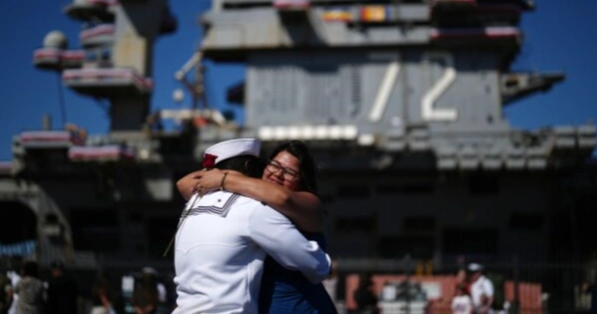
Thousands of sailors aboard the USS Lincoln returned to San Diego Bay on Thursday after more than 10 months at sea, receiving an emotional welcome filled with cheers, tears and hugs. The homecoming reunited families, including fathers meeting their babies for the first time after a historic deployment supporting the war against Iran.
The reunion ended a difficult period for many families, who said they had lost sleep and cried after hearing reports of supply shortages and worsening mental health among the crew. Sailors spent a record 265 consecutive days at sea during the deployment, with many families relying on occasional emails and rare WhatsApp calls to stay in touch.
Abel Ramirez, 20, smiled as he left the aircraft carrier, relieved that his first deployment was over.
“It feels amazing,” he said while looking for his parents, who had travelled from Texas. “There was a certain point when I never thought I would come off.”
Fourteen-year-old Cassity Garduque waved at her mother, who was wearing her sailor's uniform and waving back from the ship's upper deck.
She said seeing her mother again was overwhelming, as she had missed most of her seventh-grade school year and Cassity's birthday. She was also happy that her mother would no longer have to eat ramen almost every day.
Capt. Daniel Keeler, the ship's commanding officer, said most of the crew members were on their first deployment and described the difficulties as normal during such a lengthy mission. He said sailors had access to four meals a day.
“It's a floating city as you can see and at any moment there might be a clogged toilet,” he said.
Navy acknowledges challenges during deployment
The Navy initially played down reports of problems aboard the carrier. In August, President Donald Trump said the Lincoln's lengthy deployment was “not nearly long enough.”
Navy leaders later acknowledged some difficulties during the mission.
On Wednesday, Defence Secretary Pete Hegseth visited the Lincoln to present its crew with the Presidential Unit Citation, one of the highest honours awarded to military units.
Hegseth praised the sailors for their ability to adapt, remain resilient and complete their mission despite the challenges. He also rejected attempts to portray the carrier as a symbol of dysfunction, low morale or mission failure.
The Lincoln was the second US aircraft carrier to undertake an unusually long deployment during the war against Iran and subsequently receive the citation, which is generally awarded for significant achievements in combat.
The USS Gerald R. Ford returned in May after a 326-day deployment, the longest for a US aircraft carrier in the past 50 years and a record in the post-Vietnam War era. The Lincoln's deployment lasted 322 days, falling just short of that record.
The Navy said 64 fathers were among the first sailors to leave the carrier at the naval base in Coronado and meet their babies for the first time. Including the ship's air wing, the number of new fathers reached 122, Keeler said.
Kathy Monterrosa, a sailor's wife from Virginia Beach, Virginia, waited with her six-month-old daughter, Sarahi, dressed in a small blue-and-white sailor outfit.
“She's our deployment baby,” she said.
Monterrosa said she had been worried about her husband's safety after hearing reports about conditions aboard the ship while she was pregnant. She said she cried frequently because she did not know whether he was safe.
Her husband eventually told her that conditions had been “pretty bad”. However, she said she now felt blessed to have her family back together.
Sailor Steven Rivas became emotional while holding his seven-month-old daughter.
He said returning home did not feel real until the ship entered the bay and he saw the people waiting for the crew. His voice shook as tears filled his eyes while describing the moment.
Alma Solano Velez said her husband had prepared a long list of foods he wanted to eat after spending more than 10 months at sea. The list included oxtail, barbecue chicken, broccoli and shrimp empanadas.
He had also told her about shortages of food and showers aboard the ship. He was eager to see their daughter, who turned four while he was away, she said.
Carrier completes combat missions in the Middle East
The Lincoln left San Diego in November and reached the Middle East in January. US and Israeli forces launched airstrikes against Iran on Feb 28.
In August, acting Navy Secretary Hung Cao said the carrier had maintained adequate food supplies, although combat operations restricted opportunities to replenish supplies and temporarily reduced meal options.
On its journey home from the Middle East, the carrier stopped in Thailand early last month.
Extended deployments can place significant pressure on sailors, who must spend long periods away from their families, while also increasing the strain on ships and equipment.
The Navy told lawmakers that eight sailors attempted suicide during the Lincoln's record-setting deployment. However, experts said the figure was low for a strike group comprising about 6,000 sailors over 10 months.
According to the citation read by Hegseth, the Lincoln and its strike group carried out nearly 3,700 combat missions, launched 450 Tomahawk cruise missiles, shot down 77 one-way attack drones, sank 64 Iranian warships and destroyed 21 anti-ship cruise missiles.
The USS George Washington, an aircraft carrier usually based in Asia, replaced the Lincoln in the Middle East in August.