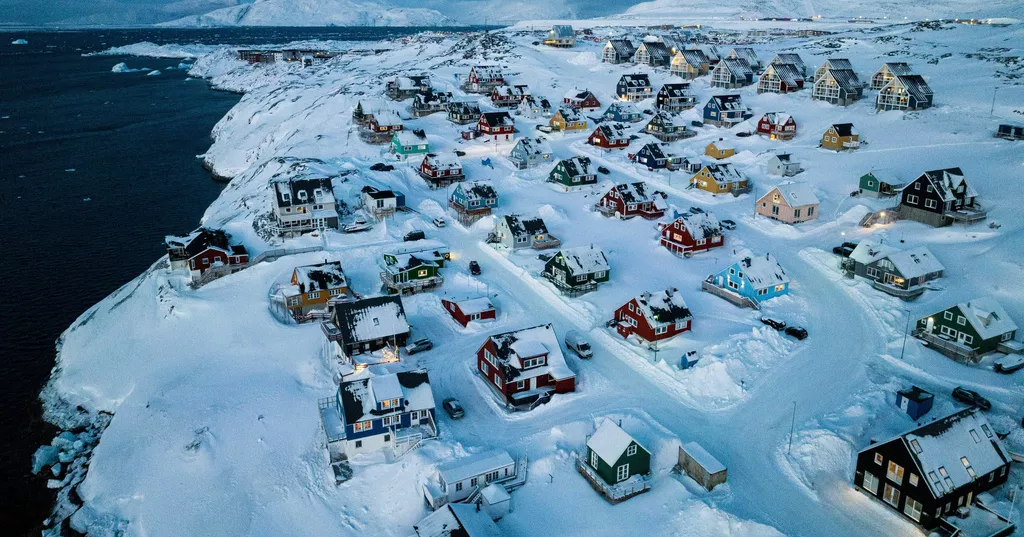
Greenland’s strategic location, vast mineral resources and growing importance in Arctic security continue to make the autonomous Danish territory a focal point of US President Donald Trump’s foreign policy ambitions.
Situated largely above the Arctic Circle between North America and Europe, Greenland has gained renewed geopolitical significance amid rising tensions involving Russia and China, the effects of climate change and the prospect of new Arctic shipping routes.
Trump has repeatedly argued that US control over Greenland is essential for national and global security, saying the island is critical to protecting North America and safeguarding the Arctic region. Although he previously suggested military action was an option, he has since indicated that force is no longer under consideration.
His renewed interest in Greenland has unsettled NATO allies and drawn firm opposition from both Denmark and Greenland's government, which insists the island’s future must be decided by its own people.
Greenland, home to around 56,000 people—mostly Indigenous Inuit—has been a strategic military asset since World War II, when the United States established a presence there to prevent Nazi Germany from gaining control and to protect North Atlantic shipping routes.
The island has become increasingly important as climate change reduces Arctic sea ice, opening the possibility of new international trade routes while intensifying competition over access to natural resources.
Security analysts note that Russia has expanded its military infrastructure across the Arctic in recent years, while China has sought a greater role in the region through its self-declared status as a "near-Arctic state" and plans for a Polar Silk Road under its Belt and Road Initiative.
The United States already maintains a significant military presence in Greenland through the Pituffik Space Base in the island’s northwest. The installation plays a key role in missile warning, missile defence and space surveillance operations for both the US and NATO.
Greenland also overlooks the strategically important Greenland-Iceland-United Kingdom (GIUK) Gap, a vital maritime corridor used by NATO to monitor Russian naval movements in the North Atlantic.
Despite Trump's arguments, some defence experts say the US already enjoys extensive military access to Greenland under long-standing agreements with Denmark, making formal control of the territory unnecessary from a security standpoint.
Denmark has also expanded defence cooperation with Washington by allowing greater US military access to Danish bases, while making clear it would oppose any attempt to annex Greenland.
Beyond security, Greenland's vast reserves of rare earth minerals have attracted growing international attention. These critical minerals are essential for manufacturing advanced technologies, including electric vehicle batteries, smartphones, computers and defence equipment.
Western countries have sought to diversify supplies of these strategic minerals as they attempt to reduce dependence on China, which dominates global rare earth production.
However, Greenland's harsh Arctic climate, limited infrastructure and strict environmental regulations continue to pose major challenges to large-scale mining and resource development.