
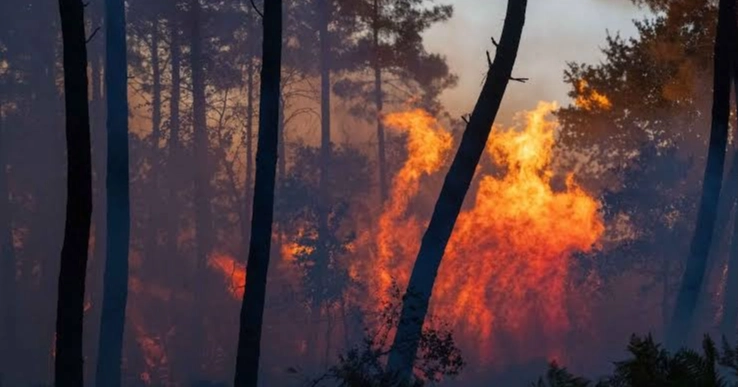
Spain declared a national emergency on Friday after fast-moving wildfires forced around 10,000 people to evacuate in the Madrid region, while major fires in southwestern France drove tens of thousands from their homes.
"We are experiencing a dramatic situation, not just in several Spanish regions but also in neighboring countries," Spanish Prime Minister Pedro Sánchez wrote on X.
"My solidarity with all the people who have been affected and been forced to leave their homes," he added.
The national emergency allows Spain's Interior Ministry to take charge of coordinating firefighting efforts as several regions battle wildfires intensified by a severe heatwave. Authorities also stepped in to help tackle another major blaze in the central province of Ávila.
The Madrid regional government said about 10,000 residents were evacuated from several villages after multiple fires spread out of control late Thursday.
"In my 60 years, I have never seen anything like this in my village," Burgohondo Mayor Francisco Martínez told Spain's public broadcaster TVE. "I have never seen fires of this size."
Spain's military emergency units, national firefighting teams and water-dropping aircraft have been deployed to support local firefighters.
An estimated 1,300 square kilometres of land have burned in Spain so far this year—more than four times the area destroyed during the same period in 2025.
Among this year's blazes is Spain's second-largest wildfire on record, which burned around 320 square kilometres in Guadalajara province, north of Madrid. Earlier this month, 13 people died in a wildfire in southern Spain, the country's deadliest in recent memory.
Sánchez on Wednesday called for political parties to work together on climate change, saying stronger action is needed to prepare for increasingly severe wildfire seasons.
Temperatures are expected to exceed 39 degrees Celsius in parts of Spain, with highs of up to 44 degrees forecast in the southeastern province of Almeria.
Tens of thousands evacuated in France
In southwestern France, authorities ordered further evacuations on Friday as wildfires continued to spread near the popular Cap Ferret peninsula on the Atlantic coast.
Around 40,000 people have fled their homes over the past two days as the fires, which started on Wednesday, burned more than 87 square kilometres. Some residents had to escape by boat.
France has requested assistance through the European Union's Civil Protection Mechanism.
President Emmanuel Macron said additional firefighting support would soon arrive, including two Canadair aircraft from Croatia, two Air Tractor planes from Portugal and Black Hawk helicopters from the Czech Republic and Slovakia.
Southern Europe has experienced several major wildfires this summer as extreme heat continues to affect the region.
According to the European Union's Copernicus Climate Change Service, Europe is the world's fastest-warming continent, with temperatures rising about twice as fast as the global average since the 1980s.
Scientists say climate change is making heatwaves and dry conditions more frequent and severe, increasing the risk of destructive wildfires, particularly across southern and southeastern Europe.