Ukrainian President Volodymyr Zelenskyy dismissed one of his senior officials on Wednesday as anti-corruption investigators named a deputy head of the presidential office among suspects in a money-laundering case.
The developments came a day after Ukraine's recently dismissed defense minister called for national elections despite Russia's more than four-year-old invasion.
Although Zelenskyy has not been implicated in the corruption investigation, the case could draw him into another political crisis and test his political resilience.
Investigators provided few details but said they had identified a group of people suspected of laundering 150 million hryvnias ($3.4 million) to pay bail for a defendant in a major corruption case last year, according to the National Anti-Corruption Bureau.
That case, involving the state-owned nuclear power company, led to the resignations of Ukraine's justice and energy ministers.
The latest suspects include a former lawmaker, the chairperson of a state bank's board and the head of its supervisory board, as well as a deputy head of the presidential office, the agency said.
Zelenskyy did not publicly comment on the investigation but issued a decree removing Iryna Mudra as deputy head of the Office of the President. Investigators have not identified Mudra as a suspect.
Lawmaker Oleksii Honcharenko said investigators searched Mudra's office on Wednesday.
Zelenskyy has continued to face scrutiny over high-level corruption investigations, although he has never been named as a suspect. Several officials close to him have been caught up in such probes.
Last year, his chief of staff Andriy Yermak resigned and was later named as a suspect in a major corruption investigation linked to a luxury construction project, creating the biggest threat to Zelenskyy's government since Russia's 2022 invasion.
The European Union has described deep-rooted corruption as one of the major obstacles to Ukraine's bid to join the bloc.
Ex-defense minister calls for wartime election
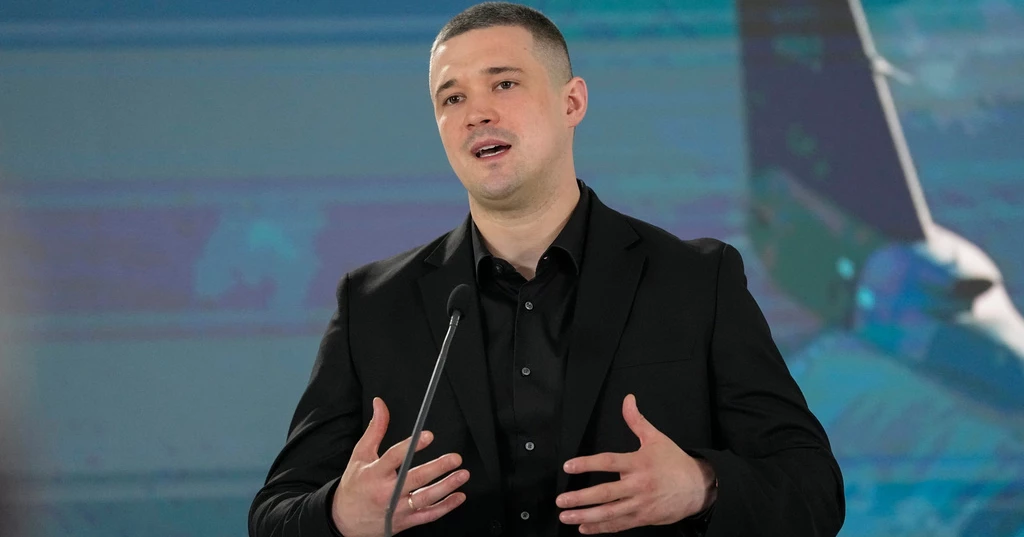
Zelenskyy is also facing pressure following his dismissal last month of Defense Minister Mykhailo Fedorov, one of the longest-serving members of his team and a close ally who helped him win the 2019 presidential election.
Seeking to ease tensions between the Defense Ministry's young, technology-focused reformers and Ukraine's experienced, Soviet-trained battlefield commanders, Zelenskyy reshuffled his wartime leadership.
He removed both Fedorov, whose reforms to military procurement were aimed at reducing corruption, and commander-in-chief Gen. Oleksandr Syrskyi.
The move prompted sustained street protests in support of Fedorov. It marked the second time within a year that a decision by Zelenskyy had sparked strong public opposition, following his 2025 attempt to limit the authority of anti-corruption agencies.
In a video address posted to YouTube late Tuesday, Fedorov called for national elections, appearing to directly challenge Zelenskyy, whose presidential term expired in 2024. Ukraine's constitution bars elections while martial law remains in effect.
“We must find a legal, safe and realistic mechanism that will allow Ukraine to restore a full democratic process even amid a prolonged war,” Fedorov said.
He argued that Ukraine is facing a governance crisis, saying the current system is focused on protecting itself and resisting change. He also criticized corruption among officials without naming individuals, saying it had weakened the country's ability to wage war.
Zelenskyy's office did not immediately comment on Fedorov's remarks. It was also unclear whether the call for elections would gain broad support among Ukrainians.
Meanwhile, lawmakers on Wednesday approved Zelenskyy's nominee, Maj. Gen. Yevhenii Khmara, as the new defense minister, effectively making Fedorov's return to the post unlikely in the near future.
Parliament also approved Andrii Sybiha to remain foreign minister after serving in an interim capacity.
Political turmoil follows Ukrainian battlefield gains
The political uncertainty comes after a number of recent Ukrainian successes on the battlefield.
Using advanced drone technology, Ukraine has repeatedly targeted Russian oil facilities, contributing to fuel shortages. Ukrainian forces have also struck warehouses belonging to Wildberries, Russia's largest online retailer, and slowed Moscow's advances along the front despite Russia's larger military.
However, Zelenskyy has struggled to make progress in US-led peace efforts, while Ukraine remains vulnerable to Russian ballistic missile attacks because additional US-made Patriot interceptors are unavailable amid limited global supplies.
Russian President Vladimir Putin has also resisted negotiating a peace agreement directly with Zelenskyy.
In the latest reported attack, a Ukrainian drone struck an oil refinery in Ufa in Russia's Bashkortostan region, according to Gov. Radiy Khabirov as quoted by Russian state news agency RIA Novosti. Ufa has three oil refineries, all of which have previously been targeted.
Russia's Defense Ministry said its air defenses intercepted 453 Ukrainian drones overnight over several regions, as well as Russian-controlled Crimea and the Black Sea.
The ministry also said Russian forces struck a bulk carrier in the Black Sea southeast of Odesa on Tuesday, alleging it was carrying military equipment. On Wednesday, Russian forces struck fuel and lubricant storage facilities for the Ukrainian military at the southern port of Chornomorsk, it said.
In southern Ukraine, a Russian drone struck a minibus in Kherson on Wednesday, killing four people and injuring four women, according to regional military administration head Oleksandr Prokudin. Another Russian drone hit a civilian vehicle in the regional capital, killing a woman, he said.
Amid the continuing fighting, Russia and Ukraine exchanged 103 prisoners of war, according to Zelenskyy and Russia's Defense Ministry.