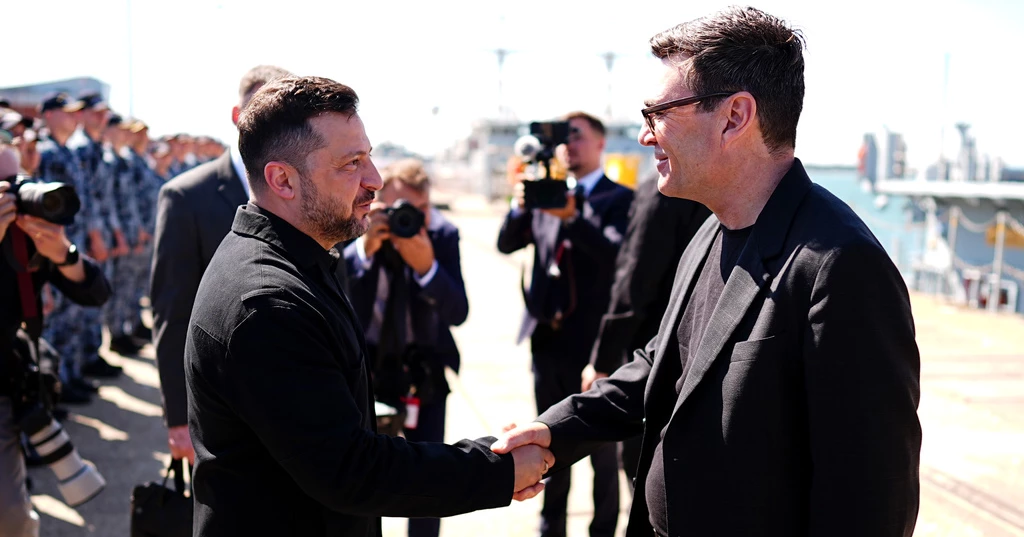
Ukrainian President Volodymyr Zelenskyy and new British Prime Minister Andy Burnham met Monday at a British naval base, discussing joint drone projects and Ukraine’s urgent need for ballistic missile interceptors to defend against Russian attacks.
Zelenskyy’s visit was the first by a foreign leader since Burnham took office a week ago. The prime minister said the visit demonstrated Britain’s “unwavering” support for Ukraine as it continues to defend itself against Russia’s nearly four-year-old full-scale invasion.
Burnham’s predecessor, Keir Starmer, visited Kyiv less than two weeks ago on his final foreign trip before leaving office. Burnham said he also planned to visit Ukraine soon.
Burnham is the fifth British prime minister Zelenskyy has dealt with since Russia launched its full-scale invasion in 2022.
“You are the first leader I have welcomed in person since taking office, and that is no accident,” Burnham told Zelenskyy. “It is intended to send a very clear message: we are with Ukraine 100%, I am personally with you 100%, and I will honor every commitment this country has made to Ukraine in full.”
Zelenskyy said relations between the two countries were “stronger than ever.”
The meeting took place aboard the aircraft carrier HMS Queen Elizabeth, docked at Portsmouth on England’s southern coast, a day before Zelenskyy is expected to meet US President Donald Trump in Washington.
Burnham said the two leaders had discussed Kyiv’s need for more interceptors to shoot down Russian ballistic missiles, particularly to protect Ukraine’s critical infrastructure during the winter.
“We’ve taken away some things that we will now follow up with our partners,” Burnham said after the meeting.
Russia has stepped up attacks this year on gas stations, power facilities and other infrastructure as part of a wider campaign aimed at disrupting Ukraine’s logistics and energy networks.
Zelenskyy said on X that the leaders also discussed “joint defense production.” Britain and Ukraine already have an agreement to cooperate on the development of new drones.
Before the meeting, Zelenskyy told Sky News that he hoped to establish a “big, big factory” in Britain.
The leaders also met more than 200 Ukrainian military personnel who had spent three weeks in Britain taking part in an exercise designed to strengthen their combat capabilities and improve measures to counter mines in the Black Sea, according to the UK government.
Burnham announced that Britain would provide Ukraine with the intellectual property behind its new “Stone Cloak” electronic warfare system. The technology can jam Russian air defenses and prevent drones from being detected.
Ukraine has expanded its campaign of frequent drone strikes deep inside Russia, targeting oil facilities, military factories and, most recently, logistics centers. The attacks have brought the war closer to millions of Russians and increased pressure on President Vladimir Putin.
The strikes have challenged Putin’s narrative that the war does not directly affect ordinary Russians. However, he has remained undeterred, while Russia has intensified its own aerial campaign, regularly attacking Ukraine with missiles and drones.
Russia and Ukraine exchange drone attacks
Russia attacked Ukraine overnight with 147 long-range drones, according to Ukraine’s air force, which said 123 of them were intercepted or jammed.
In Zaporizhzhia, one person was killed and two others injured in overnight attacks that damaged a residential high-rise and several private homes, regional administration head Ivan Fedorov said.
A Russian strike on the town of Balakliia in the Kharkiv region killed one person and wounded eight, according to Vitalii Karabanov, head of the city’s military administration.
In the Nikopol district of the Dnipropetrovsk region, Russian strikes damaged a kindergarten, residential buildings and infrastructure, injuring a woman and a 6-year-old boy, administration head Oleksandr Hanzha said.
In the eastern Kharkiv region, regional council member Oleksandr Skoryk said Russian forces had destroyed every gas station along the highway between Kharkiv and Poltava, a route stretching about 150 kilometers (93 miles).
The highway is an important supply route connecting Kharkiv, Ukraine’s second-largest city and a regional hub near the Russian border, with central Ukraine.
Romania’s Ministry of National Defense said a drone briefly entered its airspace before crossing the river border into Ukraine, where explosions were later reported. Two F-16 fighter jets were deployed to monitor the airspace.
The incident was the fourth such incursion into Romanian airspace in four days. Romania, a NATO member, said the three previous drones were shot down.
In Moscow, Russia’s Defense Ministry said its air defenses had shot down 276 Ukrainian drones overnight.
Rostov regional Governor Yuri Slyusar said five people, including a child, were killed when a Ukrainian drone struck an apartment building in Rostov-on-Don.
Ukraine’s military General Staff said its forces had struck an export terminal in Rostov-on-Don, setting it on fire.
The Ukrainian military also said other strikes in the Russian-controlled part of the Kherson region targeted a ground relay station used to control drones and a bridge over the Henichesk Strait used by Russia for military logistics.
Russian fuel and supply depots were also targeted, it said.
In Belgorod, a city in southwestern Russia near the Ukrainian border, a Ukrainian drone attack injured 12 people, including two children, according to regional emergency officials.
Iran vows retaliation after Ukrainian strike on ship
Iranian Foreign Minister Abbas Araghchi said Ukraine had attacked an Iranian vessel in the Caspian Sea, killing a sailor.
In a statement on X Sunday, Araghchi condemned the attack as a “blatant U.N. Charter violation” carried out at Israel’s behest to draw Europe into its war.
He said he had made clear in phone calls with European Union foreign policy chief Kaja Kallas and Russian Foreign Minister Sergey Lavrov that the attack “can’t go unanswered.”
Zelenskyy said on X that Ukrainian long-range strikes in the Caspian Sea over the weekend achieved “very good results.” He said the targets included “vessels involved in transporting military cargo linked to Iran, as well as a warship.”
Ukrainian Foreign Minister Andrii Sybiha rejected Iran’s threats of retaliation as unjustified and baseless, saying Tehran’s weapons supplies to Russia had made it a direct accomplice in Moscow’s aggression.
“Iran has no standing to pretend to be a victim,” Sybiha posted on X, calling Tehran’s references to the UN Charter “absurd.”
Sybiha said Iran’s statements were an attempt to divert attention from Russian attacks on civilian shipping in the Black Sea, which he said would be discussed at an emergency UN Security Council meeting Monday.