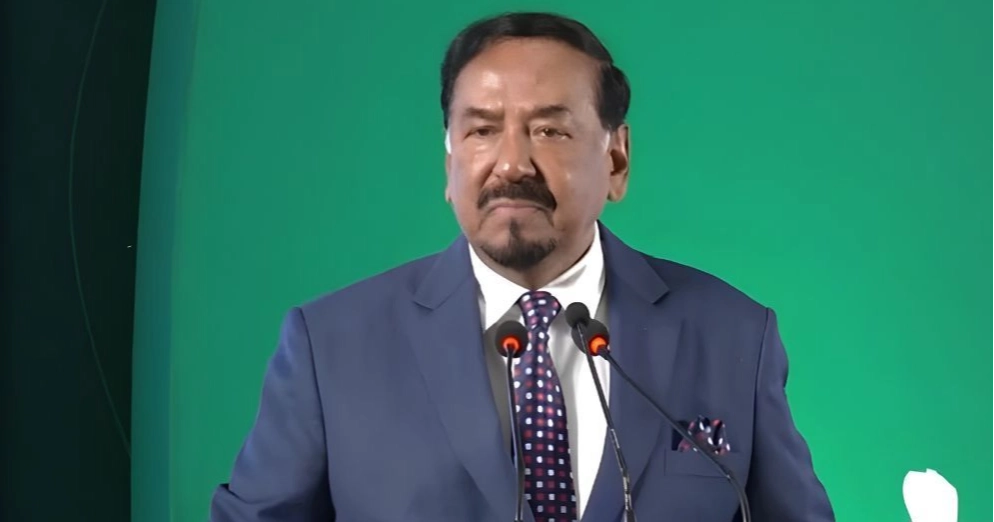
Acting President Hafiz Uddin Ahmed Bir Bikram on Friday stressed the need to properly present the true history of the Liberation War of 1971 and the sacrifices of those who fought and laid down their lives for Bangladesh’s independence to the new generation.
“The responsibility of implementing the spirit of the Liberation War rests with the next generation. Now, all we want is a beautiful country. We want our next generation to realise that the country became independent and understand the sacrifices behind that independence,” he said.
The acting president made the remarks while addressing the commissioning and Fellowship Day celebration of the Bangladesh Liberation War Courses at Kurmitola Golf Club in Dhaka Cantonment as the chief guest.
Referring to the Liberation War as more than a struggle for the independence of a territory, the acting president said it was a struggle to establish an independent state based on democracy, equality, human dignity and freedom from discrimination.
“Why did we fight the war? We wanted an independent state where everyone would enjoy equal rights, where there would be no discrimination, and where human dignity and equality would prevail. This is what we fought for,” he said.
Recalling different stages of the Liberation War, the acting president said Bengali army officers and soldiers, students, youths and people from various professions joined the war for independence in 1971.
Many young people, he said, received only a few weeks of training before taking part in frontline battles, and many of them sacrificed their lives.
He said around 600 young people were recruited in the Jessore region, of whom nearly 100 were killed in the war.
“These young men became fighters after only six weeks of training and fought against the Pakistani forces under extremely difficult circumstances,” he said.
Recalling the Battle of Kamalpur, Hafiz Uddin Ahmad said around 250 trained and newly recruited fighters took part in the attack without any effective fire support.
“Even amid heavy machine-gun fire, a soldier did not retreat,” he said, adding that nearly 50 percent of the fighters became casualties in the battle.
The acting president, who is expected to resume his normal duties the Speaker of Parliament following the election of a new president later this month, said the courage and sacrifices of ordinary soldiers and young people who participated in the Liberation War had not been adequately highlighted in the history of Bangladesh.
“Ordinary soldiers, poor boys and children from ordinary families proved how much the country meant to them. They came to give their lives for the country and thousands of them sacrificed their lives,” he said.
He said the revolt and resistance by Bengali army officers and soldiers in March 1971 marked an important chapter in the beginning of the Liberation War. Later, thousands of students and youths were trained and brought into the war.
On the objectives of the Liberation War, Hafiz Uddin said the goal of independence was to establish a state where democracy, equality, human dignity and citizens’ rights would be ensured.
Referring to the mass uprising of August 5, 2024, he said it too could be placed within the aspiration for democracy.
Against the backdrop of a prolonged political crisis and deprivation of people's rights, he said, the people of Bangladesh expressed their desire for change.
Liberation War Affairs Minister Ahmed Azam Khan, Chief of Army Staff General Waker-Uz-Zaman, Chief of Naval Staff Vice Admiral Khandker Misbah-ul-Azim, Chief of Air Staff Air Chief Marshal Hasan Mahmood Khan, Bangladesh Liberation War Courses Foundation Vice President Colonel (retd) Md Aminul Islam, foundation President Major General (retd) Jamil D Ahsan and its chief patron Major (retd) A Matin Chowdhury also spoke at the programme.
To mark the occasion, the acting president cut a cake.
Earlier, a one-minute silence was observed in memory of the martyrs, followed by a munajat seeking eternal peace for their departed souls.