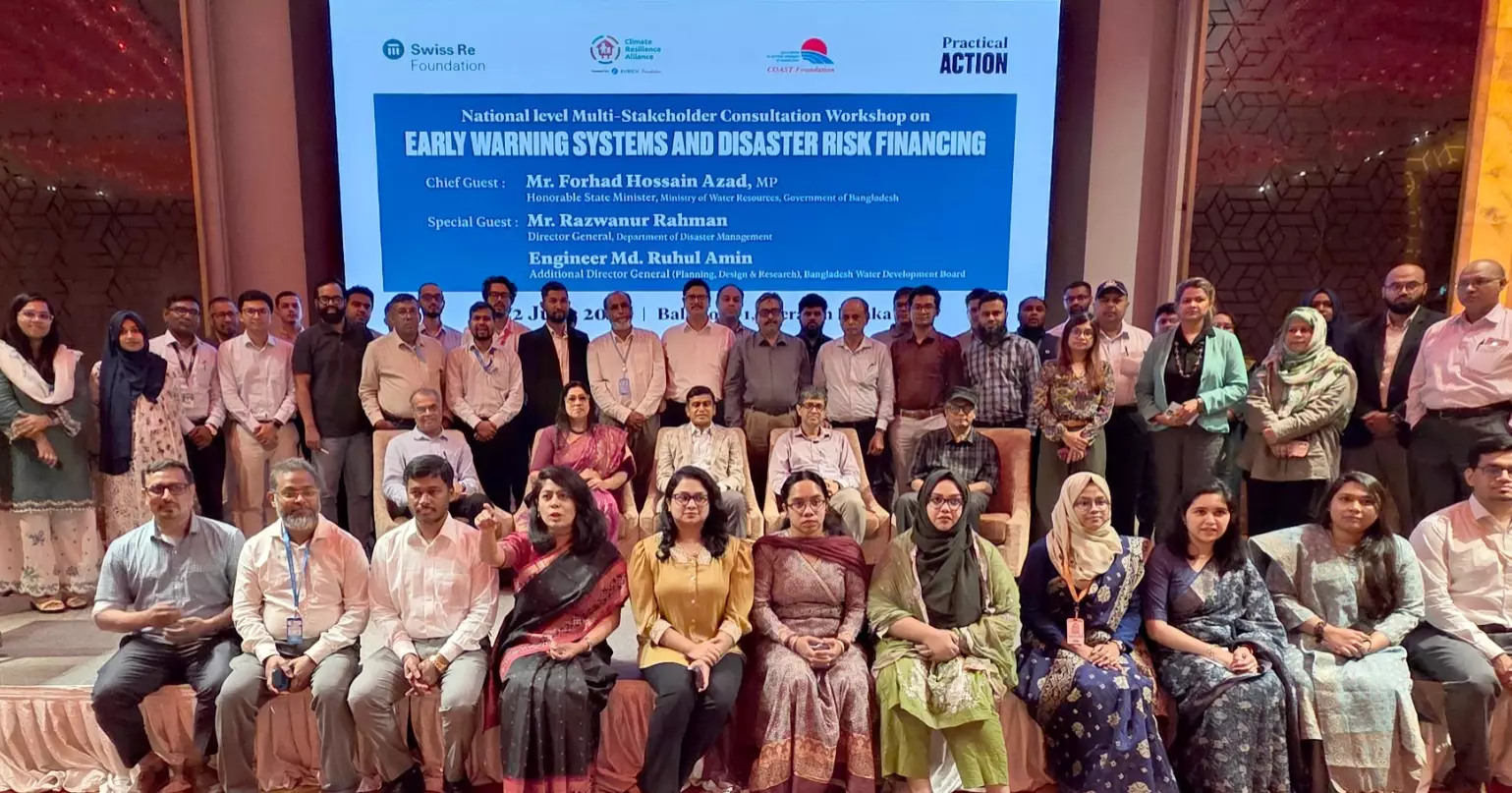
Early Warning Systems (EWS) and Disaster Risk Financing (DRF) mechanisms can play a critical role in reducing disaster risks and protecting vulnerable communities from the growing impacts of climate change, speakers said at a national-level multi-stakeholder consultation workshop in Dhaka on Monday.
The workshop on “Early Warning Systems and Disaster Risk Financing” was organized by Practical Action at Sheraton Dhaka.
State Minister for Water Resources Forhad Hossain Azad, MP, attended the event as the chief guest.
Special guests included Director General of the Department of Disaster Management Razwanur Rahman, Additional Director General of the Bangladesh Water Development Board Engineer Md. Ruhul Amin, and Executive Director of COAST Foundation Rezaul Karim Chowdhury.
The event was welcomed by Ishrat Shabnam, Country Director of Practical Action in Bangladesh, while the project brief was presented by Palash Sarker, Project Manager, and Tamanna Rahman, Thematic Lead–Climate Resilience at Practical Action Bangladesh.
Among others, Netai Chandra Sarkar of the Department of Disaster Management, Professor Dr. Anisul Haque of the Institute of Water and Flood Management (IWFM), BUET, and Rakesh Supkar, Asia Regional Head of Impact and Operations at Practical Action, attended the workshop. Representatives from government agencies, UN organizations, development banks and the private sector also participated.
During the workshop, Practical Action introduced a new project titled “Strengthening Human-Centered Innovation for Early Warning Systems and Disaster Risk Financing (SHIELD)” in Feni district, expanding its previous work in Khulna, Satkhira and Faridpur districts. The project will be implemented in Feni by COAST Foundation.
The initiative is funded by the Swiss Re Foundation and co-financed by the Z Zurich Foundation, says a press release.
Speaking at the event, Ishrat Shabnam said the project would address climate risks in Feni through the use of artificial intelligence and machine learning for early warning services and innovative solutions. She said disaster risk financing and impact-based forecasting would also be implemented with technical support from IWFM-BUET.
She added that through COAST Foundation, the project aims to build hope and trust within communities by demonstrating the real and tangible impacts of climate change and supporting people in managing those risks.
Razwanur Rahman said the government is working toward the United Nations’ “Early Warning for All” initiative by 2027 and sees significant scope for further progress in this area.
He noted that the government has already approved a strategy on anticipatory action and disaster risk financing, while the Ministry of Finance is exploring ways to strengthen protection through insurance mechanisms. He expressed hope that the project would contribute to these efforts and facilitate greater government engagement.
Rakesh Supkar said the project would help deliver early warning messages in ways that enable people to take timely action and reduce disaster risks.
He said disasters not only claim lives but also destroy livelihoods, adding that stronger early warning systems are essential for protecting communities. Recalling the devastating cyclone in India in 1999, when effective warning messages were unavailable, he expressed hope that the project would support and strengthen government plans and policies related to early warning systems.
Addressing the workshop, State Minister Forhad Hossain Azad said Practical Action’s approach is important because limited access to early warning data often leaves people vulnerable to disasters.
He said the Ministry of Water Resources, the Ministry of Disaster Management and Relief, and the Ministry of Environment, Forest and Climate Change are working together toward the shared goal of protecting people from disaster risks.
The state minister emphasized the importance of delivering warning messages in simple Bangla so that rural communities can easily understand and act upon them. He also stressed the need for coordination among international and national non-governmental organizations in disaster risk reduction efforts.
In his concluding remarks, Rezaul Karim Chowdhury said experience from Feni has shown that providing relief alone is not sufficient after disasters.
People also need support and resources to recover and rebuild their lives, he said, stressing that food security must be considered alongside relief efforts. He noted that planning for post-disaster food security is essential for effective risk reduction.
Expressing optimism about the initiative, he said the project’s focus on innovation, early warning systems and disaster financing would contribute to reducing disaster risks and strengthening community resilience.