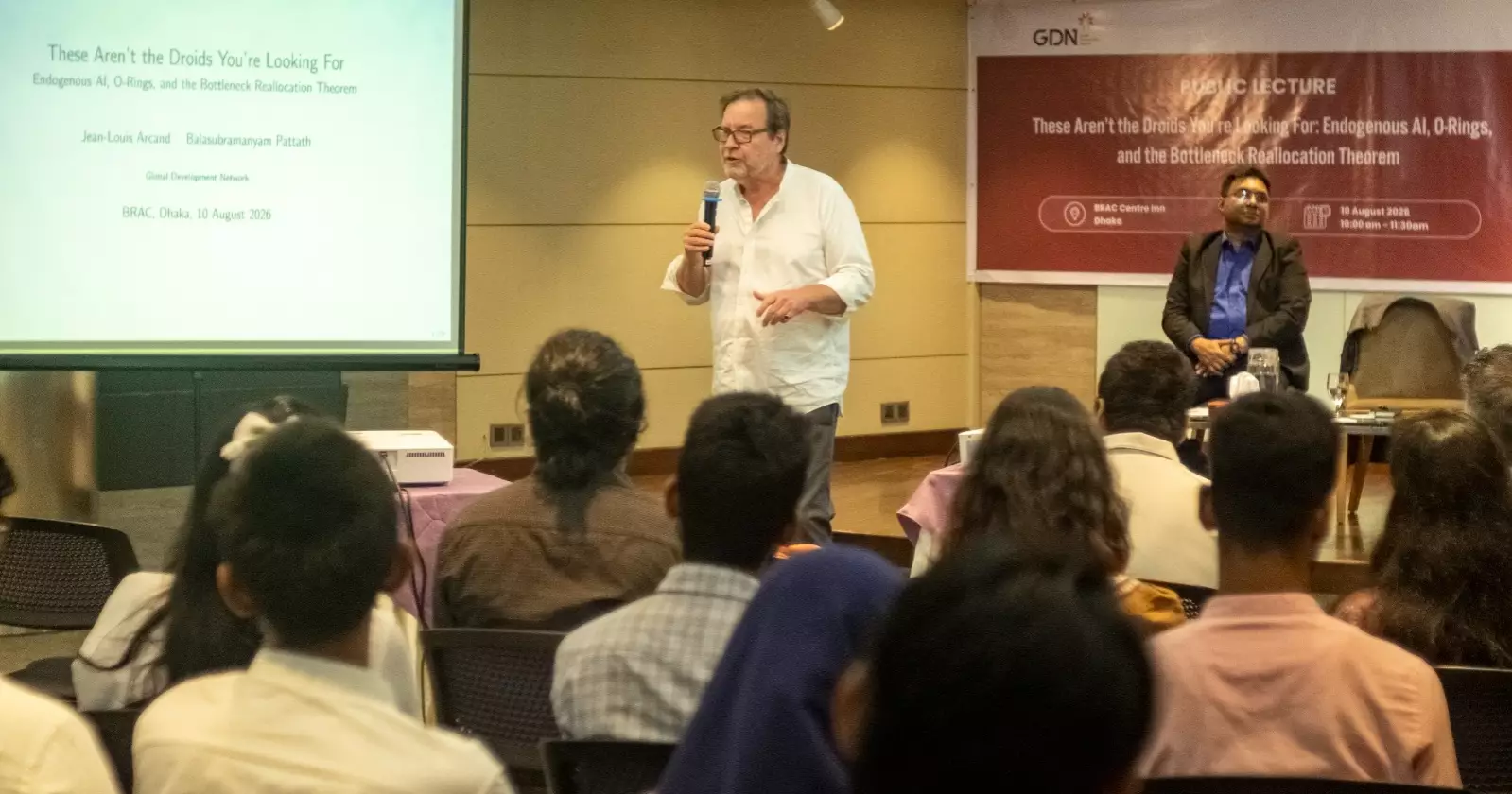
Artificial intelligence does not remove the production bottlenecks that limit efficiency but shifts them from one task to another, Professor Jean-Louis Arcand, President of the Global Development Network (GDN), said at a public lecture in the city on Monday.
"Artificial intelligence does not eliminate the bottlenecks that shape production; instead, it can shift them from one task to another," Arcand said, delivering a lecture titled "These Aren't the Droids You're Looking For: Endogenous AI, O-Rings, and the Bottleneck Reallocation Theorem" at BRAC Centre Inn in Mohakhali.
The event, organised by the South Asian Network on Economic Modeling (SANEM) in collaboration with GDN, drew researchers, academics, representatives of think tanks and policy organisations, and students.
The lecture presented Arcand's joint research with Balasubramanyam Pattath, which extends economist Michael Kremer's O-ring theory of production to artificial intelligence.
Explaining the O-ring theory, Arcand cited the 1986 Space Shuttle Challenger disaster, in which the failure of a faulty seal destroyed the spacecraft.
"Failure of a 40 dollar piece of rubber destroyed a billion-dollar spacecraft," he said, illustrating how production involves a chain of complementary tasks in which a single failure can disrupt the entire process.
The theory also explains why small differences in worker quality can produce large differences in productivity and wages, he said. The paper examines what happens when AI is introduced as a technology that lowers the probability of task failure.
Its central finding, Arcand said, is that AI does not eliminate the O-ring mechanism but relocates it. Within a single task, AI and worker quality act as substitutes; across tasks, they act as complements. "As a result, AI adoption tends to move toward the weakest links in a production chain, so that improving one task can create a new bottleneck elsewhere, a mechanism the authors term the Bottleneck Reallocation Theorem."
The paper tests this framework using data from 227 radiologists and occupation-level statistics. It finds that implied AI intensity declines with worker quality within a task, and that 38.8 percent of radiologists studied showed negative implied AI assistance, meaning AI did not improve outcomes for every worker.
Across occupations, AI use rises with wages, though much of this link stems from the tasks AI can currently perform, and is higher in occupations with a greater probability of failure.
On implications for developing countries, the lecture noted that lower-skill economies stand to gain more from AI adoption than higher-skill economies, though this advantage narrows as production chains lengthen, a pattern the study describes as conditional convergence, with differences in AI adoption costs a key factor.
Arcand also raised the question of whether lower-skill economies currently have adequate access to AI.
Higher AI adoption, the presentation showed, can flatten the wage schedule by reducing the importance of worker-quality differences in tasks where AI is used, particularly as adoption costs fall.
For Bangladesh specifically, the discussion touched on access to AI services and the country's coding potential relative to India, as well as the question of AI sovereignty and the need for developing countries to build domestic capacity in AI and large language models.
During the open discussion, participants asked about automation's potential effect on Bangladesh's ready-made garment (RMG) sector.
Selim Raihan, Executive Director of SANEM and Professor of Economics at the University of Dhaka, shared findings from SANEM's ongoing research on the sector, noting that automation is not generating unemployment but is causing job displacement.
Participants also raised questions on AI quality and access, and on the environmental impact of data centres.
Responding to a query on water use at data centres, Arcand said it was not a major concern, identifying the source of electricity powering such facilities as the more significant issue, adding that reliance on renewable energy would substantially ease environmental concerns.
The lecture concluded with an interactive discussion covering AI quality and access in developing countries, automation in the RMG sector, employment and job displacement, and the environmental footprint of data centres.