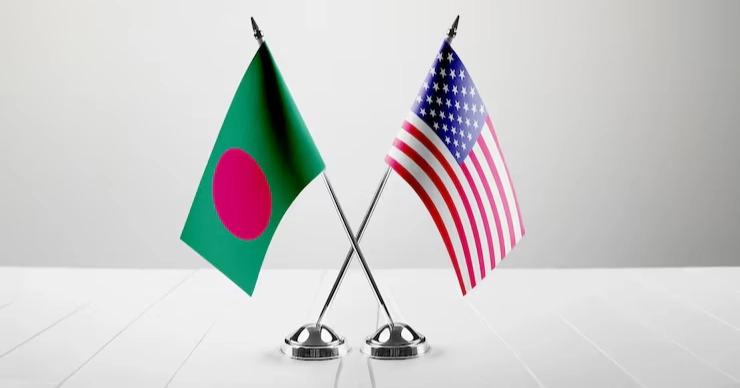
The United States has said Bangladesh could become a partner in its Pax Silica initiative in the future, stressing that Bangladesh has significant potential in the information technology (IT) sector.
US Special Presidential Envoy for South and Central Asia Sergio Gor, who paid a courtesy call on Prime Minister Tarique Rahman on Saturday, observed that Bangladesh has significant potential in the sector and "could, in the future, become a partner" in the Pax Silica initiative, according to the Ministry of Foreign Affairs.
The Prime Minister highlighted Bangladesh's strong interest in attracting investment in the IT sector.
Pax Silica is a US-led strategic initiative to build a secure, prosperous, and innovation-driven silicon supply chain - from critical minerals and energy inputs to advanced manufacturing, semiconductors, AI infrastructure, and logistics.
Rooted in deep cooperation with trusted allies, Pax Silica aims to reduce coercive dependencies, protect the materials and capabilities foundational to artificial intelligence, and ensure aligned nations can develop and deploy transformative technologies at scale.
The inaugural Pax Silica Summit convened counterparts from Japan, Republic of Korea, Singapore, the Netherlands, The United Kingdom, Israel, United Arab Emirates, and Australia.
Together, these countries are home to the most important companies and investors powering the global AI supply chain.
With a new economic security paradigm across the United States and partner nations, a clear consensus has emerged: secure supply chains, trusted technology, and resilient infrastructure are indispensable to national power and economic growth.
Meanwhile Bangladesh has decided to join the World Artificial Intelligence Cooperation Organization (WAICO) initially as an observer, said the Ministry of Foreign Affairs on Saturday.
Headquartered in Shanghai, WAICO is an inter-governmental organization which was formed on July 16, 2026.
Its stated goals include, among other things, deepening international cooperation on innovation, promoting inclusive development by reducing global digital divide, supporting open, fair, and non-discriminatory environment for global AI development, and advancing AI regulations aiming to ensure that this new and evolving technology is beneficial and safe for humans.
On July 16, twenty-nine countries signed an agreement in Shanghai on establishing the World Artificial Intelligence Cooperation Organization (WAICO).
Chinese Foreign Minister Wang Yi, who is also a member of the Political Bureau of the Communist Party of China Central Committee, signed the agreement on behalf of the Chinese government.
Representatives from the 29 countries, including Kazakhstan, Laos, Pakistan, Russia and Indonesia, signed the agreement, making their countries the WAICO's founding members.
The United Nations Secretary-General Antonio Guterres was among representatives from countries and international organizations present at the signing ceremony, reports Xinhua.
The organization will uphold the purposes of the UN Charter, be committed to extensive consultation and joint contribution for shared benefit and adhere to a people-centered approach, according to the agreement.
It aims to promote international cooperation and global governance on AI, ensuring that AI is beneficial, safe and fair, thereby promoting its healthy and orderly development to benefit all humanity.