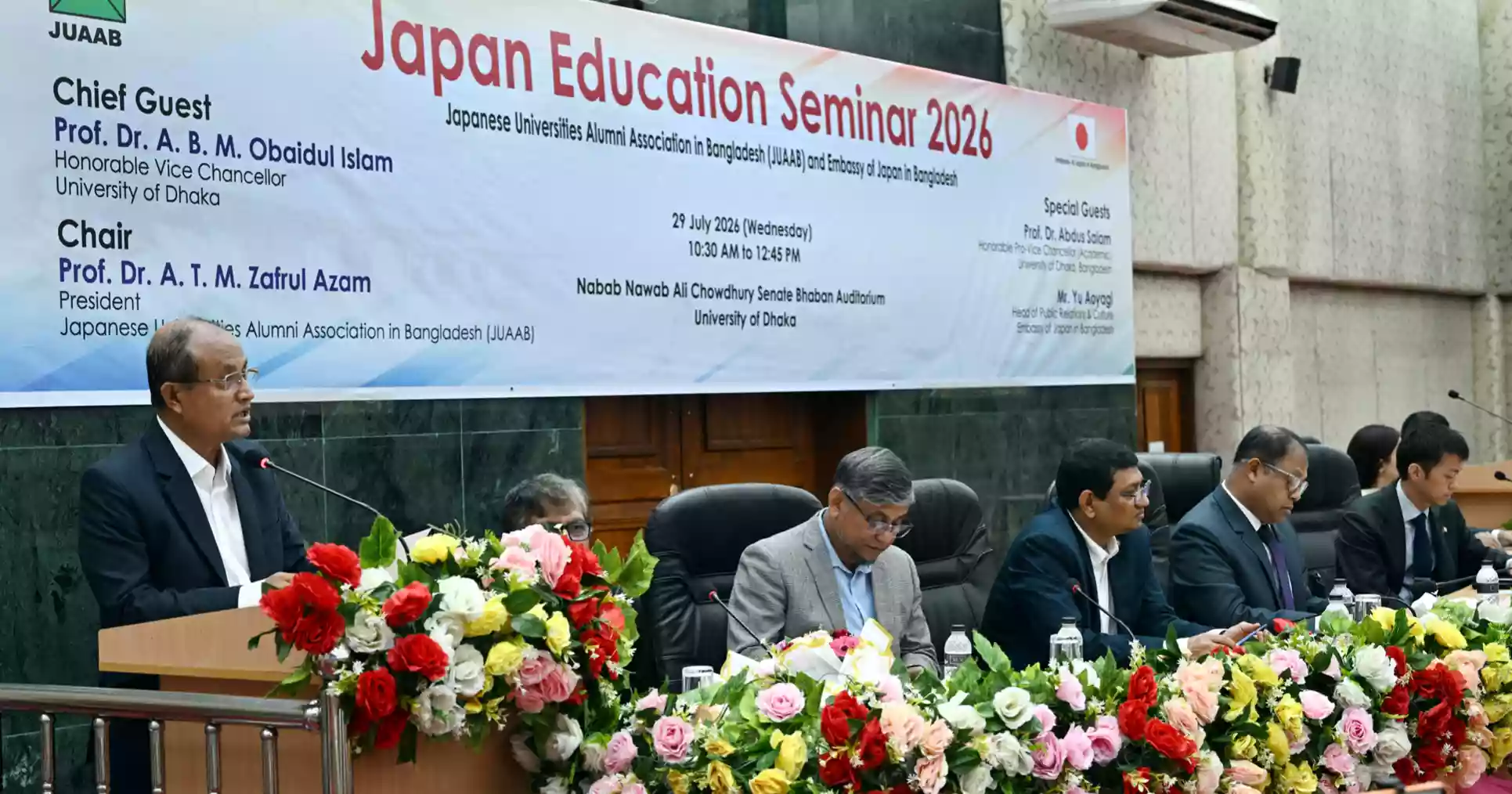
Dhaka University (DU) Vice-Chancellor Prof ABM Obaidul Islam on Wednesday called on students to take advantage of higher education and research opportunities in Japan, stressing the need to further strengthen Bangladesh-Japan cooperation in higher education, research and human resource development.
He made the remarks while addressing the Japan Education Seminar 2026 as the chief guest at the Nawab Nawab Ali Chowdhury Senate Bhaban auditorium of the university.
The seminar was jointly organised by the Japanese Universities Alumni Association in Bangladesh (JUAAB) and the Embassy of Japan in Bangladesh.
JUAAB President Prof ATM Jafrul Azam chaired the programme. DU Pro-Vice Chancellor (Education) Prof Abdus Salam and Head of Public Relations and Culture at the Embassy of Japan, Yu Aoyagi, attended as special guests.
The vice-chancellor said Japanese universities enjoy global recognition for excellence in education, research and technological innovation, adding that studying in Japan offers Bangladeshi students far more than an academic degree.
"It provides a unique opportunity to develop research skills, technological expertise, professional competence, intercultural communication and leadership qualities," he said.
Prof Obaidul Islam encouraged students to learn in detail about scholarship programmes offered by the Japanese government and the education and research opportunities available at Japanese universities, and to make the best use of them.
He acknowledged that language and financial constraints remain challenges for many students but said these could be overcome through proper preparation, perseverance and appropriate guidance.
Highlighting Bangladesh's rapid economic and technological progress, he said the country needs skilled professionals in engineering, agriculture, information technology, medical science, environmental science, business education and other key sectors to sustain its development.
Students who study in Japan can make significant contributions to national development by applying the knowledge, technology, innovative ideas and international experience they acquire abroad after returning home, he added.
The vice-chancellor also urged students to use their skills to develop innovative solutions to the country's existing challenges and create new employment opportunities.
Describing Bangladesh-Japan ties as being built on mutual respect, trust and friendship, Prof Obaidul Islam said Japan has long been one of Bangladesh's most dependable development partners in infrastructure, education, human resource development and economic growth.
He said greater collaboration in higher education and research would create new partnerships among universities, researchers, industries and young people in both countries.
The DU vice-chancellor also reaffirmed the university's commitment to expanding joint research, faculty and student exchange programmes, scholarships and institutional cooperation with Japanese universities and research organisations, saying such initiatives would enhance the quality of education and research through greater internationalisation.
The seminar featured discussions on higher education and research opportunities at Japanese universities, admission procedures, scholarship programmes, student life and various aspects of Bangladesh-Japan academic cooperation.
Teachers, students, researchers, prospective applicants for higher studies in Japan and Bangladeshi alumni of Japanese universities attended the event.