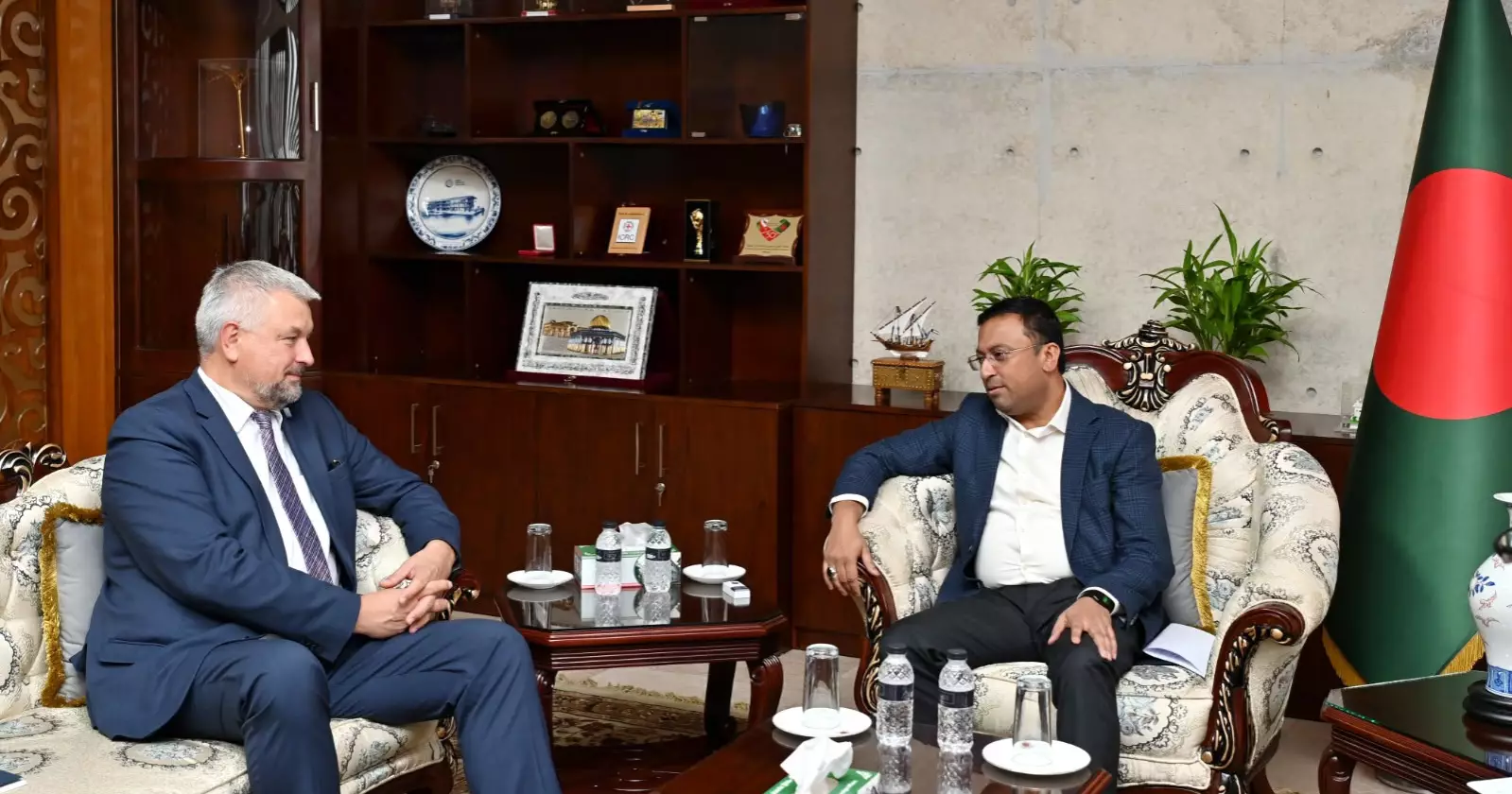
State Minister for Foreign Affairs Humaiun Kobir on Thursday stressed the need to explore untapped potential and strengthen cooperation between Bangladesh and Lithuania, particularly in trade, investment and emerging technologies.
At a meeting with Lithuanian Vice-Minister for Foreign Affairs Vidmantas Verbickas at the Ministry of Foreign Affairs, the State Minister urged Lithuania to increase imports of Bangladeshi products, including readymade garments, textiles, pharmaceutical products, leather and leather goods.
He also highlighted investment opportunities in Bangladesh and invited Lithuanian investors to invest in the country.
The two sides discussed ways to further strengthen bilateral relations, said the Ministry of Foreign Affairs.
They focused on expanding cooperation in information technology, e-registration, e-governance, financial technology (FinTech), cybersecurity, e-transportation, digitisation of transport systems, artificial intelligence and high-tech medical devices.
The Lithuanian Vice-Minister highlighted Lithuania's expertise and potential in these sectors and expressed keen interest in expanding cooperation with Bangladesh.
The two sides also discussed employment opportunities, human mobility and migration, as well as visa facilitation for Bangladeshi students, businesspeople, investors and tourists.
They discussed the issue of Rohingya repatriation and sought Lithuania's support in this regard.
The two ministers also discussed deeper engagement between Bangladesh and Lithuania during Lithuania's upcoming presidency of the European Union from January to June 2027.
Verbickas congratulated Dr Khalilur Rahman, Foreign Minister of Bangladesh, on his election as President of the 81st Session of the United Nations General Assembly.
He expressed hope that Bangladesh-Lithuania relations would be further strengthened during Dr Rahman's tenure as President of the UN General Assembly and Lithuania's EU presidency.
The State Minister emphasised the role of the EU-BD Business Forum, compliance with existing business frameworks, and the importance of regional connectivity centred on Lithuania in the Baltic region and beyond.
He said such connectivity could help explore untapped potential, enhance bilateral relations and generate mutual benefits.