
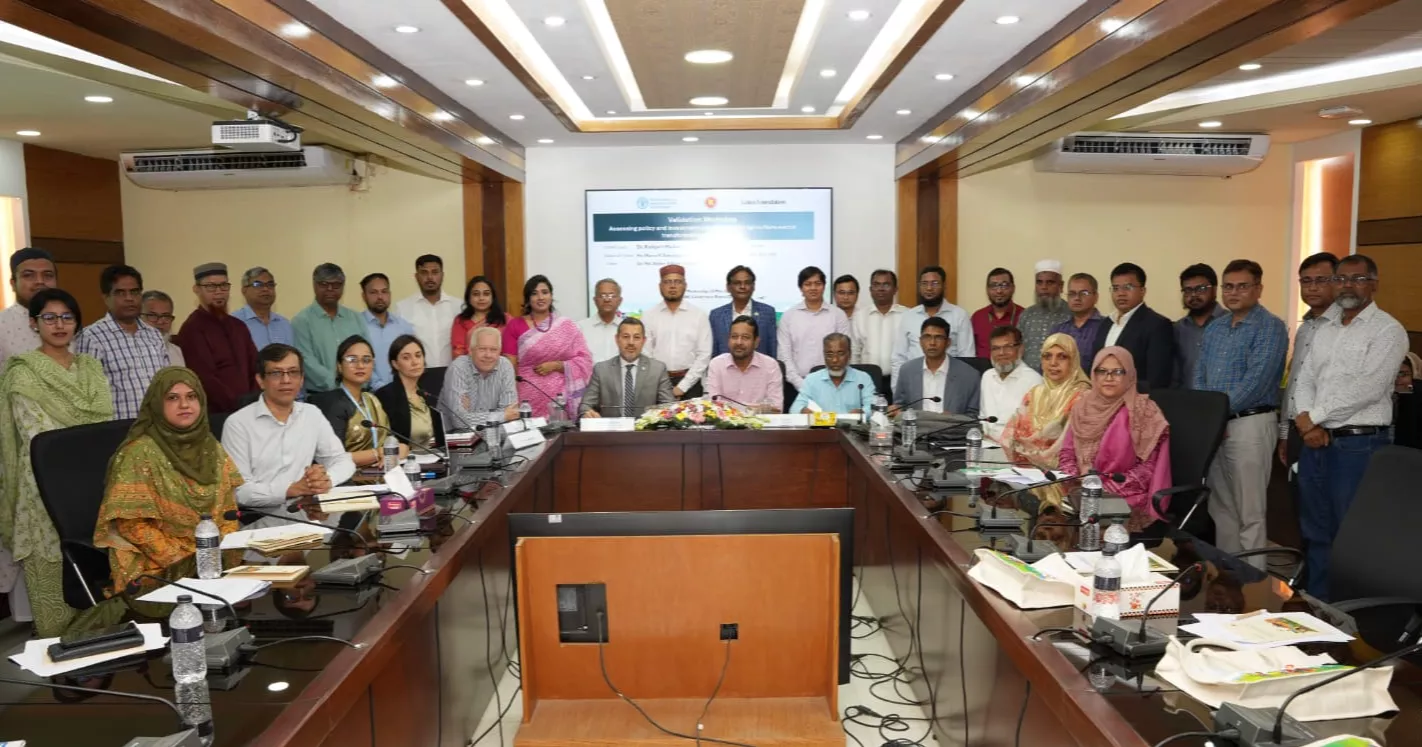
Agriculture Secretary Rafiqul E. Mohamed on Sunday emphasised the critical importance of evidence-based planning and efficient public investment in transforming the future of Bangladesh’s agriculture sector.
"As Bangladesh moves toward a more resilient, climate-smart, diversified, and investment-oriented agricultural system, stronger policy coherence, strategic public investment, and analytical decision-making tools will become increasingly important," he said while speaking as the chief guest at the opening session of a workshop.
He also highlighted that initiatives such as the Analysing Food and Agricultural Policies (MAFAP) programme provide valuable technical support for future policy formulation and investment prioritization.
Deputy Director of Agrifood Economics and Policy at FAO Marco V. Sánchez said Bangladesh has achieved remarkable agricultural progress, but this is being challenged by climate change, market volatility, resource constraints, and the fast-evolving agrifood systems dynamic.
"We must use evidence to rethink how we prioritize and design agricultural investments, so that every taka spent and every agricultural policy designed can help Bangladesh to better face these challenges.”
The Food and Agriculture Organization of the United Nations (FAO), in partnership with the government of Bangladesh and the Bangladesh Agricultural Research Council (BARC), convened the high-level workshop to discuss and validate initial findings from a policy analysis of the agriculture sector, marking an important milestone in Bangladesh’s efforts to modernize and strengthen agriculture sustainability, resilience, and productivity.
The initiative, “Technical Support for Sustainable and Resilient Investment towards the Agriculture Sector Transformation Programme of Bangladesh (AsTP)”, has been spearheaded by the Ministry of Agriculture and funded by the Gates Foundation.
The workshop brought together 35 participants in Dhaka and focused on advancing Bangladesh’s efforts toward evidence-based agricultural transformation and sustainable development through strengthened analysis of agricultural policy in the country, public-expenditure over the years, and scenarios for optimizing investments for greater returns.
It was facilitated by the FAO’s Monitoring and Analysing Food and Agricultural Policies (MAFAP) programme.
Senior government officials, policymakers, economists, statisticians, researchers, and technical experts from various ministries and institutions, including the Agriculture Environment and Food ministries , Economic Relations Division, Ministry of Finance (ERD), Planning Commission, Bangladesh Investment Development Authority (BIDA), Bangladesh Bureau of Statistics (BBS), experts from FAO Headquarters and the FAO Representation in Bangladesh were, among others, present.
The workshop built upon the important groundwork laid during the first inception mission and technical workshop held in March 2025, where the FAO team introduced the MAFAP programme and its analytical framework and initiated technical collaboration with Bangladesh counterparts on agricultural public expenditure analysis and investment optimization modelling.
The discussions contributed to the preparation of six Regional Investment Plans under the Bangladesh Delta Plan 2100 climate hotspot framework as part of the broader AsTP initiative.
These investment plans will feature will identify high-potential agricultural commodities expected to yield the highest socioeconomic and environmental returns for each climatic zone.
As part of a country-owned approach to the workshop and policy support, participants actively engaged in technical discussions and provided recommendations and feedback on improving analytical approaches, strengthening institutional coordination, and supporting more efficient and evidence-based agricultural investment planning in Bangladesh.