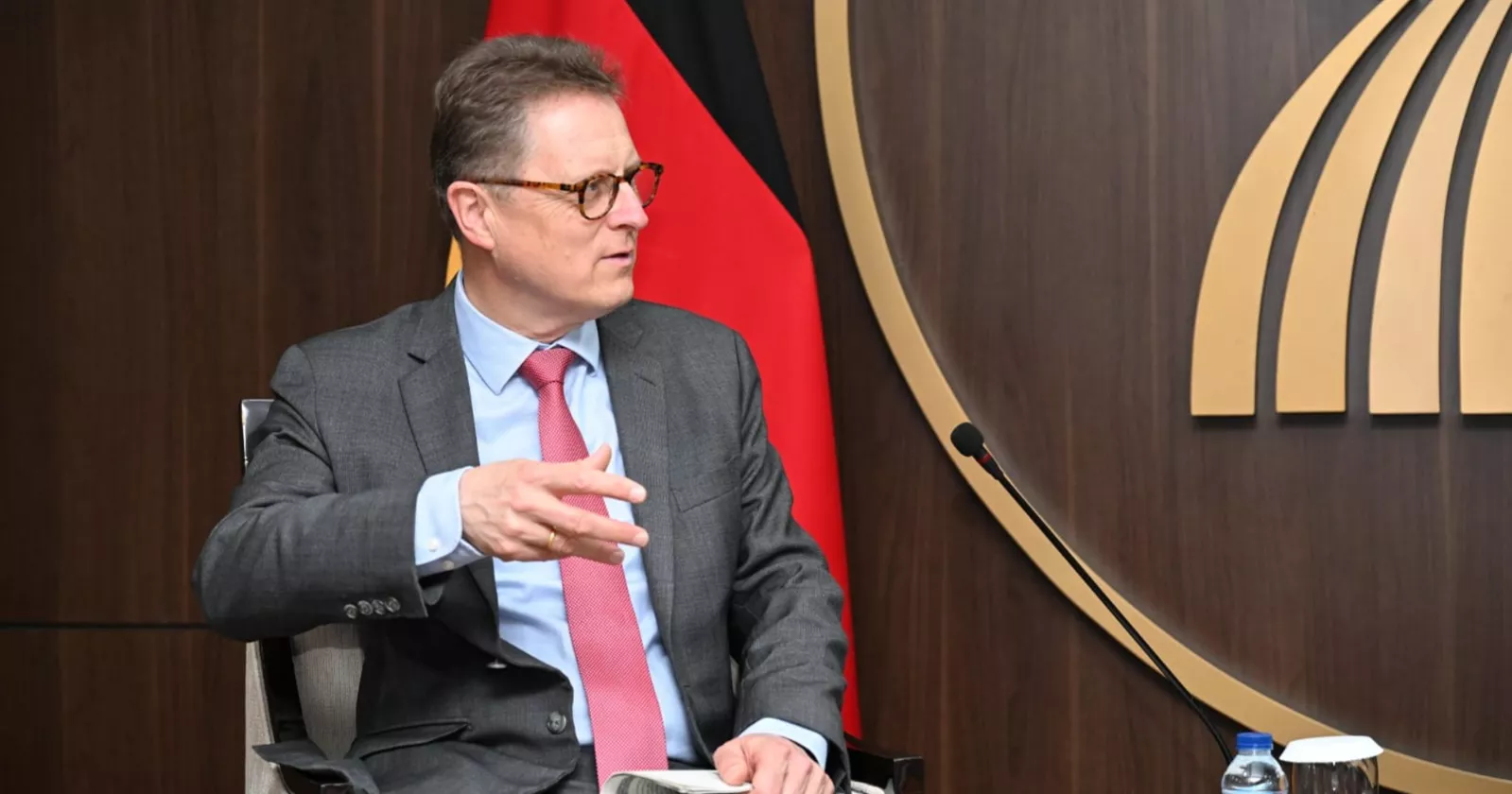
Seeking joint efforts to intensify and diversify bilateral economic relations, the Director General for Asia and the Pacific at the German Federal Foreign Office, Frank Hartmann, has said Bangladesh should make the most of the remaining period before its graduation from the Least Developed Country (LDC) category by undertaking the necessary reforms and preparations to adapt to the new economic realities it will face in the coming years.
“Bangladesh will eventually graduate from the LDC category, and it is important to prepare for the period when some trade preferences will no longer be available,” he told UNB in an exclusive interview, encouraging the country to accelerate economic reforms and diversify exports.
On Bangladesh’s planned graduation from the LDC category, Hartmann acknowledged the government’s request to defer the process and said Germany understood the external and domestic challenges behind the move.
The official who left Dhaka on Thursday wrapping up his visit highlighted the need to reduce dependence on ready-made garment exports and expand into sectors such as machinery, chemicals, electronics, and other industries.
Hartmann also pointed to the importance of preparing for the European Union’s GSP+ framework, which will govern future trade relations after LDC graduation.
The senior German government official responsible for Asia affairs praised Bangladesh for what he described as a “very successful democratic transition” following the recent elections.
“Through the elections, you set up a stable government with a strong reform project, and we would like to support all the efforts of your government for the necessary reforms,” he said.
Commenting on Bangladesh’s political situation, the official described the country’s post-July transition as largely peaceful and democratic but acknowledged continuing political divisions.
He emphasised the importance of holding individuals accountable for crimes committed during past political unrest while avoiding the exclusion of entire political groups from the democratic process.
“You cannot exclude parts of the political spectrum if they accept the Constitution, democratic system, and the institutions. There is a need for reconciliation. The political process, in the end, must be an inclusive one in order to avoid further radicalization,” he said.
“I think it would be recommendable to find a way. That needs time. That cannot be done overnight to reconcile with those forces,” he said, highlighting the importance of jointly developing a more stable democratic process.
The German official also congratulated Bangladesh on the election of Foreign Minister Dr Khalilur Rahman as President of the 81st session of the UN General Assembly, noting that both countries strongly support multilateralism and international cooperation.
Discussing investment prospects, the German diplomat said Bangladesh’s economic outlook remains positive, citing its steady growth and potential as an investment destination.
“There is a vast chance for further German investment in Bangladesh,” he said, mentioning opportunities in manufacturing, engineering, chemicals, and technology sectors.
He noted that greater awareness of Bangladesh’s economic achievements is needed across Europe and emphasised the importance of investment security, rule of law, transparent public procurement, and equal treatment of foreign investors.
“The more investment security and rule of law we see, the better the chances that German companies will diversify their investment in Bangladesh,” Hartmann said.
He also identified climate change, migration, energy security, and maritime security as key areas for deeper cooperation.
Highlighting Bangladesh’s dependence on imported fossil fuels, Hartmann said renewable energy development offers a long-term solution to energy vulnerabilities. Germany, he added, is supporting energy transition projects through technology transfer and concessional financing.
The German official praised Bangladesh for hosting more than 1.3 million forcibly displaced Rohingyas from Myanmar and called on the international community to maintain humanitarian assistance despite growing global crises.
“The Rohingya issue is an international issue, and it should not be left only on the burden of Bangladesh itself. It’s a responsibility for the international community to maintain our support to Bangladesh,” Hartmann said.
“We all have budget constraints, but it is also our responsibility as donors to maintain the Rohingya on the international agenda. And it should not be a forgotten issue. We should not forget our responsibility on the Rohingya issue because there will not be a short-term solution,” he said, noting that return can only happen under conditions of stability in a safe environment, which they do not have yet.
“I think there cannot be additional resettlement programs for the Rohingyas. We know that other countries are facing the same problem. But in order to alleviate your responsibility and your undertaking in Bangladesh, I think we have to uphold our financial and humanitarian support to the Rohingyas in Bangladesh,” Hartmann said.
While acknowledging donor fatigue and funding shortages, he said Germany would continue supporting humanitarian efforts and encourage other international partners to contribute.
Regarding proposals for third-country resettlement of Rohingyas, the official indicated that large-scale relocation to Europe was unlikely, citing Germany’s existing commitments to refugees from Ukraine and Syria.
Instead, he stressed the importance of sustained financial and humanitarian support for Bangladesh.
On regional and global issues, the German official said Bangladesh and Germany share common interests in preserving a rules-based international order and strengthening multilateral institutions, particularly the United Nations.