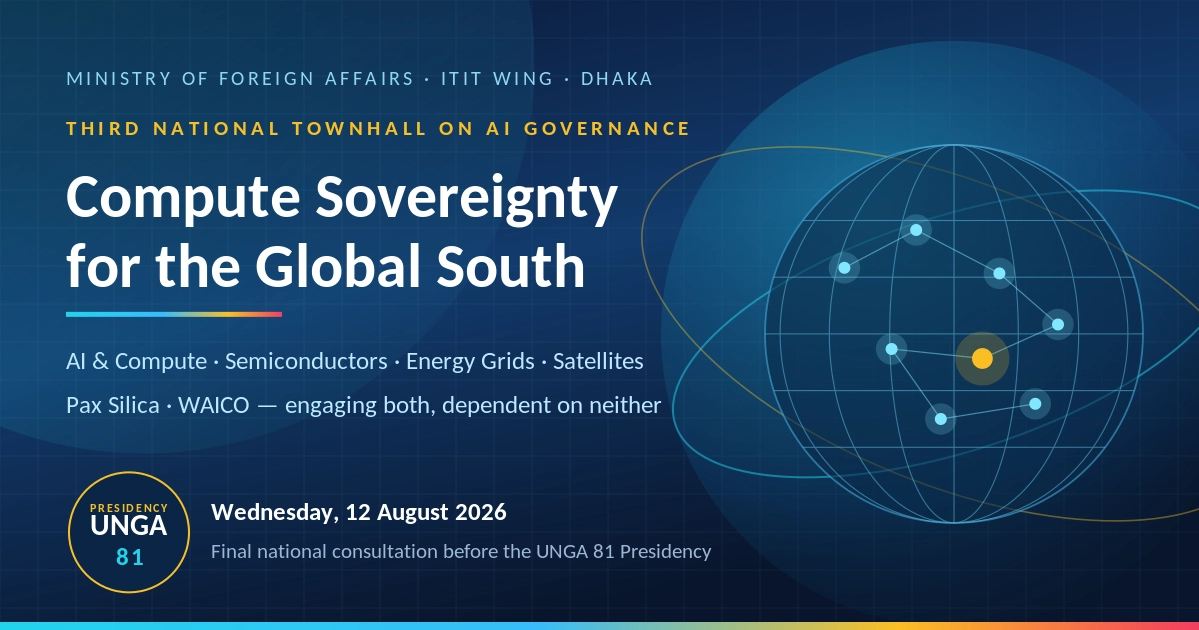
The International Trade, Investment and Technology (ITIT) Wing of the Ministry of Foreign Affairs on Wednesday convened the third virtual national Townhall on AI Governance and Global Technology Architecture, the final national consultation before Bangladesh assumes the Presidency of the 81st Session of the United Nations General Assembly (UNGA 81) in September 2026.
Held under the theme “Structural Engagement in UN Processes: Securing Global South Compute Sovereignty and Navigating International Technology Ecosystems”, the session was chaired by Dr Syed Muntasir Mamun, director general of the ITIT and ICT Wings and Chief Innovation Officer of the ministry.
It drew multilateral diplomats, senior officials, United Nations agency representatives, international think tanks, academics, private-sector leaders and civil-society and Internet-governance representatives from Bangladesh, Armenia, Ethiopia, Norway, the United Kingdom and across the African continent.
The townhall completes a three-stage national process. The first session, on 13 July 2026, conducted a global stocktaking of the Geneva digital convergence. The second one, on 27 July 2026, designed Bangladesh’s domestic institutional architecture, including the proposed Bangladesh AI Observatory and five thematic working groups.
The third stage turned outward, formulating a structural approach to engagement with United Nations mechanisms in order to advance sovereign AI and compute sovereignty for Bangladesh and the wider Global South.
Opening proceedings, the Chair observed that global AI governance has shifted from non-binding ethical declarations toward the hard physical substrate of semiconductors, energy grids, orbital infrastructure and computational scale - and that a country’s standing in the emerging order will be determined substantially by its compute sovereignty.
“You cannot buy artificial intelligence. Maybe you can buy compute, but you cannot buy AI. You have to train AI, you have to build your own AI,” said Muntasir Mamun.
The session examined the global technology stack across four physical verticals - AI models and compute, semiconductors, energy grids, and space and satellite infrastructure - and assessed two competing international platform ecosystems: the US-led Pax Silica initiative, launched in December 2025 with 24 signatory states by mid-2026, and the China-led World Artificial Intelligence Cooperation Organization (WAICO), established in Shanghai on 16 July 2026 with 29 founding member states.
Participants agreed that these should be treated as operational ecosystems rather than ideological blocs, and that Bangladesh should engage both while avoiding excessive dependence on either - Pax Silica principally on semiconductors, hardware and energy supply chains, and WAICO on open-source models, capacity building and infrastructure financing.
“Our objective should not simply be to attract technology. It should be to build the national capacity to evaluate it, negotiate it, govern it, and help shape it,” said AHM Bazlur Rahman of Bangladesh NGOs Network for Radio and Communication (BNNRC).
The most significant conceptual advance of the session was a widening of the concept of sovereignty itself. Participants argued, and the Chair accepted, that compute sovereignty is necessary but not sufficient: a state may own data centres and secure hardware access yet remain dependent if the knowledge powering those systems is produced elsewhere.
Sovereign AI was accordingly redefined as a layered construct comprising infrastructure and compute, data, knowledge, judgement and cognitive capacity - layers that may be pursued in parallel rather than sequentially, making partial sovereignty attainable within existing fiscal constraints.
“Compute sovereignty is necessary, but it alone is not enough. Access is not the same as agency,” said Dr Obi Umegbolu, founder of AI for Africa Think Tank.
The townhall endorsed three upgrades to Bangladesh’s domestic institutional framework.
The mandate of the Bangladesh AI Observatory is expanded to incorporate a Global Compute and Dependency Monitor, which will benchmark national computing capacity in floating-point operations per second, track foreign hardware dependencies, monitor data-centre energy baselines and audit public-sector algorithmic systems against international transparency standards.
A Sovereign AI Investment Platform will pool multilateral development bank grant financing, green and climate-transition capital and private technology investment to close the gap between the ambitions of the draft National AI Policy 2026-2030 and available resources.
The five thematic working groups established at the second townhall are directed to draft technical standards compatible with the United Nations Global Digital Compact.
Gender and social inclusion were elevated to a cross-cutting design principle. On the Chair’s own initiative, the session identified the absence of a gender lens as the principal remaining gap in the national narrative, and adopted recommendations that compute sovereignty be defined as gender-responsive and socially inclusive, with an intersectional lens applied across all four technical verticals.
“Women must not enter the AI future after the rules are written. They must help write the rules from the beginning,” said Shamima Akhter, chairperson of Bangladesh Women Internet Governance Forum.
Participants adopted an 18-month diplomatic roadmap spanning the UNGA 81 Presidency. Bangladesh will present the Global South vision for compute sovereignty at the opening of UNGA 81 in New York in September 2026 and table a draft resolution establishing a UN Working Group on International Compute Equity in November 2026; host a High-Level UN Ministerial Panel on Energy–AI Synergy and Sovereign Infrastructure in February 2027; and present a Global South Charter on Sovereign Compute and Digital Autonomy at the UNGA 82 High-Level Week in September 2027.
Engagement will run across the UNGA Plenary and Second Committee, the Global Digital Compact, United Nations advisory mechanisms including the UN Technology Bank, and the specialised agencies, with coalitions to be built with the G77, the Non-Aligned Movement and the African group.
Three outcome deliverables were formally adopted: the UNGA 81 Diplomatic Position Paper, titled “Championing Global South Compute Sovereignty and Sovereign AI in Multilateral Processes”; the Upgraded Charter of the Bangladesh AI Observatory; and the Multilateral Compute and Energy Investment Framework.
The Chair emphasised that the opportunity presented by the Presidency is not Bangladesh’s alone, noting that of 195 United Nations member states only some 13 to 17 speak consistently and substantively in United Nations discourse, and that the instruments now being drafted are offered as common property of states that have until now been counted among the majority that does not speak.
The technical outputs of all three townhalls will be compiled into a final outcome document for presentation at the National AI Consultation scheduled for late August 2026.