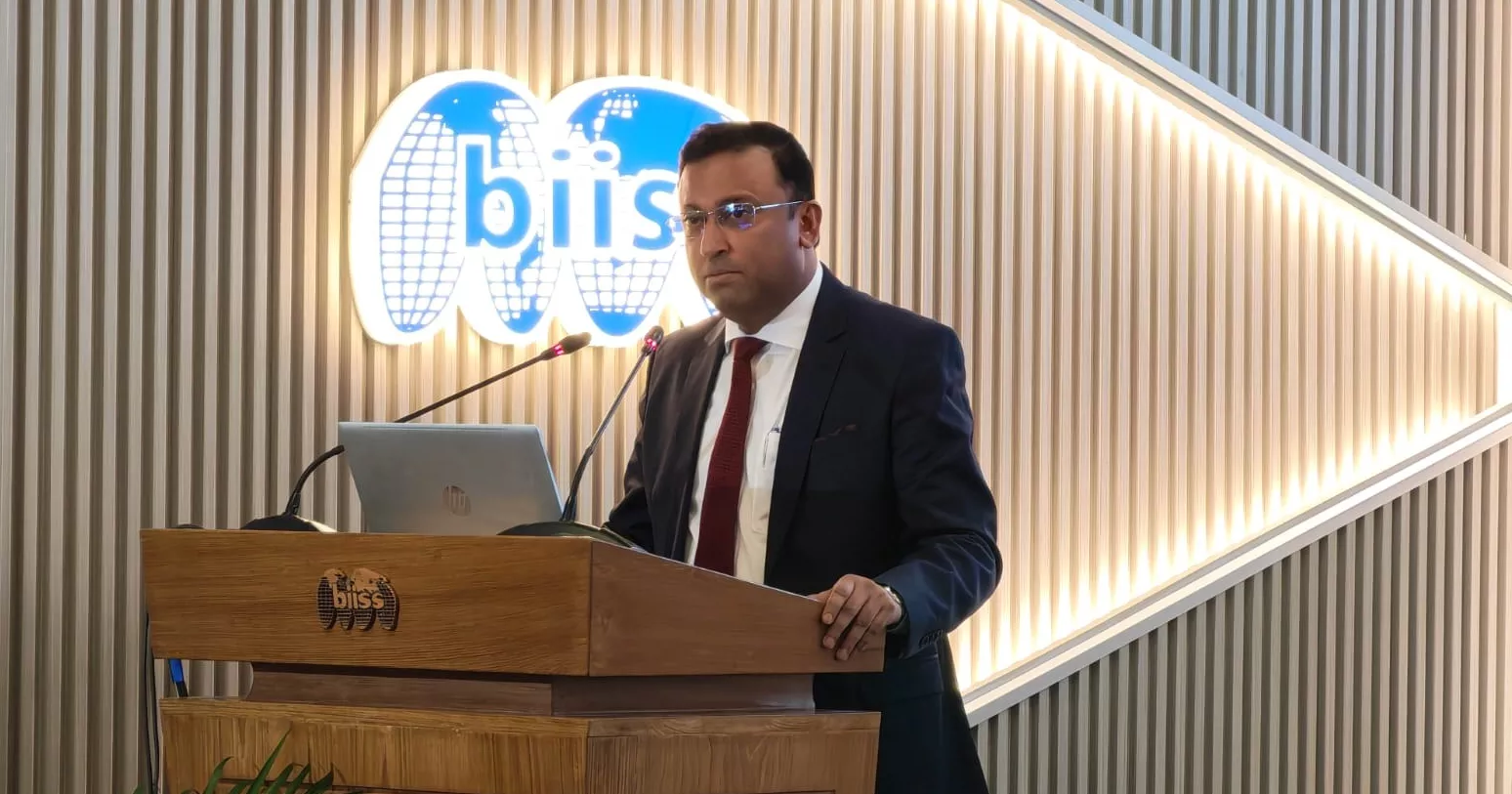
Emphasising the growing importance of regional connectivity, Prime Minister's Foreign Affairs Adviser Humaiun Kobir on Monday said investments in transport infrastructure, aviation and digital networks are key drivers of economic growth and stronger people-to-people contacts.
"Bangladesh's strategic location provides significant opportunities to strengthen regional connectivity and expand cooperation in trade, tourism, investment and cultural exchanges," he said, noting that Bangladesh welcome greater collaboration with China and other international partners in advancing sustainable infrastructure, aviation, tourism and innovation for the benefit of the peoples.
The Adviser stressed that future prosperity will depend not only on economic success but also on the quality of institutions, social resilience and international cooperation.
The Bangladesh Institute of International and Strategic Studies (BIISS) hosted the joint training programme titled "2026 Comparative Governance Forum" at the BIISS Auditorium.
Vice-President of Fudan University Prof Chen Zhimin and Chinese Ambassador to Bangladesh Yao Wen attended the opening ceremony of the joint training programme as special guests. Director General of BIISS Major General Ridwanur Rahman also spoke.
"The countries of the Global South are becoming increasingly influential in shaping global governance and sustainable development," Kobir said while speaking as the chief guest.
He said Bangladesh believes the international system must be more inclusive, rules-based and responsive to the aspirations of all nations. "We support multilateralism, peaceful dialogue and international cooperation as the most effective means of addressing common global challenges."
The Adviser said lasting progress is achieved when nations invest in knowledge, trust and partnerships built on mutual respect.
"Economic growth creates prosperity, but wisdom, cooperation and mutual understanding are what ultimately secure peace and sustainable development," he said.
The Adviser underscored the importance of deepening Bangladesh-China cooperation through knowledge sharing, dialogue and mutual learning, saying stronger partnerships are essential to addressing increasingly complex global challenges.
He said the initiative reflects the shared commitment of both countries to strengthening academic and institutional cooperation.
"I would like to acknowledge the valuable support of the Embassy of the People's Republic of China and all our partner institutions. This forum reflects our shared belief that dialogue, knowledge and mutual learning remain indispensable in addressing the increasingly complex challenges of our time," he said.
The Adviser said Bangladesh has much to learn from China's development experience while also sharing its own strengths in public policy and governance.
"Comparative governance calls for a comparative perspective on the governance systems of both countries. We can learn tremendously from the People's Republic of China. At the same time, there are areas where Bangladesh has performed well, and we should continue to build on those achievements," he said.
Describing China as one of the world's most remarkable development success stories, the adviser noted that the country has lifted around 800 million people out of extreme poverty over the past four decades through sustained reforms and economic transformation.
"China is a tremendous example of development over the last four decades. It has lifted nearly 800 million people out of extreme poverty through one of the most successful poverty alleviation programmes in history and has implemented major market reforms that have transformed its economy," he said.
At the same time, Kobir said Bangladesh has earned international recognition in several important areas, particularly disaster risk reduction and climate resilience.
"Bangladesh has become internationally recognised for reducing disaster risks and protecting lives. However, climate change is a global challenge that requires global solutions. We must continue to advocate for stronger multilateral cooperation, enhanced climate finance, technology transfer and greater support for vulnerable developing countries," he said.
Expressing optimism about the programme, he said the discussions over the coming days would generate new ideas, strengthen academic and institutional cooperation and further reinforce the enduring friendship between Bangladesh and China.
Chinese Ambassador to Bangladesh Yao Wen said challenges such as maintaining "political unity and social stability" under complex circumstances, breaking through the bottleneck of a single-industry structure, and creating a more favorable external environment are important issues that need to be addressed in Bangladesh’s governance journey.
He said Prime Minister Tarique Rahman’s people-centered, pragmatic, and efficient governing style has brought a fresh look to national governance.
The envoy said President Xi Jinping emphasised that no matter how the world changes, China will not waver in its commitment to the overall direction of China-Bangladesh friendly relations, and will always be a trustworthy good friend, good neighbour or and good partner of Bangladesh.
"This historic height has laid a solid foundation for the next “Golden Fifty Years” of China-Bangladesh relations," Ambassador Yao said.
The Ambassador said both sides agreed to advance high-quality Belt and Road cooperation and further align development strategies.
"Important consensus was reached on comprehensive management of the Teesta River, modernisation and expansion of Mongla Port facilities, and advancing the China-Myanmar-Bangladesh Economic Corridor," he said.
The envoy said Bangladesh-China practical cooperation is steadily moving toward one with more optimised structure, broader scope, and at a higher level.
Exchanges on governance are an integral part of building a Bangladesh-China community with a shared future in the new era, he said.
Since taking office, Ambassador Yao said the new government has adhered to a development-oriented approach, focusing on improving people’s livelihoods.
In June, Prime Minister Tarique Rahman paid an official visit to China.
The leaders of the two countries jointly agreed to elevate their comprehensive strategic cooperative partnership to jointly build a Bangladesh-China community with a shared future in the new era.
They also agreed to strengthen exchanges on governance experience.
"The visit was a complete success and marked a milestone in bilateral relations," said Ambassador Yao.
"Building a China-Bangladesh community with a shared future in the new era signifies that our relationship has transcended existing frameworks of cooperation and ascended to a new strategic height, with mutual trust, shared interests, and solidarity," he added.
The courses cover topics including the Chinese practice of modernising the national governance system and capacity, the four major global initiatives, and the Global South.
The courses have three features - a strong emphasis on practice; a strong emphasis on the spirit of the times and a strong emphasis on mutual learning.
The Ambassador said exchanges on governance are precisely an important vehicle for Bangladesh and China to connect heart to heart.
He hoped that during this forum, each participant will learn with reflection - deeply consider the underlying logic behind Chinese Modernization, and in light of Bangladesh’s national conditions, explore a development path suited to Bangladesh.
"Learn with gains - acquire policy tools and practical methods in areas such as national governance, poverty reduction, and digital governance, contributing to Bangladesh’s economic and social development," Ambassador Yao said.
"Learn with action - translate what you have learned into concrete actions to modernize Bangladesh’s governance system and capacity, and become inheritors and builders of China-Bangladesh friendship," he said, wishing the Comparative Governance Forum a complete success.