Information and Broadcasting Minister Zahir Uddin Swapon on Sunday announced that the restructuring, alteration, and repairing of the banking sector will be brought under the purview of an independent commission.
"When commissions have already been formed to reform the media, administration, and anti-corruption apparatus, why should a sector as vital as banking remain excluded? We will definitely do it," the minister said.
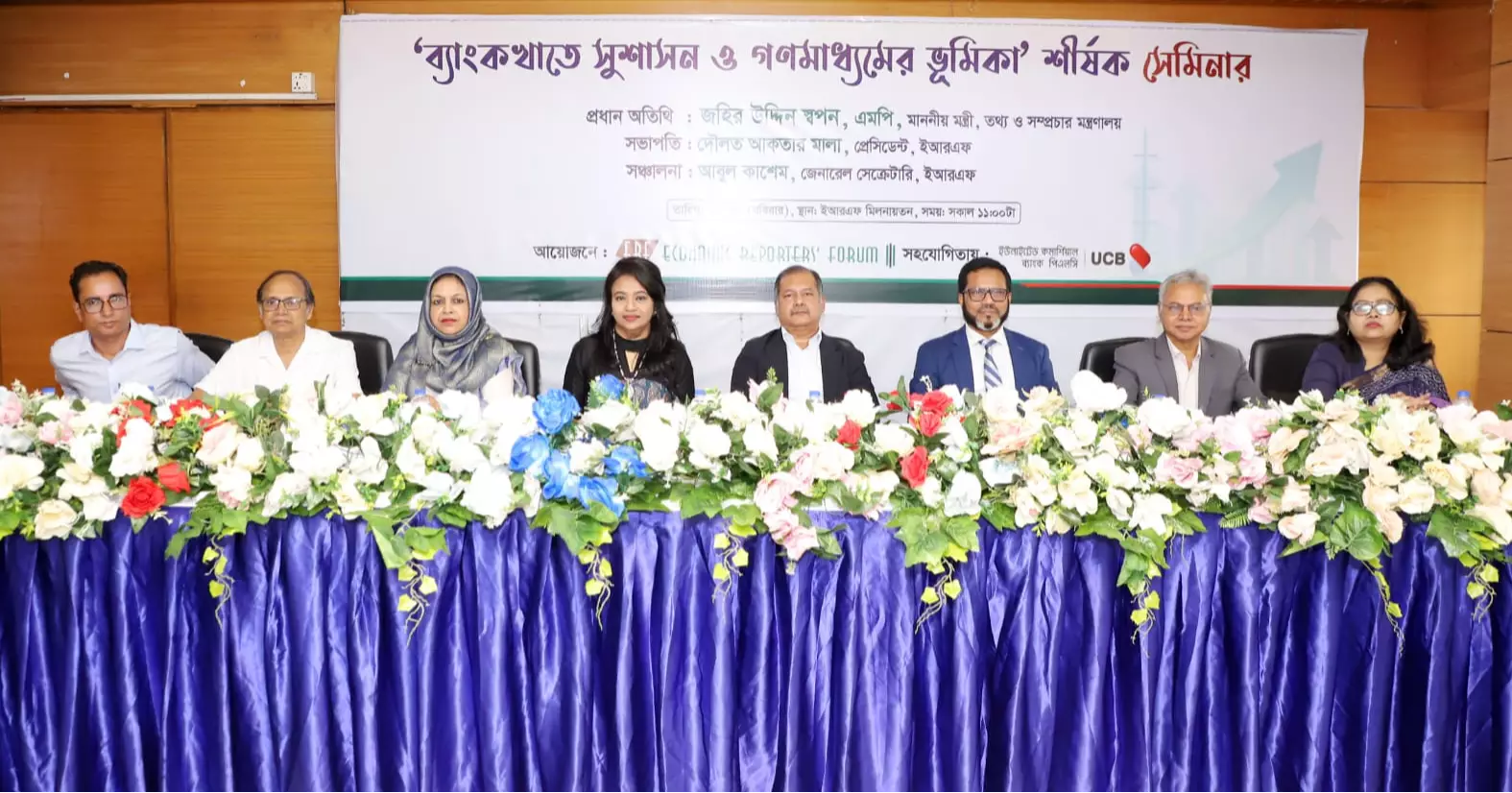
Minister Swapon made the remarks while addressing a seminar titled "Good Governance in the Banking Sector and the Role of Media" as the chief guest. Organized by the Economic Reporters' Forum (ERF), the seminar was held at the ERF office in the capital's Paltan area.
The Information Minister emphasized that good governance in the banking sector cannot be viewed in isolation. Disciplining the financial sector is impossible through media vigilance alone unless comprehensive good governance is established across the state and the political landscape.
Swapon heavily criticized the previous regime, alleging that state statistics were weaponized for political gains.
He stated that the actual economic reality was deliberately concealed through systemic data manipulation and fraud, adding that altering performance metrics and statistics at such a scale is impossible without state patronage.
Reflecting on the historical growth of Bangladesh's economy, the minister credited President Ziaur Rahman for initiating economic liberalization, which laid the foundation for the expansion of today's private sector.
He urged for a reduction in the economy's over-reliance on banks for long-term financing by strengthening the capital market. He noted a grim connection between financial fraudsters, stating that those who embezzled bank deposits are the same individuals who plundered the funds of small investors in the stock market.
Speaking at the event, Mamdudur Rashid, Managing Director of United Commercial Bank (UCB), noted that while the banking sector remains a foundation of the country's socio-economic fabric, prolonged governance deficiencies have plunged it into severe crises. He admitted that UCB is currently experiencing financial stress.
Rashid pointed out that data regarding defaulted loans had been hidden for a long time. Following recent central bank directives to publish authentic data, the real magnitude of non-performing loans (NPLs) has finally surfaced. He clarified that the current high percentage of NPLs does not indicate a sudden deterioration over a single year, but rather reflects the cumulative reality of long-standing systemic issues.
According to the keynote paper presented at the seminar, the banking sector remains the primary source of financing in Bangladesh. Since the capital and bond markets have failed to play their desired roles, banks are forced to provide the majority of short, medium, and long-term financing. Consequently, the stability of the entire economy is inextricably linked to good governance within the banking system.
The paper further highlighted that the media acts as the 'fourth estate' in ensuring accountability and preventing corruption. However, it noted that past governments often attempted to muzzle the media instead of welcoming constructive criticism.
The keynote paper was jointly presented by Obaidullah Roni, Special Correspondent of Samakal, and Sanaullah Sakib, Senior Reporter of Prothom Alo.
Presided over by ERF President Doulot Akter Mala, the event was moderated by the organization's General Secretary, Abul Kashem.
Bangladesh Bank Deputy Governor Nurun Nahar, Director General of the Bangladesh Institute of Bank Management (BIBM) Md. Ezazul Islam, Chairman of Policy Exchange Bangladesh Masrur Reaz, and former Pro-Vice Chancellor of Dhaka University Sayema Haque Bidisha, among others, spoke as special guests.