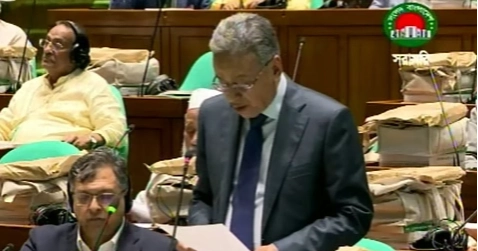
A bill bringing significant amendments to the VAT law was placed in Parliament on Monday, with the Finance Minister requesting to bypass the step of sending it to the Parliamentary Standing Committee for scrutiny so it can be passed within the current session, which has just two more days left.
Finance and Planning Minister Amir Khosru Mahmud Chowdhury placed the Value Added Tax and Supplementary Duty (Amendment) Bill, 2026, which proposes, among other things, to restore monthly submission of VAT returns instead of the quarterly filing system that was introduced in the budget for the current fiscal. by amending the Value Added Tax and Supplementary Duty Act, 2012.
He requested to pass the Bill on Tuesday bypassing the Parliamentary Standing Committee as he described it as an “innocent Bill” and the opposition might not have any objection about it. The bill will be placed in the House tomorrow for passage.
The bill seeks to replace Section 64 of the 2012 Act. Under the proposed provision, every registered, enlisted, registrable or enlistable person must file a return for each tax period within 15 days of the end of that period, in the manner prescribed by the National Board of Revenue (NBR).
If the 15th day falls on a public holiday, the return may be submitted on the next working day.
Government, semi-government and autonomous bodies, banks, insurance companies, and persons or entities filing nil returns will get 20 days from the end of the tax period.
The bill also empowers the NBR to extend the filing deadline by order, without interest or penalty, in the public interest. Details of supplementary duty payments must be included in the VAT return, and the board may make electronic filing mandatory for any registered or enlisted person by order.
It is proposed that the law will be deemed to have come into force on October 1, 2026, and will be titled the Value Added Tax and Supplementary Duty (Amendment) Act, 2026.
The statement of objects and reasons says the 2026-27 budget relaxed the requirement for monthly returns by allowing submission within 15 days of the end of every three tax periods, or three months. It says field-level officials and taxpayers have since submitted written statements citing various obstacles to revenue collection.
The statement lists the following seven complications:
Revenue uncertainty: Under quarterly filing, VAT is deposited every three months instead of monthly, which could create an immediate cash shortage for the government.
Financial risk: When a large lump sum falls due after three months, many small and medium enterprises (SMEs) may divert the money to other business uses and then fail to pay in one go.
Input tax credit: Adjusting rebates every three months, instead of monthly, would complicate the deadlines for buyers' and sellers' rebate claims, as well as invoice tracking.
Less scope for correction: A single error would affect three months of transactions, making it more time-consuming and complex to detect and correct.
Monitoring and audit: With returns arriving at VAT circle offices all at once, scrutinising or auditing so many transactions with limited manpower would be almost impossible.
Interest calculation: Failure to deposit the net payable tax for each tax period in the government treasury would complicate interest calculation and other matters.
A-Challan module: The module needs to be amended because there is currently no treasury challan.
The statement says the need to amend Section 64 subsequently arose. As Parliament was not in session, President issued the Value Added Tax and Supplementary Duty (Amendment) Ordinance, 2026 (Ordinance No. 38 of 2026) on October 14 under Article 93(1) of the Constitution.
Under Article 93(2), the ordinance must be placed before Parliament at the first sitting of the fourth session of the 13th Jatiya Sangsad after its promulgation. The cabinet has given in-principle and final approval to a draft of the bill to turn the ordinance into law.
Under the bill, the ordinance will be repealed, but any actions taken or measures adopted under it will be deemed to have been taken under the new law.