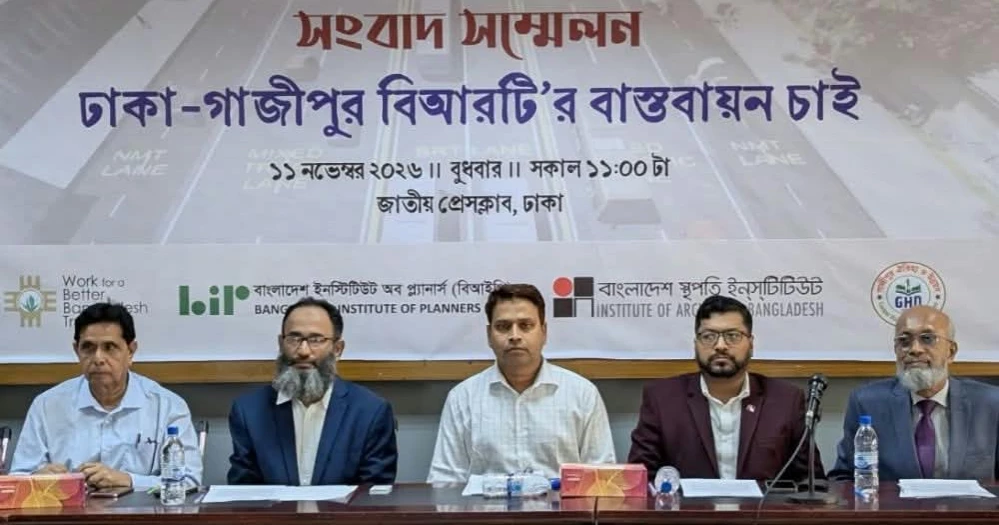
The Bangladesh Institute of Planners (BIP) and several other organisations Wednesday urged the government to review and reconsider its decision to scrap the dedicated bus lane on the Dhaka-Gazipur Bus Rapid Transit (BRT) corridor and convert the road into a 3+3 lane highway.
They made the call at a press conference titled "We Want Implementation of Dhaka-Gazipur BRT" at the Tofazzal Hossain Manik Miah Hall of the Jatiya Press Club this morning.
BIP, the Institute of Architects Bangladesh (IAB), Works for a Better Bangladesh (WBB) Trust and Gazipur Oitijjho O Unnayan jointly organised the event.
Presenting the keynote, BIP President Planner Muhammad Ariful Islam said the cabinet decided on October 18 to abolish the designated bus lane and convert the road into a 3+3 lane highway.
He questioned the decision, saying it was taken after around Tk 2,800 crore had been spent on infrastructure, without purchasing BRT buses or launching the service.
"If there are financial or operational problems in implementing the project, the responsible individuals and institutions must be held accountable. The BRT system or the bus lane cannot be blamed," he said.
He called for preserving all documents related to the project from its inception, along with the list, roles and responsibilities of consultants, implementing agencies and others involved. He also demanded a probe commission and the publication of its findings.
Ariful said any decision on the BRT lane should follow a financial and environmental assessment covering construction and operating costs, passengers' time savings, environmental benefits, and the potential time and economic losses caused by traffic congestion.
Decisions, he said, must be taken after hearing all stakeholders and making the information public. He also expressed hope that the cabinet would make the rationale behind its decisions public.
Once operational, he said, the BRT would cut travel time between Gazipur and the airport, reduce dependence on private cars, and create opportunities for investment and urban economic growth in Gazipur.
He added that completion of ongoing road projects in Dhaka and Gazipur could also ease pressure on the corridor.
The BIP president noted that the corridor is included in the 2005 Strategic Transport Plan (STP), the 2015 Revised STP, the 2025 update and the Gazipur Transport Master Plan, so its future must be determined within the broader transport planning framework.
He suggested declaring the Airport-Gazipur corridor an "Urban Artery" and retaining the BRT lane to implement the country's first BRT corridor.
He also called for BRT initiatives in Dhaka city and elsewhere in the country, and for strengthening Dhaka BRT PLC rather than shutting it down.
Any technical flaws, irregularities or conflicts of interest in the project, he said, should be investigated by an appropriate third party following international standards.
"Transport development must be plan-based, not project-based," he stressed.
Referring to the Prime Minister's "I have a plan" pledge, Ariful expressed hope that the same spirit of planning would be reflected in the BRT project, and that decisions would give top priority to environmental protection.
Gazipur Oitijjho O Unnayan President Engineer Shamsul Haque highlighted the prolonged suffering of Gazipur residents.
He said the BRT project, which began in 2012, remains unfinished after 14 years, while a 28-km BRT project in Peshawar, Pakistan, was completed in just two years.
He sought explanations for the decision to scrap the project when about 97 percent of the work was done, and demanded accountability for the delay.
He said traffic congestion had begun easing as construction progressed, raising hopes among Gazipur residents. Due to a lack of adequate public transport, he added, the number of auto-rickshaws is rising.
Shamsul warned that scrapping the project would end the special road-crossing facilities at 25 stations, increasing hardship for women and people with disabilities.
"Those who do not use public transport are the ones deciding on this project," he lamented. He urged civil society representatives to visit Gazipur and see commuting conditions first-hand.
IAB General Secretary Masudur Rashid said the BRT could contribute not only to transport but also to the development of surrounding areas and quality of life.
He said any flaws should be fixed through technical corrections, and scrapping the entire project would be a major mistake.
Noting that feasibility studies had been carried out before the project was taken up, he questioned the rationale for fresh studies leading to its cancellation.
He said the BRT could become both a model project and a distinctive architectural landmark, and urged the government to revive it quickly with necessary changes.
At the question-answer session, BIP General Secretary Muhammad Muslehuddin Hasan, who moderated the event, said they had held individual discussions with Members of Parliament from Gazipur and planned joint talks with them.
Despite meeting the Prime Minister last June and holding a press conference and other initiatives, he said, their demands had not reached the government.
He said they have no personal interest in the project and want it implemented in the greater public interest.
"This is not merely a transport project, but a large-scale urban transformation initiative," he said.
He noted the Prime Minister's sincerity towards the road transport sector and expressed interest in meeting him. He also praised the bus franchise initiative but said it alone cannot fully solve the transport problem without the BRT.
At the press conference, BIP put forward an eight-point demand: review and reconsideration of the October 18 decision on the BRT.