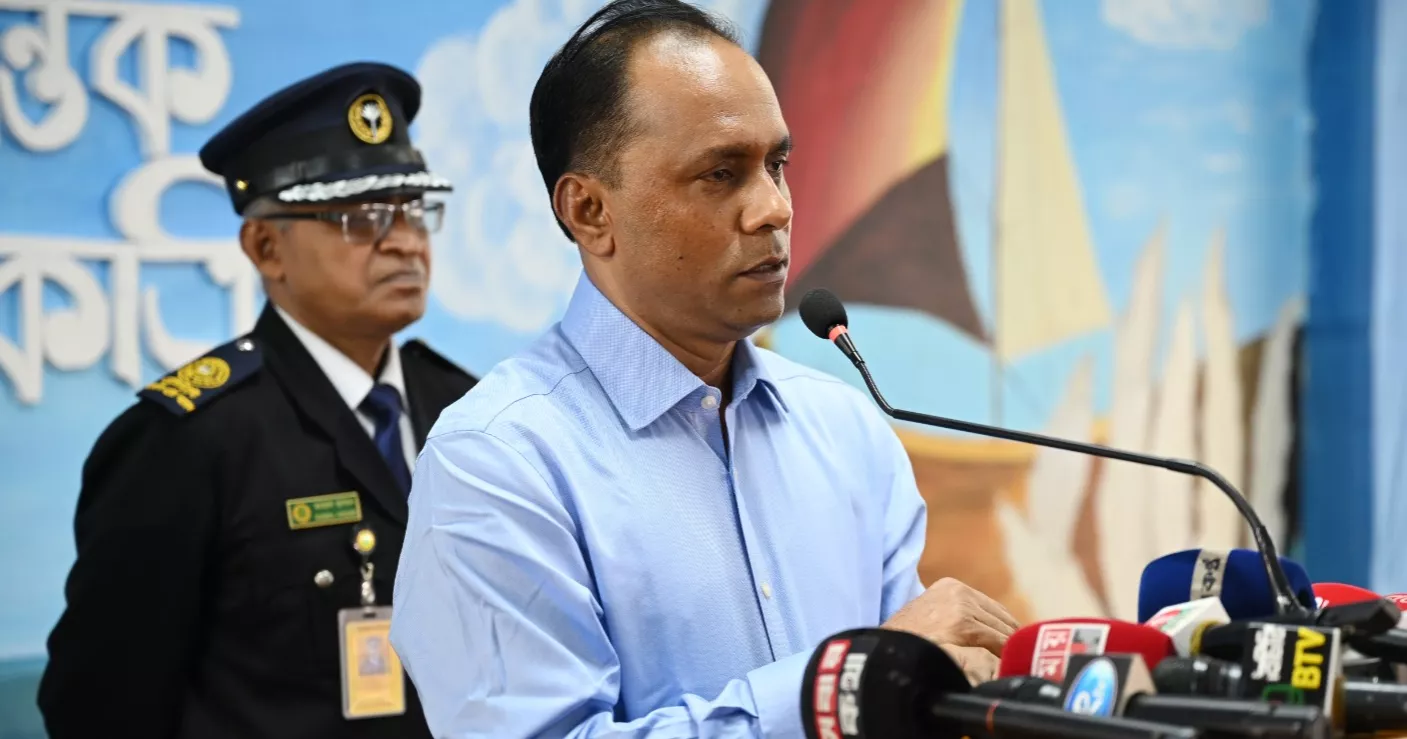
Deputy Speaker Kayser Kamal has said both the treasury bench and the opposition have important responsibilities in building the nation, stressing that parliament must play an effective role in ensuring accountability and scrutinizing the government.
Speaking about the need to make parliament effective, he said the opposition should fulfil its responsibilities within parliament rather than frequently resorting to street agitation.
Kamal made the remarks as the chief guest at the Sharad Utsab and freshers' reception for the 31st batch of Dhaka University’s Institute of Education and Research (IER), held at the institute today.
“Today, everyone is saying that parliament must be made effective. If parliament does not function effectively, the possibility of the country falling into trouble again cannot be ruled out,” he said.
Kamal added, “Therefore, just as the treasury bench, meaning those from the ruling party, must do their part to make parliament effective, the opposition also has a greater responsibility in this regard.”
He said there was no reason to assume that the ruling party alone would run the country simply because it held a majority in parliament. “No. Both the ruling party and the opposition are part of nation-building,” he said.
The Deputy Speaker questioned why the opposition had not formed a shadow cabinet to scrutinize the government's performance, identify its shortcomings and offer constructive criticism.
“We often talk about parliamentary democracy and the Westminster-style Parliament. But why is the opposition not forming a shadow cabinet?” he asked.
He explained that under the Westminster-style parliamentary system, the ruling party runs the government and the executive, while a shadow cabinet scrutinizes the government, identifies its mistakes and provides constructive criticism.
“We had expected that, in this new Bangladesh, a shadow cabinet would be formed to scrutinize the ruling party. Unfortunately, we shift the burden, but we are not taking the responsibility,” he said.
Kamal also emphasized the importance of institutional reform, questioning whether meaningful changes had taken place in state institutions following the political transitions of 1990 and 2024.
“To build the nation, we need institutional reform. We can topple political leadership, but why are we not working on institutional reform?” he said.
He urged all concerned to work together to reform institutions, including the civil bureaucracy and engineering departments, arguing that institutional shortcomings were preventing farmers, workers, students and other citizens from receiving the services they deserved.
Calling for collective responsibility in nation-building, Kamal said the distinction between the ruling and opposition parties should not overshadow their shared responsibility towards the country.
“This is our country. Who belongs to the ruling party and who belongs to the opposition? More importantly, we are all on the side of Bangladesh,” he said.
He urged everyone to work with principles and integrity to build the country people aspired to, recalling the sacrifices made by thousands for that vision and the suffering of students who had lost their eyesight or suffered permanent disabilities.