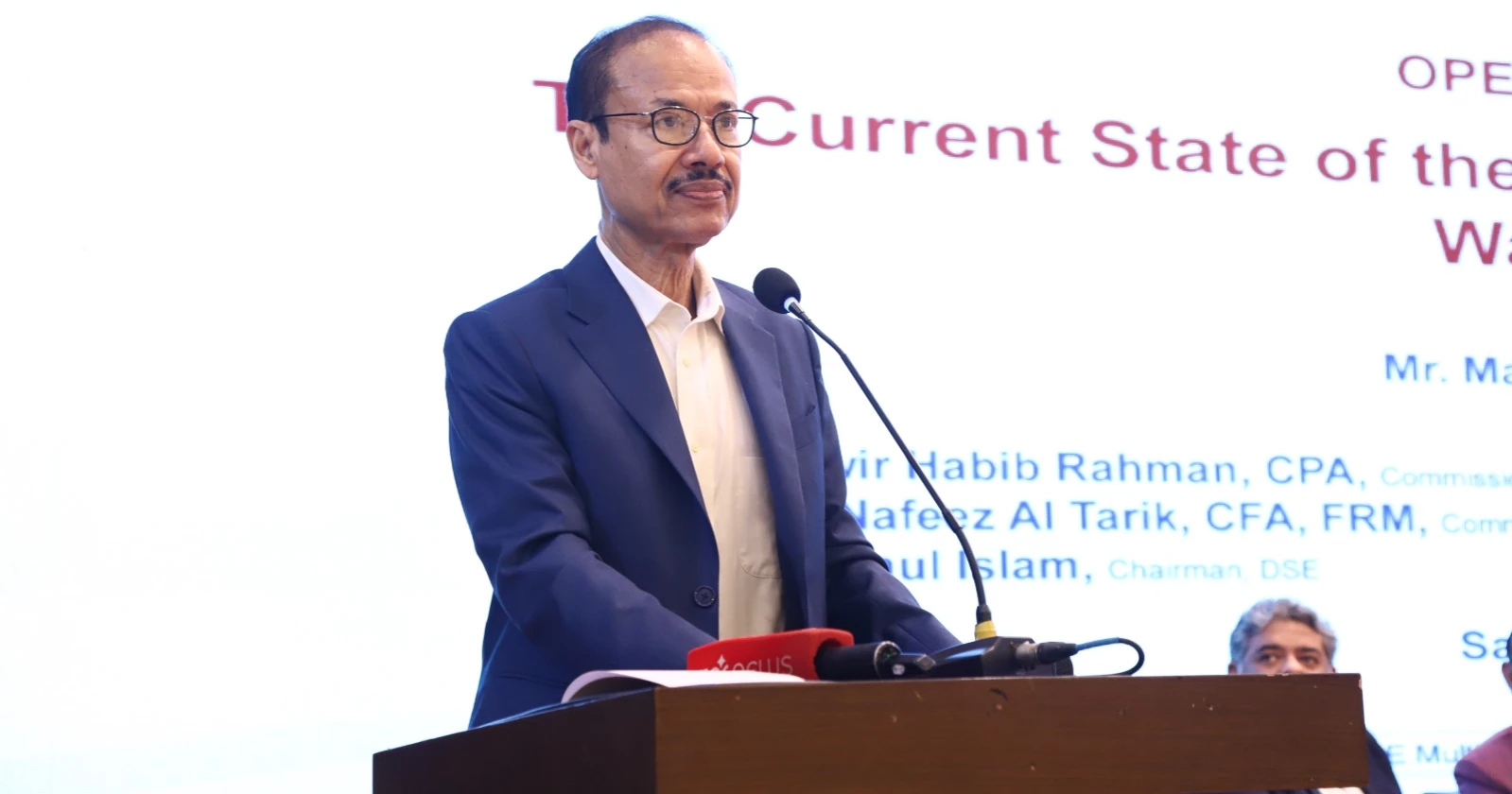
Bangladesh Securities and Exchange Commission (BSEC) Chairman Masud Khan on Monday said the commission is determined to restore investors' confidence in the capital market through concrete action rather than rhetoric, acknowledging that a trust deficit persists among market participants.
"It is not BSEC's job to boost the market index or turnover. The core responsibility of a regulator is to ensure a fair, transparent and orderly market, and to protect investors," Masud said at an open discussion titled "Present State and Future Course of Bangladesh's Capital Market," organised by the DSE Brokers Association of Bangladesh (DBA).
Masud said the commission scrapped the long-standing floor price, considered a major "pain point," especially for foreign investors - on its second day in office.
He noted that Morgan Stanley Capital International (MSCI), which had suspended Bangladesh's index over the floor price, has now decided to reinstate it from November, calling it a significant step in attracting foreign investment.
The BSEC chief also said a long-pending complication involving Beximco Pharma's Global Depositary Receipts (GDRs) listed on the London Stock Exchange has been resolved, within a month of his joining the commission.
He warned that had the issue remained unresolved, no Bangladeshi company would have been able to list GDRs abroad in future, adding that several major local firms have since shown interest in listing on foreign exchanges.
On brokerage house oversight, Masud said penalties alone cannot address major shortfalls, calling for risk-based supervision and regular surprise inspections by BSEC and the Dhaka Stock Exchange (DSE).
He said steps are underway to make the surveillance systems of both BSEC and DSE artificial intelligence (AI)-based, with DSE upgrading its system first, followed by BSEC.
He said BSEC is working with DSE to strengthen the bond market, noting that high fees had been a major barrier to bond trading, which have now been reduced following discussions with the exchange.
He informed that BRAC Bank is planning to float a Tk 1,000 crore social bond, which, as per commission requirements, will need to be listed on DSE's main board.
He expressed hope that many more bonds would be listed on the main board over the next year, widening opportunities for mutual funds and merchant banks to invest.
On reducing delays in the IPO process, Masud said repeated verification of similar questions and documents at multiple stages has been prolonging approvals. To address this, an "extended audit" system is being introduced under new IPO rules to verify a company's assets, land, machinery, receivables and liabilities against its financial statements. Going forward, companies will submit IPO applications to DSE or the Chittagong Stock Exchange (CSE) with a copy to BSEC, and any queries on financial statements will be routed through the exchanges rather than directly to companies.
He said rules for direct listing are almost finalised and will be sent for public opinion once approved by the commission board. Under direct listing, companies will not need to go through the IPO process and can get listed within two to three months by offloading a specified portion of shares.
He expects several good companies to enter the market through this route over the next six months to a year. A hybrid model combining IPO and direct listing is also being introduced, allowing a company to offer part of its shares via IPO and the rest through direct listing, with a board decision expected within a week.
Masud said BSEC also has the authority, under Section 20A of the Securities law, to direct a company to list on the capital market in public interest, even if the company is unwilling. A set of rules defining "public interest company" is being framed to exercise this power, which could make listing mandatory for certain categories of companies.
On the Central Counterparty Clearing Bangladesh Limited (CCBL), Masud said the DSE chairman has informed him that its board will be reconstituted within a month, paving the way for a new clearing system.
He expressed hope that CCBL would become operational in Bangladesh within a year, which would bring brokers' margin and CCA shortfalls, among other issues, under an automated system.
He said work is also progressing on introducing scrip netting and a T+1 settlement system, with a roadmap prepared in consultation with DSE, CSE, the Central Depository Bangladesh Limited (CDBL) and foreign custodian banks. He said efforts will be made to move to the T+1 system by the end of the year.
Noting that restoring investor confidence will take time, Masud said artificially propping up the market through short-term measures is not a sustainable solution, stressing the need to ensure sustainable growth instead.
"We are working. We will restore confidence through action, not words," he told investors, adding that they would be able to assess the commission's performance by comparing its current activities with the roadmap presented two months ago.
Reiterating that boosting the index or turnover is not BSEC's responsibility, Masud said securities commissions worldwide are primarily tasked with ensuring fair, transparent and orderly markets, protecting investors, and deepening the capital market.
Artificially inflating the index or turnover, he said, could create a conflict of interest between the regulator and market interests, adding that the market should be allowed to move on its own strength.