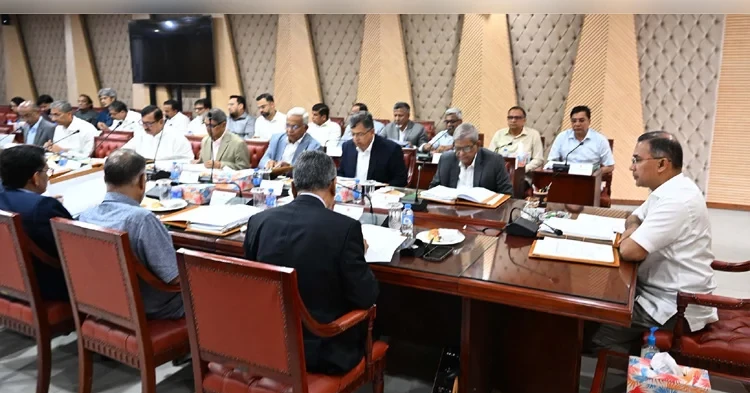
The Cabinet on Monday cleared the draft of the National Human Rights Commission Act, 2026, aimed at protecting, promoting and ensuring human rights.
The draft law received final approval at a Cabinet meeting chaired by Prime Minister Tarique Rahman at the Bangladesh Secretariat.
“Respecting human rights is one of the commitments of the state, while protecting, promoting and ensuring human rights are among its main objectives,” said a press release issued by the Cabinet Division.
Bangladesh is committed to fulfilling its obligations under various international conventions and treaties on human rights, including the United Nations Universal Declaration of Human Rights, it said.
“It is essential to establish an effective and independent Human Rights Commission to protect, promote and ensure human rights. In this context, the draft ‘National Human Rights Commission Act, 2026’ has been formulated,” the release said.
According to the proposed law, the Commission will comprise a chairman and four commissioners, including at least one woman, following the recommendation of a search committee.
The search committee, in its recommendation, shall give priority to ethnic communities and disadvantaged groups in forming the Commission.
The committee will include a university professor, a civil society representative and representatives of ethnic or disadvantaged communities.
The draft law proposed empowering the Commission to take step for effective investigation and issue interim orders for ensuing the immediate safety of victims and preventing further harm during an investigation.
In line with the UN Optional Protocol to the Convention against Torture (OPCAT), the draft law provides for establishing a National Preventive Mechanism (NPM) unit to prevent torture, deaths and enforced disappearances in custody.
Visa Policy 2026 approved
The Cabinet also approved the draft Visa Policy 2026, aimed at making the entry and exit of foreigners into Bangladesh easier and more orderly, attracting foreign direct investment (FDI), businesses and skilled human resources, and modernising the existing visa system.
The new visa policy also aims to promote tourism and the hospitality sector, ensure technology and knowledge transfer, maintain national security and international diplomatic balance, and develop a modern, service-oriented immigration framework based on the principle of reciprocity.
“The Visa Policy 2026 has been formulated to make the existing visa system modern, secure, dynamic and simplified,” said the Cabinet Division release.
The new visa policy contains 34 visa categories, up from 33 in the visa policy 2006.
Under the new policy, all previous visa-related circulars will be cancelled, and a unified and modern visa framework will be established at the national and international levels.
The Ministry of Home Affairs, the Department of Immigration and Passports and Bangladesh missions abroad will implement the new policy.
Draft Bank Resolution (Amendment) Act 2026 approved
The Cabinet also gave the final approval to the draft "Bank Resolution (Amendment) Act, 2026", repealing a provision (Article 18-a) of the existing law.
Article 18(a) was meant to introduce a market-based alternative alongside conventional resolution tools, allowing a bank under resolution to be restructured while remaining operational, addressing capital and liquidity shortfalls, protecting the interests of depositors and investors, and reducing the government's financial exposure.
However, no person or institution applied under the section after fulfilling all its conditions, prompting the government to draft the "Bank Resolution (Amendment) Act, 2026" to repeal the provision altogether.