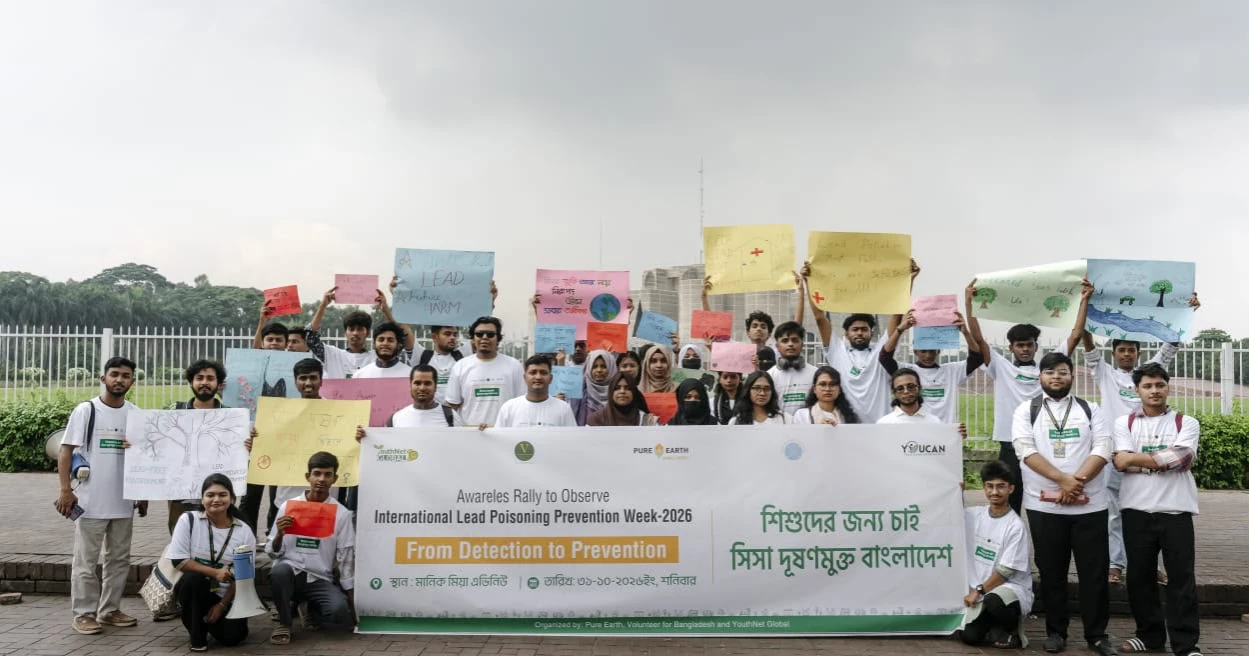
Youth activists, environmental campaigners and volunteers on Saturday called for urgent and coordinated action to tackle lead pollution in Bangladesh, warning that 38.34 percent of children in the country have blood lead levels above the reference threshold.
They made the call at a rally and human chain held at Manik Mia Avenue in the capital, marking International Lead Poisoning Prevention Week 2026.
The programme was jointly organised by Volunteer for Bangladesh (VBD), Dhaka District South, YouthNet Global and Pure Earth Bangladesh.
Local representatives, civil society members, young environmental activists, journalists and volunteers joined the programme, urging stronger enforcement of environmental laws, safer recycling of used lead-acid batteries and better protection for children and communities exposed to toxic substances.
According to a national survey by the Bangladesh Bureau of Statistics (BBS), 38.34 percent of children in Bangladesh have blood lead levels above the reference threshold.
The organisers also said around 7.5 percent of pregnant women are affected by lead exposure.
Health experts warn that no level of lead exposure is considered safe, particularly for children, as the toxic metal can impair brain development and affect learning, memory, concentration and behaviour.
Prolonged exposure can also increase the risk of cardiovascular diseases, kidney damage and other health complications in adults.
Unsafe recycling of used lead-acid batteries is among the major sources of lead contamination in Bangladesh.
Lead-containing paints, toys, cookware and cosmetics are also potential sources of exposure.
Speaking at the programme, Pure Earth Bangladesh Country Director Mitali Das said protecting children from lead poisoning required coordinated efforts to identify contamination sources, control pollution, ensure safer consumer products and promote environmentally sound battery recycling.
She said Pure Earth was working with the Ministry of Environment, Forest and Climate Change, the Department of Environment and other stakeholders to develop guidelines on Extended Producer Responsibility (EPR).
The proposed guidelines would make producers responsible for managing their products after use, helping improve the collection, tracking and environmentally sound recycling of used lead-acid batteries.
YouthNet Global Coordinator for Environmental Justice and Sustainable Development Mohaiminul Islam Zipat said unsafe battery recycling and unplanned industrial activities were exposing children, workers and surrounding communities to serious health risks.
“Lead pollution is not merely an environmental problem; it is a major threat to public health and future generations,” he said.
Afsana Akter Mim Swarna, Project Officer of Volunteer for Bangladesh, Dhaka District South, described lead pollution as a silent public health crisis threatening present and future generations.
She said awareness campaigns alone would not be enough without effective policies, industrial accountability and stronger enforcement of environmental laws.
Bangladesh has approved a National Strategy and Multi-Year Action Plan for 2026-2035 to reduce lead exposure and move towards a lead-free country, according to the organisers.
The strategy aims to raise the proportion of children with blood lead levels below the specified reference threshold to 50 percent by 2030 and 95 percent by 2035.
Campaigners said achieving these targets would require stronger industrial pollution monitoring, effective regulation of battery recycling, safer consumer products and the identification and rehabilitation of contaminated sites.
The Dhaka programme was part of a week-long nationwide awareness campaign being conducted across all eight administrative divisions under the theme “Together, We Stand Against Lead Pollution”.
YouthNet Global is leading the initiative with support from Pure Earth Bangladesh, while Volunteer for Bangladesh, YOUCAN and Earth Development Foundation are serving as co-organisers.
Similar activities have been held in different parts of the country.
In Khulna, environmental campaigners and volunteers organised a rally and human chain at Shibbari intersection on Thursday, while students, teachers and youth representatives at the University of Rajshahi on Friday called for stronger enforcement of environmental regulations.
The campaign also covers Chattogram, Mymensingh, Rangpur, Sylhet and Barishal.