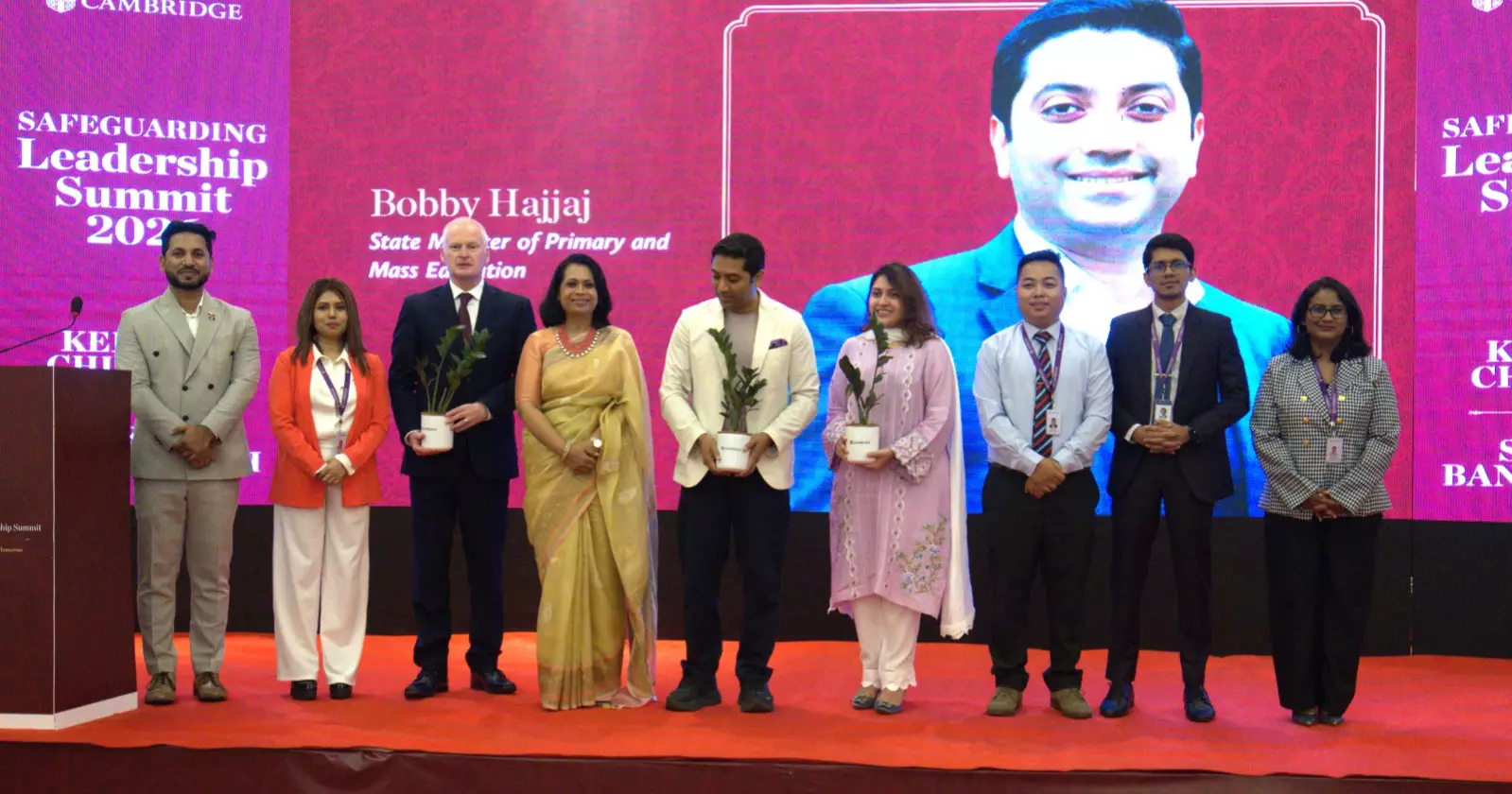
State Minister for Primary and Mass Education Bobby Hajjaj on Wednesday highlighted the importance of educational institutions taking responsibility for students’ safety and well-being alongside their academic development.
Speaking at a leadership summit as the chief guest, he underscored the need for schools to create environments where students feel safe, supported and able to raise concerns.
Bobby Hajjaj said the current government has undertaken various far-reaching initiatives on a massive scale to tirelessly improve the quality of education.
"Beyond enhancing academic standards, the government is committed to working in partnership with all educational institutions to improve their infrastructure and ensure a safe, healthy environment for students. At the same time, emphasis is being placed on increasing student engagement with the community," he said.
Haileybury Bhaluka and Cambridge University Press & Assessment jointly hosted the Safeguarding Leadership Summit 2026 at Le Méridien Dhaka, bringing together heads of educational institutions, education leaders, teachers and safeguarding professionals from across Bangladesh.
Held under the theme “Stronger Together, Safer Tomorrow – Keeping Children Safe in Bangladesh,” the summit focused on strengthening child safeguarding practices, promoting students’ mental and social wellbeing, and building effective safeguarding systems across educational institutions.
The summit emphasised that the success of an educational institution cannot be measured solely through academic outcomes.
Ensuring a safe, supportive and inclusive learning environment is equally important to achieving educational excellence, speakers said.
Participants highlighted the need to make safeguarding an integral part of school culture rather than treating it simply as a set of policies and procedures.
In his opening remarks, Country Lead of Cambridge University Press & Assessment Sarwat Reza stressed the importance of broadening the concept of school excellence beyond academic performance and placing student safety and wellbeing at the heart of educational leadership.
Speaking from the perspective of Bangladesh’s educational context, Simon O’Grady, founding head master of Haileybury Bhaluka, emphasised the importance of school leaders being visible, curious, courageous, consistent, evidence-informed and committed to continuous learning.
He also highlighted a range of safeguarding challenges, including physically and psychologically harmful disciplinary practices, declining attendance and completion rates at the secondary level, students’ reluctance to report concerns, and cultural barriers that can make it difficult for young people to question authority.
Speakers at the summit stressed that developing safeguarding policies alone is not sufficient. Teachers, staff and school leaders must understand what action to take when a concern arises, whom to report it to, how to document the matter appropriately, and what follow-up actions are required.
One of the key highlights of the summit was the interactive session “What Would You Do If...?”, led by Simon O’Grady.
The session invited education leaders to discuss realistic safeguarding scenarios and consider appropriate responses.
It connected safeguarding principles with situations that schools may encounter in everyday practice, while reinforcing the importance of preparedness and accountability at every level of an institution.
The scenarios included issues relating to student self-harm, concerns or complaints about the conduct of a member of school staff, bullying, and inclusion.
Participants exchanged views on immediate response, reporting responsibilities, confidentiality, the collection and preservation of relevant information and evidence, and the provision of longer-term support to students.
The summit called on education leaders to strengthen safeguarding systems within their respective institutions. Particular emphasis was placed on establishing clear responsibilities, creating safe environments for raising concerns, expanding professional training, and regularly reviewing child protection and safeguarding arrangements.
According to the organisers, safeguarding cannot be the responsibility of a single individual or be limited to one policy document.
Effective safeguarding requires leadership, accountability, evidence-based practice, professional development and a shared sense of responsibility across the entire school community.