Bangladesh needs a combination of immediate measures and medium- to long-term strategies to address its worsening energy crisis while ensuring that energy shortages do not hamper economic growth, energy expert Prof M Tamim has said.
Independent University Bangladesh Vice Chancellor Professor Dr. M. Tamim said the country’s domestic gas production is declining while limitations in infrastructure, technology, investment and financing are making it difficult to meet the growing demand for energy.
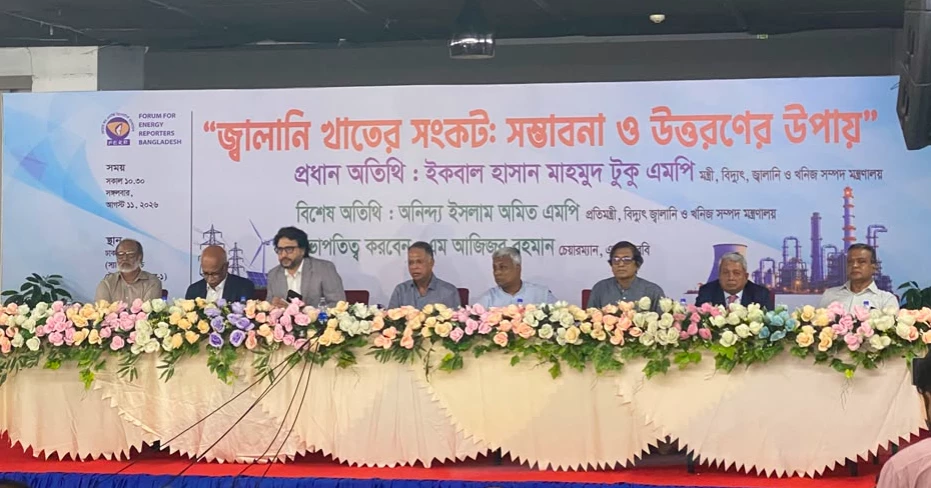
He was speaking at a seminar titled "Crisis in the Fuel Sector: Prospects and Path forward" at Dhaka Club.
Forum for Energy Reporters Bangladesh (FERB) organised the seminar where Power, Energy and Mineral Resources Minister Iqbal Hassan Mahmood attended as the chief guest while state minister Aninda Islam Amit was present as special guest.
“We have limitations in all three of our fossil fuel sources: oil, coal and gas. Yet we have to operate expensive oil- and gas-fired power plants,” Tamim said, stressing the need to diversify the energy mix.
He suggested making maximum use of coal-fired power plants, saying they should be operated at around 80-85 percent capacity where technically feasible, while rapidly expanding solar power.
“If we can quickly add 2,000 to 3,000 MW of solar capacity it would create an opportunity for fuel savings during the daytime by reducing the need to operate oil- and gas-fired power plants,” he said.
The IUB VC said such solar capacity could be developed through rooftop and medium-scale connected projects, including a “plug-and-play” approach where the government provides land and grid connectivity and developers compete to offer electricity at lower prices.
He said the current energy crisis is the result of problems that has accumulated over many years and could not be resolved overnight.
“We need to think about what should be done in the medium and long term. We are constantly engaged in firefighting,” he said.
Referring to the Speedy Supply of Power and Energy (Special Provisions) Act, he said the emergency legislation has been understandable when Bangladesh was facing severe load shedding and needed electricity quickly.
“But if a project takes five years to implement, why should we award a contract within two months without testing the actual cost and price?” he questioned.
He said exceptional decisions might still be necessary in an emergency, but such decisions should not become a substitute for competitive procurement and proper cost assessment.
On domestic gas, Tamim said Bangladesh’s gas fields are declining and managing declining fields required advanced technology, experience and investment, areas where Bapex had limitations.
He said Bangladesh should consider bringing in international expertise and technology to improve recovery from existing fields, including smaller gas-bearing layers that have not been fully developed.
He also mentioned the possibility of carefully developing Chhatak gas field, saying earlier estimates indicated significant reserves, although the field posed considerable technical risks because of its shallow depth and previous blowouts.
“These initiatives need to be taken so that we can manage the situation over the next three to four years,” he said.
Tamim said Bangladesh has become heavily dependent on imported energy, creating a major burden for the economy.
He argued that the country should assess whether its domestic coal resources could be utilised, taking into account technical, economic, environmental and political considerations.
At the same time, he said Bangladesh would remain dependent on energy imports for decades and should therefore focus on securing reliable and diversified sources.
He also stressed the importance of regional energy cooperation, saying Bangladesh could explore greater use of electricity available through regional power exchanges and strengthen grid connectivity with India, Nepal and Bhutan.
He cited the 1,160 MW of electricity being imported through India’s power exchange as an example of a potentially useful mechanism for meeting Bangladesh’s electricity needs.
Such cross-border connectivity would also become increasingly important if Bangladesh expands renewable energy, he said, as neighbouring countries could provide support when solar or other renewable generation fluctuates.
“Europe has extensive interconnection between countries. When one country has surplus renewable power, it can supply another where generation is lower. We need to think in that direction as well,” Tamim said.
He stressed that Bangladesh could not afford to sacrifice economic growth because of energy shortages.
“Economic development cannot be stopped. We have to support our economic growth through energy. If we can bring in the required energy, I believe we can supply the demand,” he said.