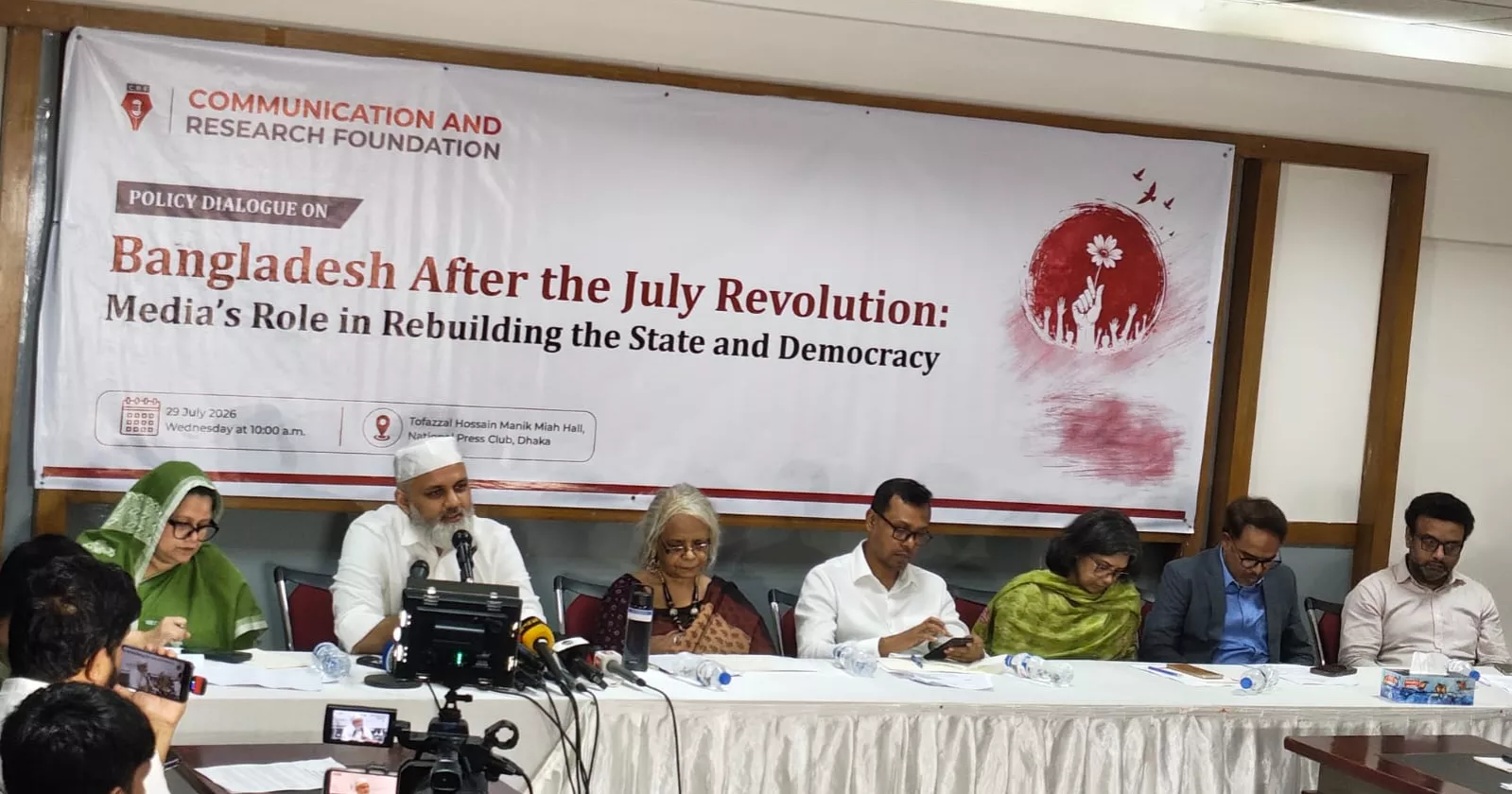
Speakers at a policy dialogue on Wednesday called for comprehensive reforms in Bangladesh's media sector, saying a strong, independent and accountable media is essential for rebuilding the state and strengthening democracy in the aftermath of the July mass uprising.
They made the remarks at a policy dialogue titled "Bangladesh After the July Revolution: Media's Role in Rebuilding the State and Democracy", organised by the Communication and Research Foundation at the National Press Club in the Capital.
Speaking at the programme, BNP Reserved Seat MP and party Media Cell member Mahmuda Habiba said rebuilding the state and democracy is a complex process, while the country's media remains one of the most vulnerable sectors.
She said democracy depends on a "triangle of trust" among the state, citizens and the media, arguing that the media cannot function effectively as the fourth pillar of the state without ensuring job security, dignity and a safe working environment for journalists.
Habiba said media professionals continue to face uncertainty over employment and inadequate wages, making it unrealistic to expect them to play their democratic role effectively.
She also questioned whether the growing commercialisation of media, where profit motives often outweigh journalistic values, is undermining the profession.
Calling for structural reforms, she said journalists' rights, accountability, transparency and accurate dissemination of information must be ensured to restore public confidence in the media.
Habiba said reforms cannot be achieved by the government alone and stressed the need for citizens and media professionals to work together to create pressure for change.
She referred to recommendations made by the Media Reform Commission, saying meaningful implementation would require sustained political commitment.
Discussing the broader political context, she said previous governments had created beneficiary groups across politics, bureaucracy, media and civil society, leaving behind deeply rooted structural challenges.
She reaffirmed the Bangladesh Nationalist Party's commitment to constitutional governance and accountability to the people.
Former University of Dhaka Mass Communication and Journalism Professor Dr Gitiara Nasreen said the events of July should be described as a mass uprising rather than a revolution, arguing that a revolution implies fundamental structural transformation, which has not yet occurred.
She stressed the importance of fact-based journalism and cautioned against historical distortions in reporting.
Nasreen traced the evolution of Bangladesh's media, saying it had transformed from a voluntary public service into an industry increasingly influenced by both the state and corporate interests.
She said dual control by governments and business groups has weakened public trust in the media and compromised journalistic independence.
While opposing activist journalism, she said the media must remain accountable to the public and fulfil its democratic responsibilities.
She also highlighted the safety risks faced by journalists, attacks on media institutions and the need for a strong, independent media commission to protect press freedom and ensure public trust.
Nasreen said meaningful social and political change cannot be reduced to social media campaigns alone, noting that the July uprising reflected genuine public participation and sacrifice.
Assistant Professor Mahmudunnabi of the University of Liberal Arts Bangladesh (ULAB) delivered the keynote presentation at the programme.
Among the panellists were Barrister Razibur Rahman, Jamaat-e-Islami MP; Jimi Amir, a former member of the Media Reform Commission, and others.