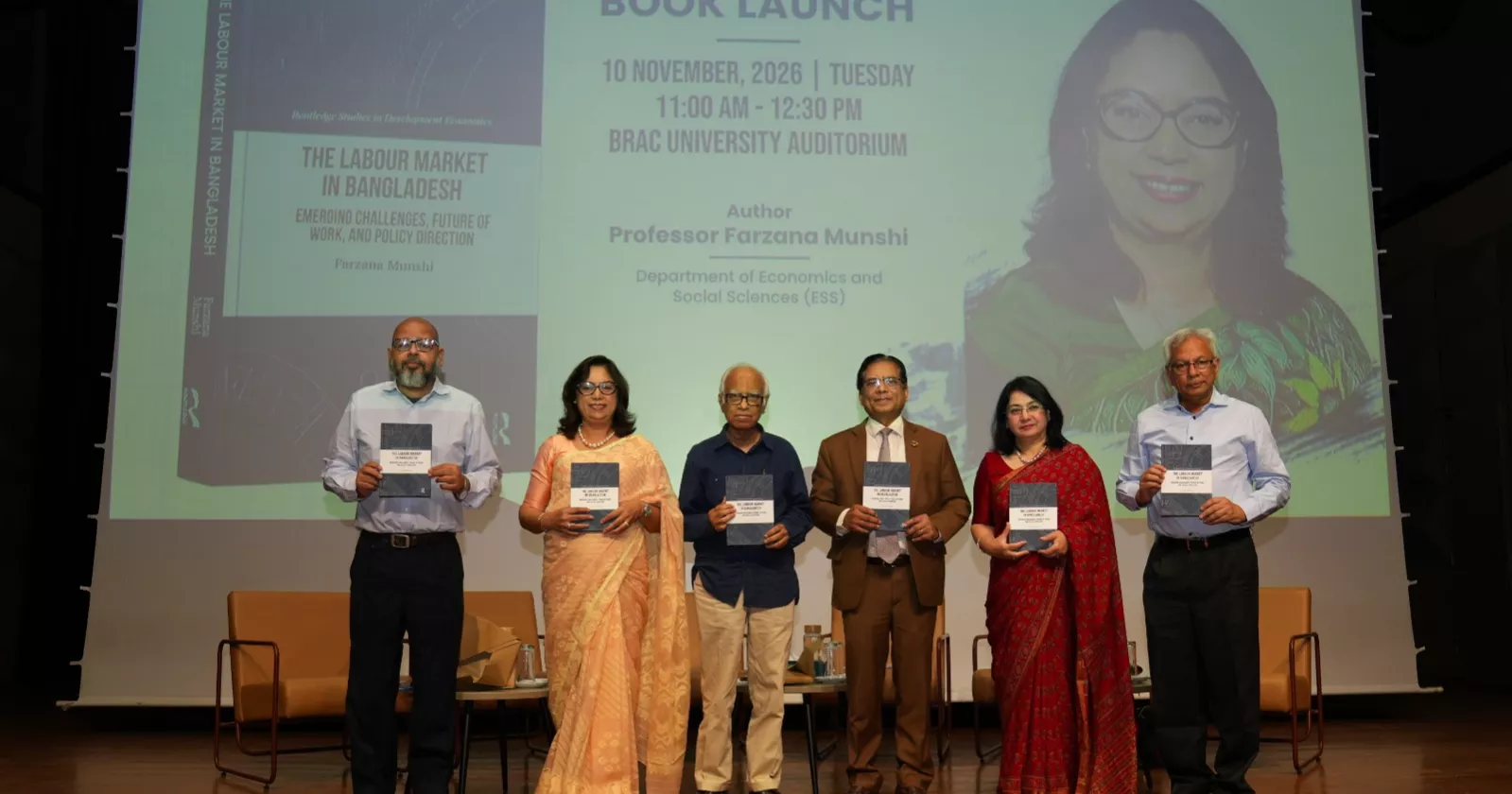
Bangladesh’s economy is changing faster than its labour market can adapt. To bridge this gap, the country needs to create quality jobs, expand opportunities and prepare its workforce for technological change, experts said at a book launch at BRAC University on Tuesday.
The Department of Economics and Social Sciences hosted the launch of The Labour Market in Bangladesh: Emerging Challenges, Future of Work, and Policy Direction written by Professor Farzana Munshi of the department.
The book brings together major labour-market challenges and examines their implications for the future of work in Bangladesh.
It highlights persistent problems such as widespread informality, youth and graduate unemployment, skills mismatches, and gender disparities, alongside emerging challenges from technological change, automation, and AI.
The book argues that improving workers’ skills alone will not be sufficient without corresponding investment and the creation of productive employment opportunities.
Bangladesh therefore needs a new employment model that prioritises not only job creation but also better-quality, formal employment to sustain economic growth and progress in poverty reduction.
Chief Guest Professor Wahiduddin Mahmud, former Adviser for the Ministries of Planning and Education, warned that Bangladesh could fall into the middle-income trap, where countries struggle to become industrialised, high-income economies. He pointed to two mismatches.
The first is between infrastructure and skilled manpower. The second is between the skills the education system produces and the skills the economy needs.
He cautioned that low-wage labour and manpower exports cannot drive growth in the long term. Instead, he said, the country must strengthen its human resources, expand productive employment and match skills development to a changing economy.
Professor Mustafizur Rahman, Distinguished Fellow at the Centre for Policy Dialogue (CPD), said output is moving towards higher-value sectors but employment is not keeping pace. This mismatch makes inclusive growth harder.
Dr Fahmida Khatun, also a Distinguished Fellow at CPD, said shutting certain groups out of economic opportunity limits both their own prospects and the country’s productivity. She urged a focus on the quality of jobs, not just the number.
Professor A. K. Enamul Haque, Director General of the Bangladesh Institute of Development Studies (BIDS), said AI and automation are taking over repetitive tasks and changing the nature of work. Human creativity, critical observation and original thinking, however, remain essential.
He called for education reforms that prepare people for a changing labour market.
Professor Wasiqur Rahman Khan, Chairperson of the Department of Economics and Social Sciences, moderated the discussion. Members of the Board of Trustees, faculty and students from across the university’s schools and departments attended.
The discussion tied closely to SDG 4 (Quality Education), SDG 5 (Gender Equality) and SDG 8 (Decent Work and Economic Growth).
These goals reflect BRAC University’s commitment to research that shapes national policy and to education that prepares graduates for the future of work.