Transport sector experts and policymakers on Tuesday underscored the need for quality skills development and greater social acceptance to increase the number of women professional drivers in Bangladesh, saying the profession could significantly enhance women’s mobility, income generation and financial independence.
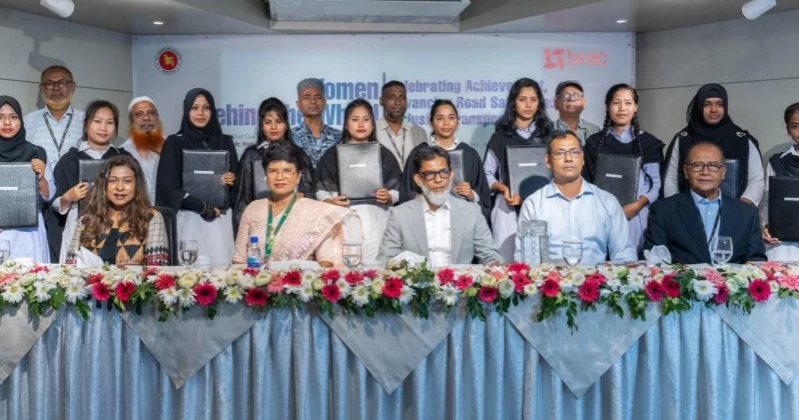
They made the remarks at an event titled “Women Behind the Wheel: Celebrating Achievement, Advancing Road Safety and Inclusive Transport,” organised by BRAC’s Road Safety Programme at BRAC Centre in Mohakhali to mark the completion of professional driver training and certification of women drivers.
State Minister for Railways, and Road Transport and Highways Division Habibur Rashid, Anna Minj, MP, and Chairman of the Bangladesh Road Transport Authority (BRTA) Mohammad Habibur Rahman spoke at the event with Managing Director of BRAC Enterprises Tamara Hasan Abed in the chair.
A presentation on the women driver training initiative was made by Ahmed Najmul Hussain, director of BRAC’s Road Safety Programme.
At the event, certificates were formally awarded to 10 women who successfully completed training at BRAC Driving School and are now prepared to begin their careers as professional drivers.
In his speech, Habibur Rashid said women’s participation in the transport sector remained limited for many years due to social barriers and prevailing stereotypes.
He also noted that the current government has undertaken a range of initiatives, including technology-driven traffic management, speed control measures, the development of safer road infrastructure, and the modernisation of public transport systems.
Alongside these efforts, new employment opportunities for women are being created through women-only bus services, professional driver training programmes, and initiatives to facilitate licensing, the state minister said.
Speaking as a special guest, Anna Minj, MP, highlighted two key challenges facing women drivers. First, society is still not fully prepared to accept women driving buses and other forms of public transport, which continues to limit employment opportunities in the profession. Second, adequate facilities for women, including toilets and other essential amenities in public spaces, remain insufficient.
Meanwhile, BRTA Chairman Habibur Rahman said the authorities remain committed to creating a more supportive environment for women passengers and women drivers in public transport.
He assured that qualified women drivers would receive appropriate support and services to facilitate the licensing process. Efforts are also underway to make the licensing system more women-friendly while maintaining standards of safety and competence.
Tamara Hasan Abed said the event reflected a collective commitment to women’s empowerment, safety, and inclusive transport systems.
Through the development of skilled and responsible drivers and the promotion of a culture of safe road use, BRAC’s Road Safety Programme continues to make a significant contribution to road safety in Bangladesh, she said.