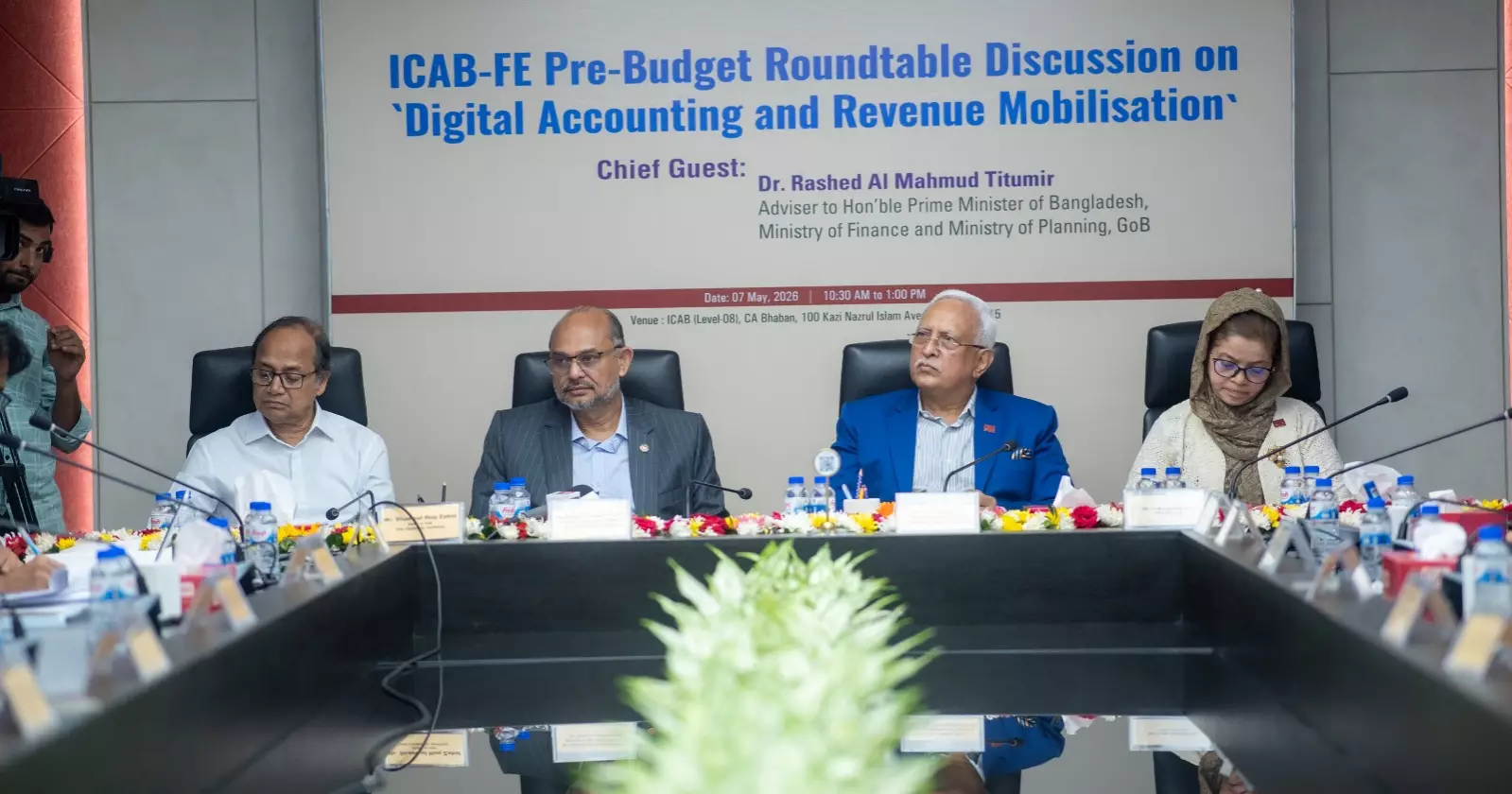
Adviser to the Prime Minister for Finance and Planning Dr. Rashed Al Mahmud Titumir on Thursday stressed the need for building a robust digital public infrastructure (DPI), expanding social protection and strengthening self-regulation in financial markets to drive Bangladesh’s economic transformation.
Speaking as the chief guest at a pre-budget roundtable titled “Digital Accounting and Revenue Mobilization”, jointly organised by the Institute of Chartered Accountants of Bangladesh and The Financial Express at CA Bhaban in Dhaka, Titumir said the government wants to establish a “humanitarian, democratic welfare state” centred on citizens.
He said the government is working to develop a national digital database system under a “One Citizen, One Class, One Digital World” framework to ensure better public service delivery and accountability.
Highlighting the government’s ongoing initiatives, the adviser said family cards and farmers’ cards are already being linked with banking services, enabling farmers to access formal financial channels through digital cards.
“Bangladeshis are eager for modernization in a uniquely Bangladeshi way, rooted in our own history and traditions,” he said, noting that many successful reforms in the country emerged without foreign technical assistance projects.
Titumir also underscored the importance of bringing informal sectors into the formal economy and credited past governments for expanding women’s participation in education and the formal labour market through stipend and employment initiatives.
Referring to the country’s economic challenges, he said Bangladesh inherited a “damaged economy” and must now focus on long-term structural reforms, including expanding manufacturing capacity, green growth, electric vehicle production and railway modernization.
He said increasing the size of the economy through industrialization and investment is essential for boosting revenue collection and improving spending on education and healthcare.
The adviser reiterated the government’s commitment to gradually raising allocations for education and health sectors, saying improvements in human capability and accessibility are vital for building a humane society.
On financial governance, Titumir stressed the need for stronger market-based regulation and professional accountability, particularly in auditing, valuation and credit assessment.
He warned that excessive regulation creates distortions and argued that self-regulatory professional bodies should play a greater role in ensuring transparency and discipline in the market.
Referring to the issue of non-performing loans (NPLs), he questioned how bad assets had been repeatedly certified by professionals and institutions, saying accountability within the system is necessary before introducing new mechanisms like asset management companies.
The roundtable was presided over by Shamsul Huq Zahid, editor of The Financial Express, while ICAB President NKA Mobin delivered the welcome address.
Among others participating in the discussion were Muhammad Abdul Majid, Dr. Fahmida Khatun, Taskeen Ahmed and Kamran T. Rahman.