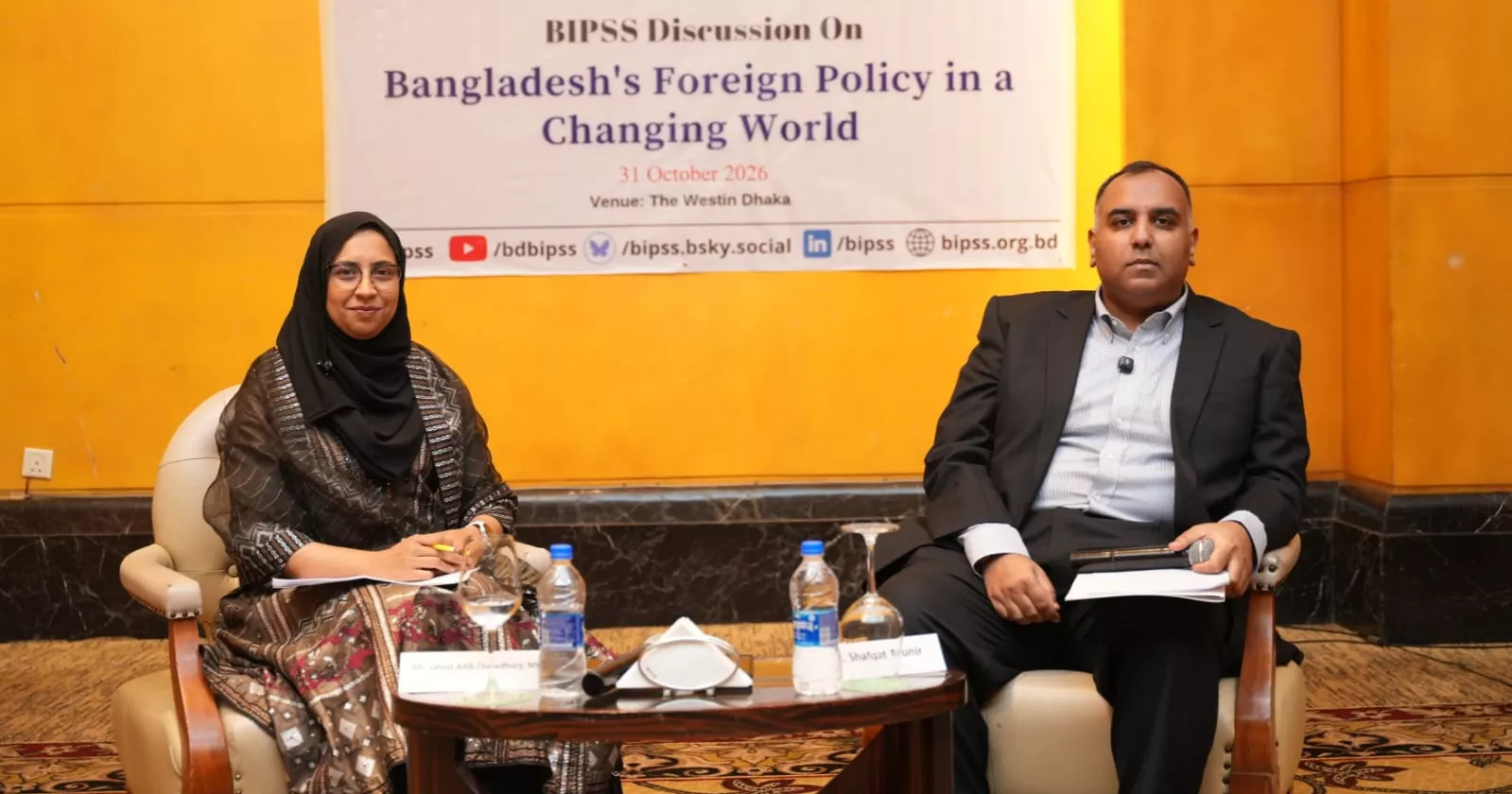
Bangladesh’s foreign policy should be guided by national interests and the aspirations of its people rather than being shaped by competing demands from major powers, Chairman of the Parliamentary Standing Committee on Foreign Affairs Jahrat Adib Chowdhury has said.
She stressed the need to make effective use of Bangladesh’s relationships with global partners in trade, investment and economic cooperation while maintaining flexibility in its international engagements.
Jahrat, also a member of the Executive Committee of the Inter-Parliamentary Union (IPU), made the remarks at a fireside chat titled “Bangladesh’s Foreign Policy in a Changing World” hosted by the Bangladesh Institute of Peace and Security Studies (BIPSS) in Dhaka on Saturday.
She highlighted the importance of economic diplomacy, regional cooperation and stronger institutional capacity, particularly in the context of Bangladesh’s graduation from the least developed country (LDC) category.
She also underscored the role of parliamentary diplomacy in building lasting relationships across countries and political parties and strengthening cooperation between parliament and the Ministry of Foreign Affairs.
BIPSS President Major General (Retd) A N M Muniruzzaman highlighted the rapid transformation of the global order, marked by growing multipolarity, geopolitical competition and the restructuring of global supply chains.
He said these developments presented both strategic challenges and opportunities for Bangladesh, given its geographical position at the intersection of South and Southeast Asia and the growing geopolitical and economic significance of the Bay of Bengal.
Muniruzzaman emphasised the importance of strategic autonomy and pragmatic multi-alignment, enabling Bangladesh to maintain constructive partnerships with different global powers while safeguarding its sovereignty and national interests.
Highlighting climate diplomacy and humanitarian responsibilities, he stressed the need for continued advocacy for climate justice and sustained international engagement to find a durable solution to the Rohingya crisis.
The discussion was moderated by Shafqat Munir, Vice President and Senior Fellow of BIPSS, and attended by ambassadors, diplomats, government officials, civil society representatives and journalists.
Participants also discussed the need for pragmatic regional relations, stronger institutional support for migrant workers and greater efforts to address irregular migration and protect the rights and welfare of Bangladeshi citizens abroad.
The discussion highlighted the growing links between foreign policy and national security, with issues such as energy security, border management, cybersecurity and regional stability requiring coordinated and forward-looking responses.
Shafqat Munir stressed the importance of maintaining Bangladesh’s strategic autonomy through engagement with different partners and pursuing cooperation that best serves the country’s national interests.
He also called for a broader understanding of Bangladesh’s regional neighbourhood, extending beyond its immediate land borders to encompass wider South and Southeast Asian and maritime connections.
Emphasising the need for a clear national security strategy and architecture, he proposed establishing a National Security Council to strengthen coordination between foreign policy and national security.
Shafqat Munir identified three key takeaways from the discussion: the growing interdependence between economic resilience and national security, the increasing importance of parliamentary diplomacy in advancing national interests abroad, and the need for strong institutions and accountability to support a credible and forward-looking foreign policy.
The event was part of BIPSS’s continuing efforts to facilitate dialogue on Bangladesh’s evolving foreign policy priorities and contribute to informed discussions on the country’s role in an increasingly fragmented and competitive global environment.