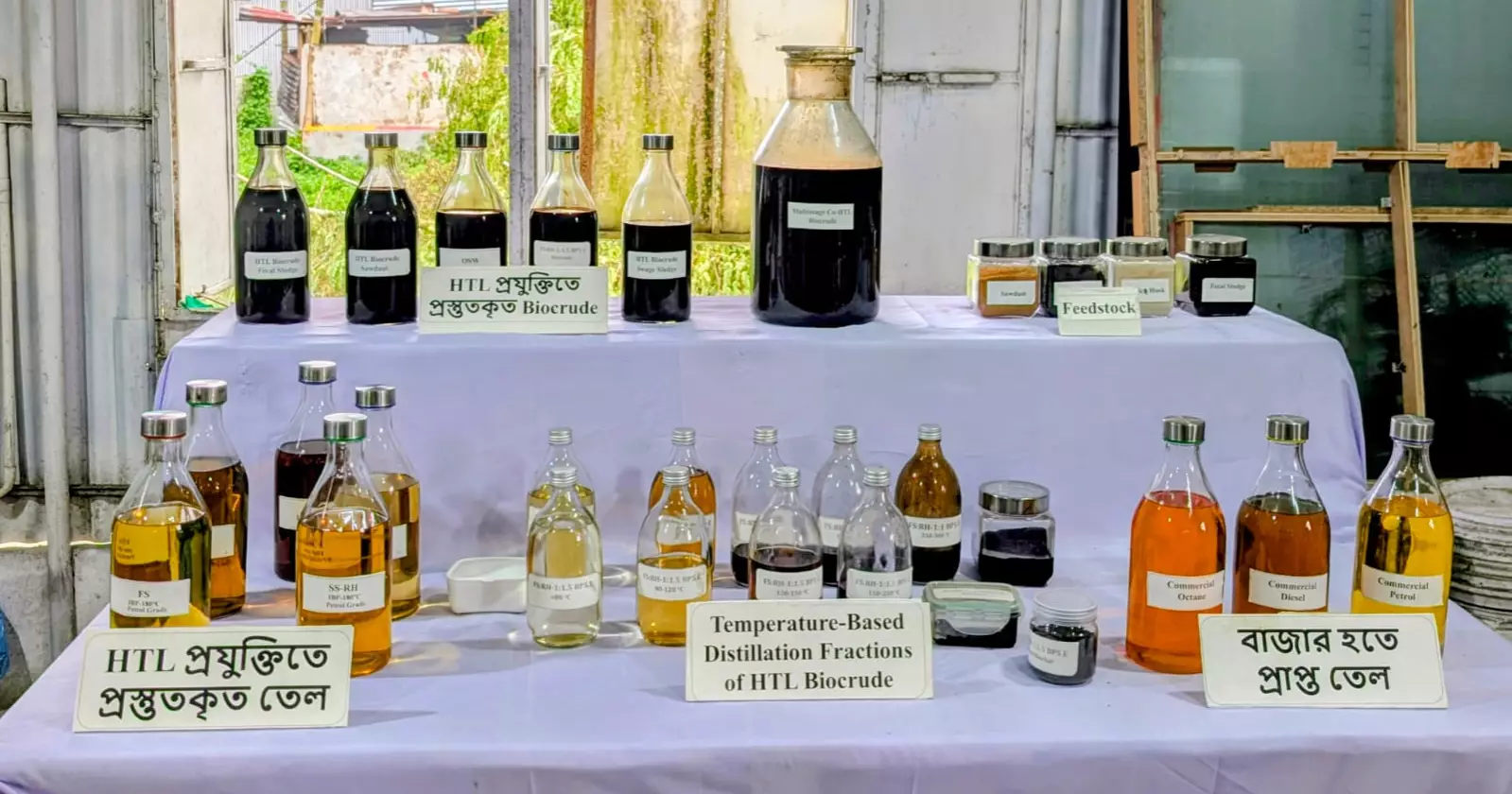
Researchers at Khulna University of Engineering & Technology (KUET) have unlocked the potential to produce fuel oil, coal, and liquid fertilizer from human waste.
With their developed technology, it is possible to process one ton of human waste to produce approximately 60 to 70 liters of fuel oil and 45 to 50 kilograms of coal. The researchers also stated that liquid fertilizer can be produced through the same process by recovering nitrogen, phosphorus, and organic components from the waste followed by necessary purification.
The research team claims that no part of the waste remains unusable in this technology. As a result, alongside human waste management, opportunities are being created for the production of energy and agricultural inputs. They view this research as a "zero-waste technology."
Led by Dr. Md. Khalekuzzaman, Professor of the Department of Civil Engineering at KUET, the research has been conducted continuously since March 2016. Although the work initially began as academic research, it later became more structured and evolved into the "Sludge to Oil" project. The project officially commenced in April 2022.
During the formal research phase of the "Sludge to Oil" project, the primary government funding agency was the Bangladesh Energy and Power Research Council under the Ministry of Power, Energy and Mineral Resources. The budget for this project was approximately 20.7 million BDT (2 crore 7 lakh taka).
In addition, two projects titled "Sludge to Asphalt" and "Multi-Stage Co-HTL" were implemented with funding from ITN-BUET and the Bill & Melinda Gates Foundation. Conducted from 2023 to 2025, the total budget for these projects was approximately 4.3 million BDT (43 lakh taka).
Currently, the research is being conducted on a broader scale under the "Bangladesh Biorefinery and Biocrude Innovation Centre." It is operating under sub-project number 13733 of the Higher Education Acceleration and Transformation Project of the University Grants Commission. The Higher Education Acceleration and Transformation Program is jointly funded by the Government of Bangladesh and the World Bank.
The current project has a budget of approximately 56.7 million BDT (5 crore 67 lakh taka) and a tenure running until June 2028. Furthermore, the researchers mentioned that discussions are underway with the Bangladesh Energy and Power Research Council regarding another project worth approximately 50 million BDT (5 crore taka) for laboratory development.
How Much Oil per Ton of Waste
Through the technology developed by the researchers, human waste is processed under high temperature and pressure to be converted into bio-crude oil. Waste drying is not required in this process; consequently, wet human waste can be processed directly.
According to the data provided by the researchers, it is possible to obtain approximately 60 to 70 liters of fuel oil from every ton of human waste. From the same amount of waste, about 45 to 50 kilograms of coal can also be produced.
However, the process is not limited to oil and coal production alone. After separating the oil and solid fraction, it is possible to recover nitrogen, phosphorus, and various organic compounds from the remaining aqueous phase. Following necessary purification, there is an opportunity to use these elements to produce liquid fertilizer.
In other words, after processing one ton of human waste, there is the potential to obtain fuel oil on one hand, and coal as well as liquid fertilizer from the aqueous phase on the other. In the words of the researchers, the entire process is designed in such a way that no major portion is discarded as waste again.
The initial economic analysis by the researchers also presents an encouraging outlook. According to data from the current experimental stage, they estimate that if production is scaled to a commercial level, it may be possible to keep the production cost per liter of fuel oil under 100 BDT.
However, this is not yet the final commercial production cost. The actual cost will be determined after long-term production in a pilot plant, taking into account large-scale production, raw material collection, transportation, electricity and heat demand, machinery costs, and other operational expenses.
According to the researchers, if approximately 25 to 50 percent of the country's suitable waste can be brought under this technology, it could contribute to meeting an estimated 10 to 30 percent of national energy demand.
Along with reducing dependence on fuel imports, this holds the potential to save foreign currency equivalent to approximately 65 billion to 130 billion BDT (6,500 crore to 13,000 crore taka) annually.
Nonetheless, this calculation will depend on how much waste can be collected nationwide, how much of it can be brought under the technology, and how efficiently commercial-scale production can be executed.
From Laboratory to Pilot Plant
As an essential next step in the research, plans are in place to establish a continuous pilot plant capable of processing 1 to 3 tons of waste per day. Based on the researchers' current estimates, an investment of approximately 1 billion to 1.2 billion BDT (100 to 120 crore taka) may be required to set up such a commercial-standard plant.
Once this plant is established, the technology will be operated continuously for 12 to 18 months to verify its efficacy. At the same time, production costs, energy efficiency, safety, equipment durability, and regular operational capacity will be tested.
The researchers' blueprint also includes a mechanism to preheat the waste using solar thermal energy prior to processing. Through this, a portion of the heat required in the production process can be supplied from a renewable source. As a result, there is potential to further reduce overall production costs and energy demand.
In the long run, large-scale commercial plant designs and investment plans will be formulated based on the results of the pilot plant. If successful, opportunities could emerge to establish such plants across various regions through public-private partnerships (PPP) and private investments.
From Waste to Wealth
Enormous amounts of human waste, sewage treatment plant sludge, kitchen waste, and agricultural residues are generated daily in Bangladesh. If a large portion of this waste is not managed properly, it poses grave risks to the environment and public health.
The technology developed by the researchers utilizes that very waste as raw material. Alongside producing fuel oil and coal from human waste, the opportunity to generate agricultural liquid fertilizer from its aqueous portion creates the prospect of obtaining multiple products from the same waste source.
According to the researchers, if the technology succeeds at a commercial scale, it will alleviate waste management pressure on one hand and open up opportunities for local energy production on the other. Concurrently, it holds the potential to create new employment, advance domestic machinery and engineering industries, and foster a new waste-based industrial sector.
Nevertheless, the researchers emphasize that moving from laboratory- and experimental-stage success to the commercial level requires more long-term testing. In particular, ensuring continuous large-scale production, determining actual production costs, verifying fuel quality, maintaining safety standards, and securing reliable raw material supply chains are now the most vital tasks.
The "Made in Bangladesh" Hydrothermal Liquefaction (HTL) technology developed by KUET researchers shows the path toward converting human waste into a promising domestic source of fuel and agricultural inputs. Developed through local talent and engineering expertise, this technology, if commercially successful, can contribute to waste management, reduce reliance on energy imports, generate employment, and drive local industrial growth. What is needed now is to test production costs, fuel quality, and safety in a continuous pilot plant to advance the technology toward a large-scale reality.