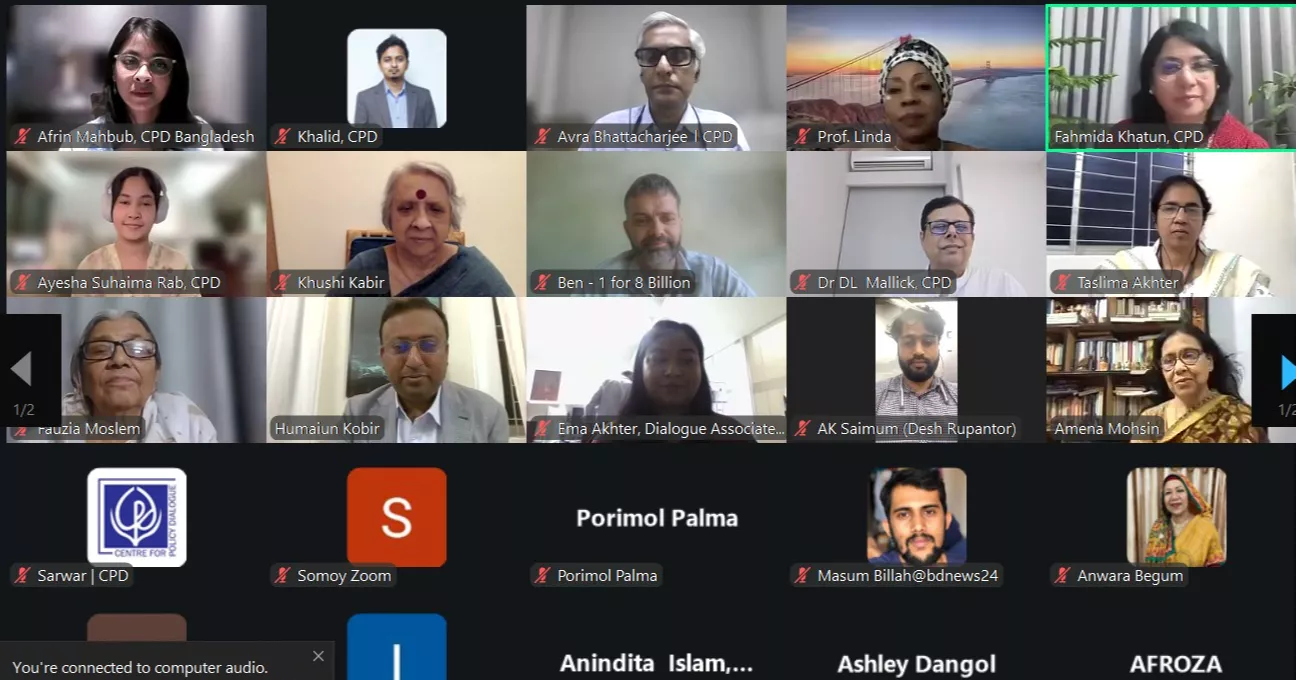
Referring to Bangladesh's experience with the Rohingya crisis, Prime Minister's Adviser on Foreign Affairs Humaiun Kobir on Tuesday emphasised that future UN leadership must be capable of protecting the interests of all countries - large and small, developed and developing alike.
Speaking at a virtual discussion, he said the world is experiencing one of the most complex periods since the establishment of the United Nations.
Bangladesh seeks stronger UN support for peacekeeper, police deployments
The Centre for Policy Dialogue (CPD), in collaboration with Southern Voice and the 1 for 8 Billion campaign, organised the virtual discussion titled "Rethinking UN Leadership in a Fragmented World: A Bangladesh-Centred Perspective."
The panellists included international affairs expert Dr Amena Mohsin; Shaheen Anam, Executive Director of Manusher Jonno Foundation; Taslima Akter Lima, President of Bangladesh Garments Sramik Sanghati; Fauzia Moslem, President of Bangladesh Mahila Parishad; and Khushi Kabir, Member of the CPD Board of Trustees and Coordinator of Nijera Kori. CPD Executive Director Dr Fahmida Khatun chaired the session.
The event called for a more transparent, inclusive and accountable UN leadership selection process capable of responding effectively to the complex challenges of the twenty-first century.
The speakers said the UN Secretary-General selection process should be transparent, merit-based and less influenced by powerful states.
The discussion focused on the qualities, priorities and principles that should shape future UN leadership, particularly ahead of the selection of the next UN Secretary-General.
The Adviser stressed that the next UN Secretary-General must possess integrity, independence, professional excellence, diplomatic skills and moral authority to engage with all Member States while remaining committed to the principles of the UN Charter.
He also underscored the need for an open, merit-based, accountable and participatory selection process to strengthen both the legitimacy of the Secretary-General and the credibility of the United Nations.
The Adviser noted that the current process, under which the Security Council recommends a single candidate to the General Assembly, does not provide sufficient choice or scrutiny.
He suggested that the Security Council prepare a shortlist of candidates for the General Assembly to vote on so that the final selection reflects merit, credibility and experience.
The next UN Secretary-General will inherit a world marked by overlapping crises, including geopolitical fragmentation, armed conflict, climate emergencies, humanitarian displacement, debt distress, technological disruption and declining trust in multilateral institutions.
At this critical juncture, the selection of the next UN leader is not only about choosing an individual; it is also about determining whether the United Nations can become more representative, accountable and responsive to the needs of all countries, particularly those of the Global South.
Dr Fahmida chaired the session and said that although the discussion focused on leadership, the issue was much broader as it concerned the future of multilateralism itself.
She noted that the forthcoming selection of the next UN Secretary-General is not merely about choosing an individual but also about reflecting on how the institution itself can become more representative, accountable and effective.
Dr Fahmida stressed that a transparent and merit-based selection process, stronger accountability, institutional independence and greater responsiveness to vulnerable communities are essential if UN leadership is to deliver meaningful change.
In her keynote presentation, CPD Research Associate Afrin Mahbub noted that the current UN Secretary-General selection process remains heavily influenced by the five permanent members of the Security Council, with limited transparency beyond the publication of candidates' names and vision statements.
She pointed out that no woman has ever served as UN Secretary-General, while women remain underrepresented across the UN system.
Using Bangladesh as an analytical lens, she observed that women's representation remains limited despite the country's long history of female political leadership, and that symbolic representation does not automatically translate into substantive influence.
Drawing on civil society perspectives from Bangladesh, she emphasised that gender representation is necessary but not sufficient; it must be supported by institutional reform, accountability, inclusive governance and genuine decision-making power.
Adviser to the 1 for 8 Billion campaign Ben Donaldson said the nomination phase was nearing completion, but uncertainty remained because of the influence of the permanent members of the Security Council.
He also warned that backroom deals over senior UN appointments undermine transparency across the wider UN leadership system.
During the open-floor discussion, participants raised questions about how the next UN Secretary-General could represent the interests of both major powers and vulnerable developing countries facing climate change, debt, inequality and forced displacement.
The speakers reiterated the need to democratise the United Nations by strengthening the role of the General Assembly and amplifying the voices of Asia, Africa, Latin America and the wider Global South.
Concluding the session, Dr Fahmida said future UN leadership requires not only diplomatic skill but also moral authority, independence and the ability to navigate evolving geopolitical realities.