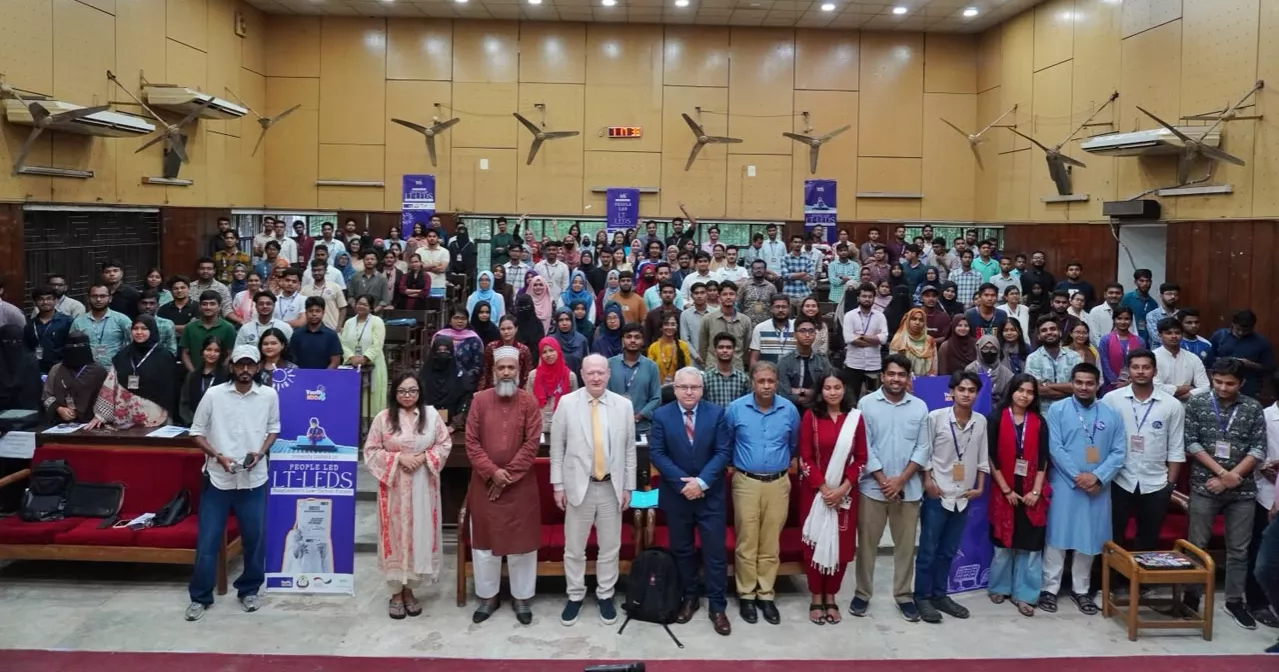
German Ambassador to Bangladesh Dr Rüdiger Lotz has called for a whole-of-society approach to support Bangladesh’s long-term low-carbon and climate-resilient development, stressing the importance of government, businesses, communities and young people working together to shape the country’s future.
He made the remarks while speaking at the "University Dialogue on People-led LT-LEDS: Bangladesh’s Low Carbon Future", held at Shahjalal University of Science and Technology (SUST) on Monday.
The dialogue was organised by Youth for NDCs (Nationally Determined Contributions) and supported by the German Embassy in Dhaka, with DSS as the campus partner, said a media release issued on Monday.
Dr Lotz said Bangladesh is on track to become one of the world’s 20 largest economies in the coming decades, and its diversifying economy will significantly increase energy demand.
Referring to the current energy crisis, he said that it has shown the risks of dependence on external shocks, while noting that rooftop solar is increasingly being discussed as part of the energy transition.
He emphasised that young people must be central to this process.
“Young people will live with the consequences of today’s decisions and will soon be in positions to shape the future,” he said, adding that climate education and capacity building should start from schools and local levels.
The Ambassador said Bangladesh bears the least historical responsibility for climate change but faces serious climate impacts.
He reaffirmed Germany’s commitment to working with Bangladesh through financing, technology, capacity building and cooperation on clean energy to build a more resilient future.
The dialogue brought together around 220 students and young people to discuss Bangladesh’s long-term low-emission development pathway, with a particular focus on technology, innovation and data systems.
Participants explored how climate data, renewable energy research, digital innovation, life sciences, youth entrepreneurship and university-led evidence can contribute to Bangladesh’s future LT-LEDS(Long-term Low Emission Development Strategies) process.
The expert panel discussion, titled “Powering Bangladesh’s Low-Carbon and Climate-Resilient Future through Technology, Innovation, and Data Systems,” featured Ulrich Klepmann, Head of Development Cooperation, German Embassy Dhaka; Dr. Md. Amdadul Haque, Associate Professor, Department of Political Studies, SUST; Dr. Md. Faruque Miah, Dean, School of Life Sciences, SUST; and Farah Anzum, Country Lead, Global Strategic Communications Council.
The panelists called for a dedicated high-level technical committee on LT-LEDS and discussed the role of data systems, university research, renewable energy innovation, governance, biodiversity, ecosystem evidence and youth-led climate solutions in shaping Bangladesh’s long-term development pathway.
Speaking at the event, Amanullah Porag, Executive Director of Youth for NDCs, said Bangladesh’s LT-LEDS cannot be limited to a technical document prepared in closed rooms.
“It has to reflect the knowledge of universities, the realities of communities, the ambition of young people and the development choices Bangladesh must make for 2050,” he said. “For a country like Bangladesh, long-term low-carbon development is not only about reducing emissions; it is about energy security, jobs, competitiveness, resilience and justice.”
As part of the dialogue, participants worked in four thematic groups: Climate Data and Evidence-Based Planning; Renewable Energy and Smart Energy Systems; Digital Innovation, Green Jobs and Youth Entrepreneurship; and Life Sciences, Nature and Climate Resilience. Each group identified gaps, challenges and solutions, and developed concrete recommendations for Bangladesh’s long-term low-carbon development planning.
The recommendations generated from the SUST dialogue will feed into the broader People-led LT-LEDS recommendations report, which aims to bring youth, academic and stakeholder perspectives into Bangladesh’s long-term climate and development planning process.