Bangladesh is planning a major overhaul of its healthcare system by shifting its focus from treatment to prevention, with a proposal to establish a primary healthcare unit in every union and urban ward and recruit 100,000 new community health workers, Dr S.M. Ziauddin Hyder, Special Assistant to the Prime Minister on Health Affairs, said on Monday.
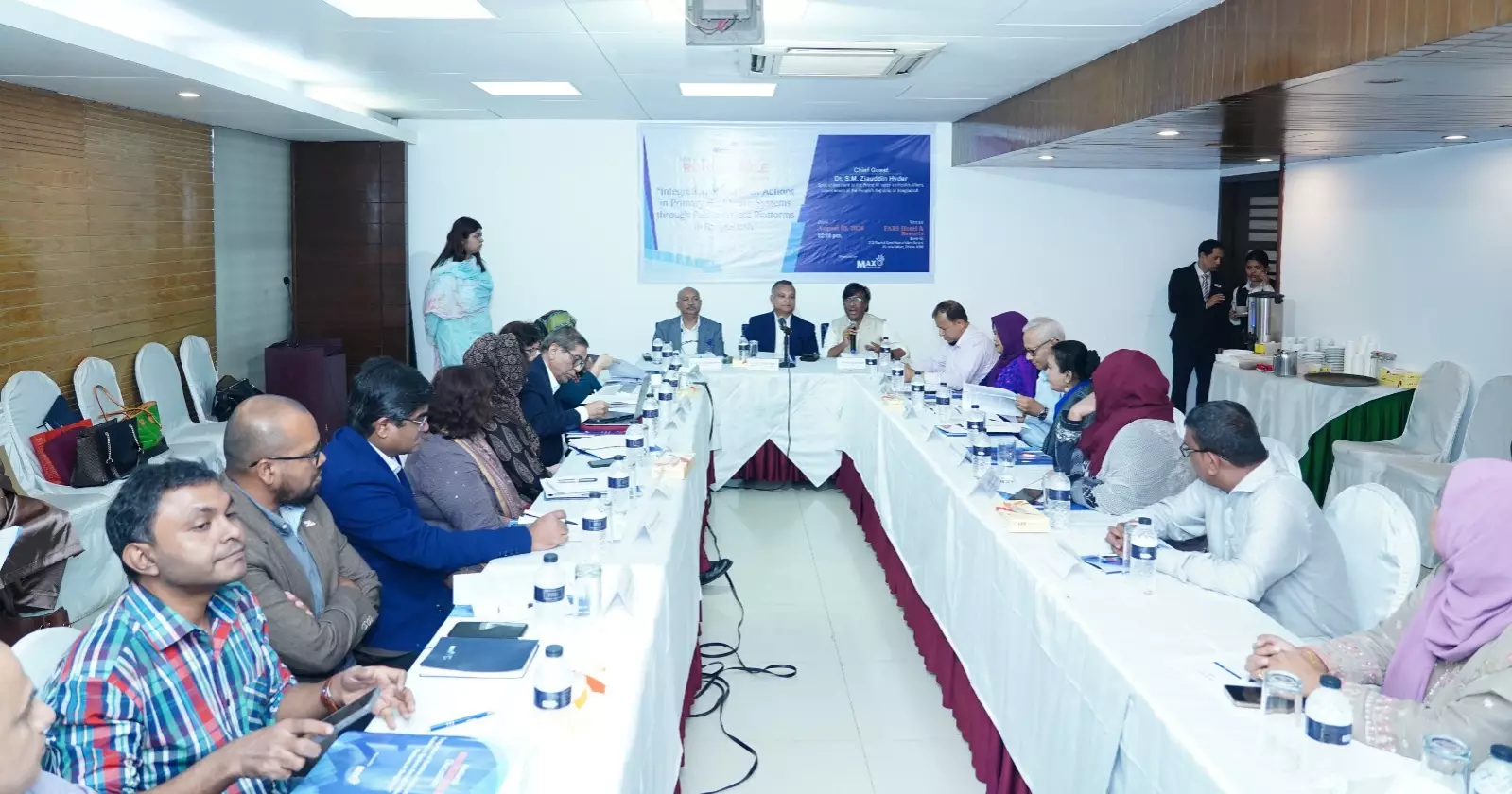
The remark came at a national roundtable titled "Integration of Nutrition Actions in Primary Healthcare Systems through Public-Private Platforms in Bangladesh," organised by Max Foundation Bangladesh in Dhaka.
He said Bangladesh's nutrition policies had historically lacked strong government ownership and had largely been driven by development partners and donors.
"We have made progress in reducing malnutrition and stunting, but the pace has not been sufficient. We need a stronger, government-led and coordinated approach," he said.
Dr Hyder said the government aims to ensure that every citizen has access to preventive healthcare services at their doorstep through a nationwide primary healthcare network.
Under the proposed plan, each union and every ward in city corporations and municipalities will have a Primary Healthcare Unit staffed by nine community health workers.
Currently, around 43,000 frontline health workers are serving under different government health programmes. The government plans to recruit another 100,000 workers, creating a workforce of around 143,000, while estimates suggest that about 152,000 workers will ultimately be required nationwide.
The community health workers will visit households every two to three months to provide preventive healthcare services, including blood pressure and blood sugar screening, mental health assessments, child growth monitoring, pregnancy detection and referrals to healthcare facilities when necessary.
The programme will also introduce digital health cards and an electronic referral system to connect citizens with integrated health information and healthcare facilities.
Dr Hyder said the initiative would help detect diseases at an early stage, reduce out-of-pocket healthcare expenditure and ease the pressure on overcrowded secondary and tertiary hospitals.
He stressed that nutrition should not be treated as a standalone health intervention but integrated across agriculture, education, social welfare and other sectors through a coordinated national approach.
To strengthen coordination, the government is considering establishing a high-powered National Food and Nutrition Authority or National Food and Nutrition Commission to oversee nutrition-related policies and ensure effective inter-ministerial collaboration.
The proposed body would coordinate nutrition-sensitive interventions across ministries, monitor implementation, generate evidence and strengthen institutional capacity.
Calling for collective action, Dr Hyder said achieving better nutrition outcomes would require close collaboration among the government, academia, civil society, development partners, NGOs and the media.
"We want to build a healthier Bangladesh where no child suffers from stunting and no girl is forced into early marriage and early motherhood," he said.
The discussion brought together senior government officials, representatives of UN agencies and development partners, researchers, academics, civil society members and private sector stakeholders to explore ways to integrate nutrition services into routine primary healthcare.
Experts said Bangladesh is currently facing a triple burden of malnutrition—undernutrition, micronutrient deficiencies and a growing prevalence of overweight and obesity. Although the country has made notable progress in reducing child stunting and improving maternal and child health, nutrition services remain fragmented and are often delivered through vertical programmes rather than as an integral part of primary healthcare.
The discussants underscored the need for stronger public-private partnerships to improve service delivery, strengthen referral systems, enhance supply chains, promote behaviour change and generate evidence to support policy formulation.
They also emphasised the importance of institutionalising community-based nutrition interventions within government systems to improve the quality, accessibility and sustainability of primary healthcare services.
The roundtable called for stronger coordination among government agencies, development partners, research institutions, civil society organisations and the private sector to ensure nutrition is recognised as a core component of primary healthcare and national health planning.
Prof Dr Pravath Chandra Biswas, Director General of the Directorate General of Health Services (DGHS), attended the programme as the special guest. The keynote paper was presented by Saiqa Siraj, Public Health and Nutrition Specialist, while the session was chaired by Dr ATM Tariqul Islam, Country Director of Max Foundation Bangladesh.
Senior officials from the Health Services Division, the Institute of Public Health Nutrition (IPHN), DGHS, Dhaka University, icddr,b, BRAC James P Grant School of Public Health, GAIN, WHO, UNICEF, Social Marketing Company and other organisations also participated in the discussion.