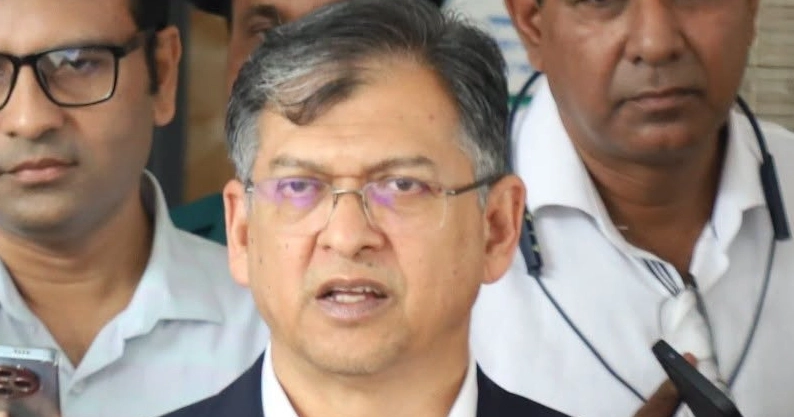
Home Minister Salahuddin Ahmed on Tuesday informed Parliament that the government continued all possible legal, diplomatic and international police efforts to bring former Inspector General of Police (IGP) Benazir Ahmed back to Bangladesh.
He made the statement in response to a resolution adopted by the House on September 8 on a motion placed by opposition lawmaker Mir Ahmad Bin Quasem under Rule 147 of the Rules of Procedure during the third session of the 13th Jatiya Sangsad.
In his statement, Salahuddin said the issue was sensitive and involved public interest, and the government had taken necessary steps while fully respecting the rule of law, justice and appropriate international and diplomatic procedures.
After a competent court in Bangladesh issued an arrest warrant for Benazir, the government initiated the process of issuing an Interpol Red Notice against him. An Interpol Red Notice was subsequently issued against him on April 11, 2025, he said.
The minister informed the House that on June 12, 2026, the National Central Bureau (NCB) Abu Dhabi formally informed NCB Dhaka that Benazir had been arrested in the United Arab Emirates. “At the same time, the UAE requested Bangladesh to send a formal extradition request through diplomatic channels within 30 days.”
“Without waiting until the deadline, the Bangladesh government sent a formal extradition request to the UAE Central Authority through diplomatic channels on June 16, 2026, just four days after receiving the information,” he said.
Salahuddin said a copy of the request was also sent to NCB Abu Dhabi on the same day for information and coordination.
He explained that extradition was a judicial and state-level process and could not be completed automatically through an Interpol Red Notice or merely because a person had been arrested.
The minister said the central authority and courts of the country receiving an extradition request examined it under their domestic laws, considering the nature of the offences, arrest warrant, evidence and other legal requirements before making a decision.
Salahuddin said the Anti-Corruption Commission (ACC) had sent Mutual Legal Assistance Requests (MLARs) to the relevant countries seeking information on assets held abroad in the names of Benazir and his family members.
Subject to receiving the necessary records, information and evidence, further legal steps would be taken to freeze, seize, confiscate or recover the assets in accordance with applicable laws, court orders and international legal cooperation frameworks, he said.
The minister said the granting of bail to a person did not mean the termination of extradition proceedings.
“Similarly, the need to complete certain legal and judicial procedures for extradition should not be considered government inaction or failure,” he said.
Salahuddin said Bangladesh had sent the extradition request within the stipulated timeframe, provided additional documents as required by the UAE, appointed local lawyers and continued regular inquiries and coordination regarding Benazir's whereabouts and movements.
He reiterated the government's commitment to the rule of law, proper judicial procedures and international cooperation.
On June 14 last, Salahuddin told Parliament that Benazir had been arrested in Dubai by the UAE police in connection with a case filed by the ACC.
However, the former police chief later secured bail from a court there.