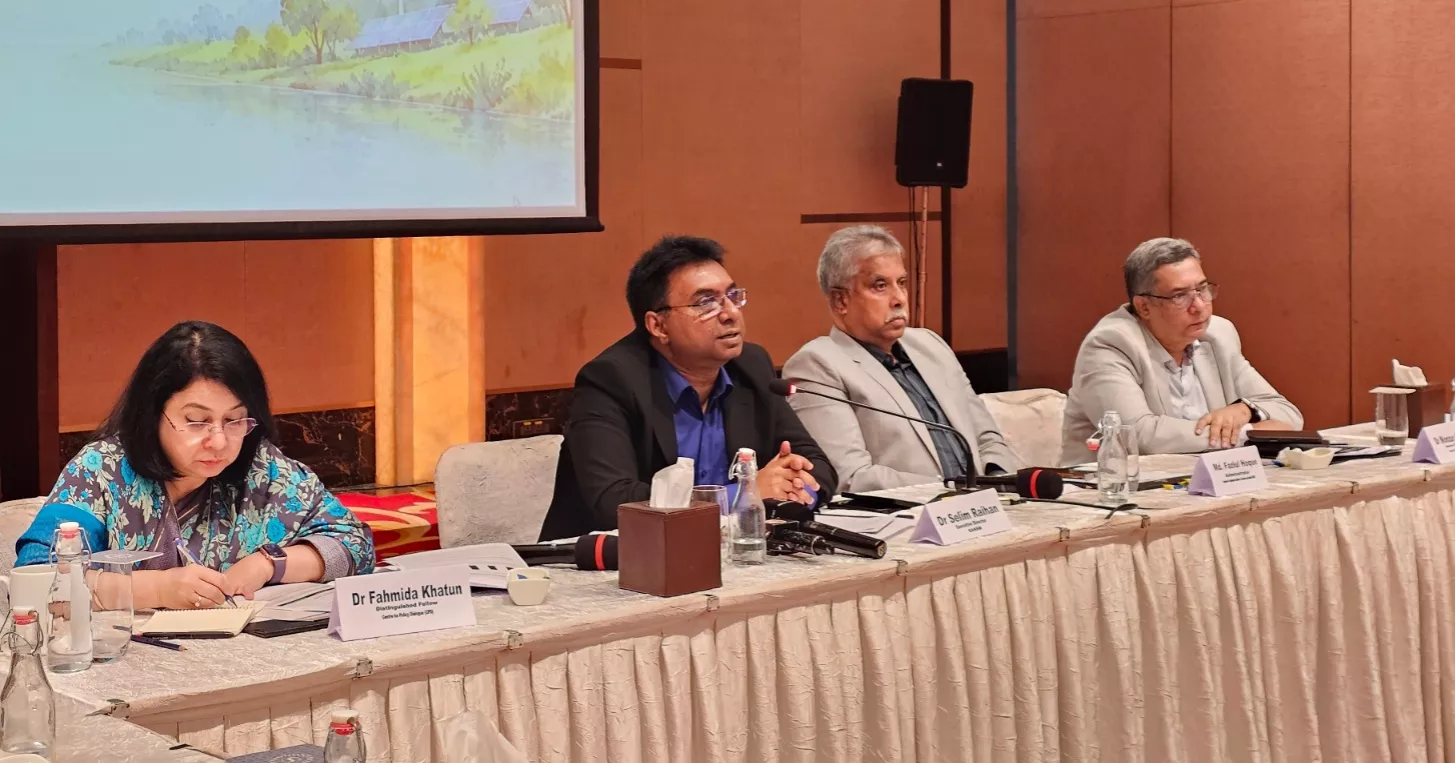
Bangladesh must make green growth central to its development strategy to secure energy supplies, protect macroeconomic stability and stay competitive in global markets, speakers said at a policy dialogue in the capital on Tuesday.
The South Asian Network on Economic Modeling (SANEM) organised the dialogue at a city hotel.
In his keynote presentation, SANEM Executive Director Selim Raihan, also a professor of economics at the University of Dhaka, outlined the economic case for green growth.
He pointed to the risks of dependence on fossil fuels, bottlenecks in the renewable energy supply chain, and the need to align international climate commitments, including Nationally Determined Contributions (NDCs), with domestic development priorities.
Selim Raihan stressed the need for consistent policy definitions, common sectoral milestones and effective implementation mechanisms.
A high-efficiency transition, he argued, could support economic growth and private consumption while reducing reliance on petroleum, gas and coal, provided its distributional effects are addressed.
Distinguished Fellow at the Centre for Policy Dialogue (CPD) Fahmida Khatun called for inclusive development and a just transition.
She said global climate finance remains skewed towards mitigation, with about 65 percent going to mitigation and only 35 percent to adaptation.
Fahmida called for stronger international financial and technological support, along with the domestic capacity to put those resources to effective use.
Federation of Bangladesh Chambers of Commerce and Industry (FBCCI) Administrator Fazlul Hoque said energy options should be judged on affordability, availability and scalability.
Solar power is drawing wide attention, he noted, but land constraints remain a challenge.
Fazlul cited the failure over two decades to set up a central effluent treatment plant for the leather sector as an example of weak policy implementation.
Consumers Association of Bangladesh (CAB) President AHM Shafiquzzaman highlighted the high upfront cost of rooftop solar.
Installing a 1 MW system under a capital expenditure model, he said, could require an investment of about Tk 6-8 crore, calling for addressing financing and operational challenges alongside installation costs.
Member (Secretary) of the General Economics Division of the Planning Commission Monzur Hossain expressed optimism about meeting the target of generating 20 percent of electricity from renewable sources, equivalent to about 6,000 MW, by 2030.
He highlighted the potential of rooftop solar and called for accessible green finance, training and capacity development to support micro, small and medium-sized enterprises (MSMEs).
Director (Innovation) at the Bangladesh Energy and Power Research Council (BEPRC) Hasan Mahmud underscored energy efficiency, conservation and local technological innovation.
Project Economist at UNDP Bangladesh Meheruna I Chowdhury linked green growth to trade competitiveness.
She stressed the need to prepare businesses for evolving international requirements, including the European Union's Carbon Border Adjustment Mechanism (CBAM).
The discussion also touched on the quality of solar panels and inverters, barriers to net metering, solar irrigation and grid integration.
Speakers said better access to climate finance, public awareness and technical support, together with effective implementation of renewable energy policies, would be key priorities for a sustainable transition as Bangladesh approaches LDC graduation.
In his concluding remarks, Selim Raihan called for a broader industrial policy framework that encourages investment in green activities and helps new businesses navigate institutional and bureaucratic barriers.
The dialogue underscored the need to align green growth with Bangladesh's development ambitions through coordinated policies, sustainable financing, technological innovation and stronger institutional capacity.