Humanitarian actors have called for effective implementation of the 'Grand Bargain' commitments in Bangladesh, stressing localization, equitable partnerships, quality funding for local and national actors, and accountability to affected populations.
They also expressed concern over the limited progress in localization, saying direct funding continued to reach only a small number of local non-governmental organizations (NGOs), despite existing commitments.
The Grand Bargain was adopted at the World Humanitarian Summit in Istanbul in May 2016 to get more financial and operational resources directly into the hands of people in need and to make global humanitarian action more effective and efficient.
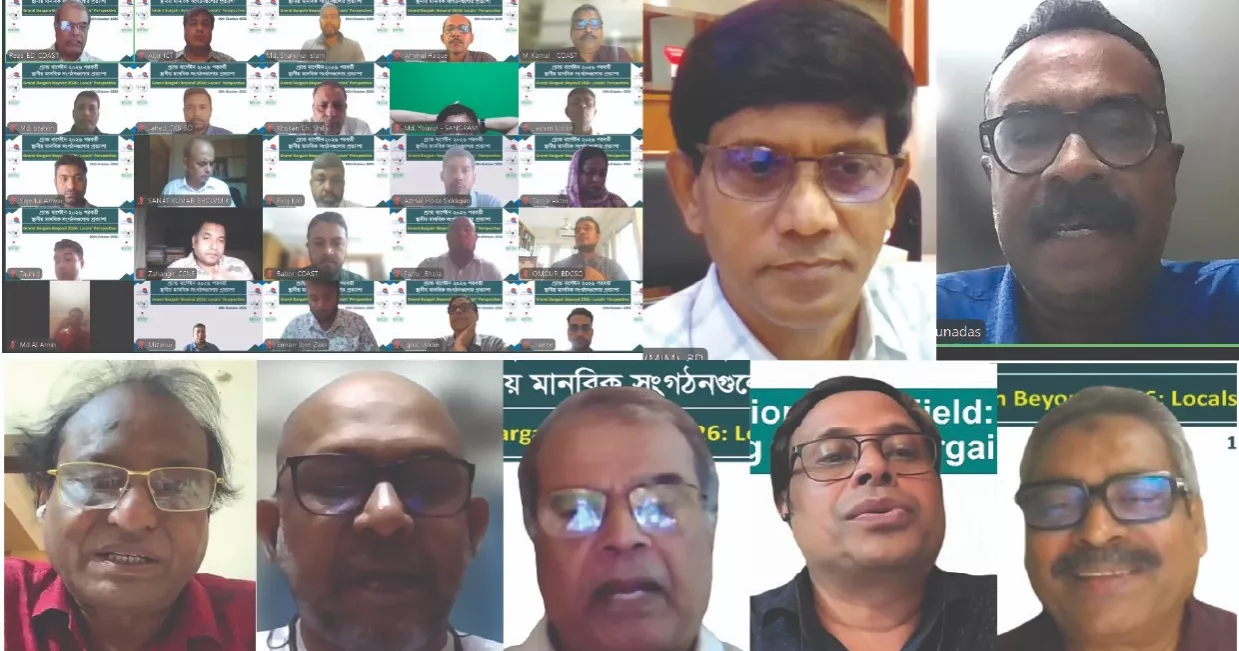
The concerns were raised at an online seminar titled “Grand Bargain beyond 2026: Locals’ Perspective,” organized on Saturday by COAST Foundation, BDCSO COAST and the Cox’s Bazar CSO-NGO Forum (CCNF).
Presenting the keynote paper, Md. Iqbal Uddin of BDCSO COAST said the current funding and coordination arrangements in the Rohingya response raised serious questions about the implementation of localization commitments.
He said United Nations agencies led all eight major sectors in the Rohingya response coordination structure, while one sector was co-led by an international NGO (INGO). No sector was led by a national or local NGO.
According to the 2026 Joint Response Plan (JRP) funding figures presented at the seminar, UN agencies received 87.96% of the funding, INGOs 7.78% and national NGOs 4.26%, with no allocation reported for local NGOs.
Netai Chandra Dey Sarkar, Director (MIM) of the Directorate of Disaster Management, who attended the seminar as the chief guest, emphasized capacity exchange rather than blaming local organizations and called for stronger capacity development and at least 25% direct funding for local NGOs.
Rezaul Karim Chowdhury, Executive Director of COAST Foundation, who chaired the session, said UN agencies and INGOs should focus on facilitation, while local NGOs should play a leading role in implementation.
Clarence Sutharshan, Country Director of Tearfund, reaffirmed the organization's commitment to locally led humanitarian responses and strengthening the capacities of local actors.
Md. Abdul Alim of ActionAid Bangladesh said some UN agencies provided funding through intermediary organizations and described this as localization. He called for a country-level definition of localization that clearly establishes the respective roles of UN agencies, INGOs and local NGOs.
Md. Zahangir Alam raised concerns over the concentration of funding by a few international agencies in one particular NGO in Cox's Bazar, which he said had 34 projects. He described the practice as favoritism, concentration and partisanship, calling for an end to funding practices that favor selected organizations over others.
M. Yousuf, Director of Sangram in Satkhira, urged civil society organizations to continue advocating for locally led responses and engage government authorities to advance localization.
Hasan Shahriar of Jago Nari in Barguna questioned the commitment of donors and INGOs to providing direct funding to local NGOs.
Md. Khalilur Rahman, Director of POPI in Dhaka, called for mapping local NGOs at the district level so donors could identify and engage them quickly during disasters. He also recommended simplifying and harmonizing due diligence procedures.
Mujibur Rahman, adviser to Shushilan in Cox's Bazar, identified the mindset of UN and INGO leadership as a barrier to localization.
Mustafa Kamal Akanda of EquityBD moderated the online seminar.
Other participants included Md. Shibly Sadick, Executive Director of SATHI in Natore, and Shibu Baidyo of Ganochetona Foundation in Satkhira, along with representatives of BDCSO and CCNF.