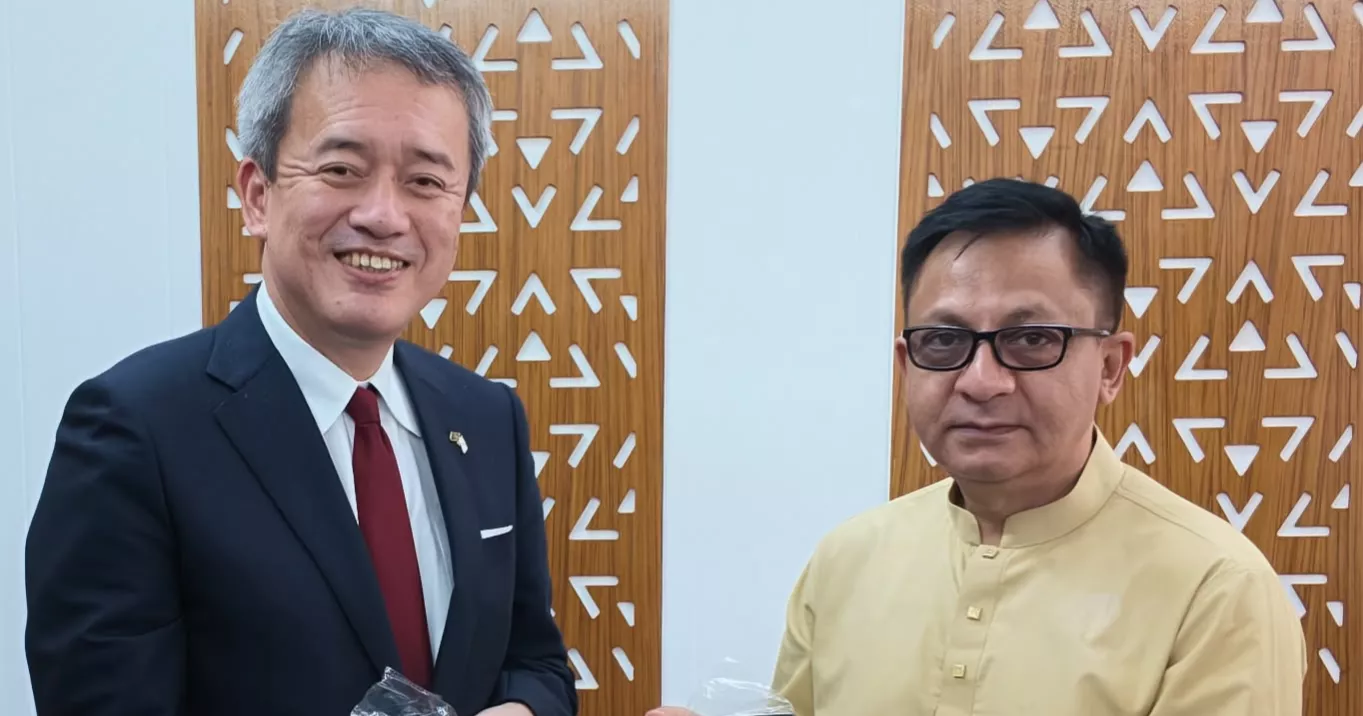
Commerce Minister Khandakar Abdul Muktadir Sunday said the government is working to simplify business procedures, remove administrative hurdles and ensure an investor-friendly environment to attract foreign investment, stressing that expanded Japanese investment could open new avenues for industrialisation, technology transfer and job creation.
"The government will extend the necessary policy and institutional support to further strengthen economic partnership with Japan," the minister said at a meeting with a delegation led by Masayuki Ōmoto, president and CEO of Japanese multinational Marubeni Corporation, at the Ministry of Commerce.
At the meeting, Marubeni expressed interest in expanding its existing investment in Bangladesh and in investing in new industrial sectors. Industries Secretary Abdun Nasser Khan was also present.
Discussions covered proposals related to fertiliser production, information technology, energy, ship recycling and the manufacture of Toyota-brand vehicles.
Progress on the signing and implementation of the Bangladesh-Japan Comprehensive Economic Partnership Agreement (CEPA), diversification of the jute sector, and prospects for expanding bilateral trade and investment also featured prominently.
Muktadir said Japanese technology, experience and investment could play a key role in the growth of Bangladesh's manufacturing industries, with scope to expand joint ventures in shipbuilding and recycling, automobiles, agro-based industries and high-tech sectors.
The government, he added, is advancing necessary reforms to make investment in these areas easier.
On jute, the minister said the sector is being steered beyond conventional products towards high-value, diversified goods. "Emphasis is being placed on developing new products by blending jute fibre with cotton, viscose and polyester, innovating improved seed varieties and expanding research."
The government wants to tap international technical cooperation and investment opportunities in this regard, he said.
Highlighting Marubeni's long-standing business involvement in Bangladesh, Ōmoto pointed to opportunities for modernising the Karnaphuli Fertilizer Company Limited (KAFCO), making effective use of natural gas and boosting fertiliser production capacity.
He also showed interest in fresh investment and technological cooperation in producing DAP and TSP fertilisers.
Citing Bangladesh's potential in information technology, the Marubeni CEO said hundreds of Bangladeshi engineers at BJIT, a joint-venture company, are serving international markets, including Japan.
He said there is scope to expand the collaboration in artificial intelligence and IT offshoring.
The meeting also discussed environmentally sound modern technology and investment in ship recycling, the proposal to manufacture Toyota vehicles, and uninterrupted power supply to economic zones. Small modular reactor (SMR) technology also came up as a possible option for long-term energy security.
The commerce minister said that alongside streamlining company registration, trade licensing and investment approval processes, the government is prioritising the repatriation of profits and capital by foreign investors.
Japanese firms interested in expanding investment in Bangladesh will receive all necessary assistance, he added.
Both sides underscored the need to deepen Bangladesh-Japan economic ties, make the most of the potential benefits of the CEPA, and expand long-term partnership in industry and technology.