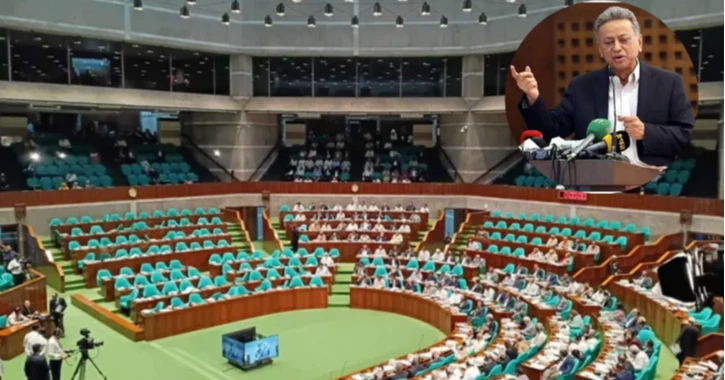
The government has proposed an allocation of Tk 136,606 crore for education and human resource development in the FY2026-27 budget, Finance Minister Amir Khosru Mahmud Chowdhury announced on Thursday.
It marks an increase of Tk 49,400 crore from the current fiscal year's allocation of Tk 87,206 crore.
Presenting the proposed budget in Parliament, the finance minister said the government is giving priority to education and health sectors to build a skilled workforce, allocating resources equivalent to 2 percent of GDP for education in FY 2026-27 budget.
He said the government plans to increase education spending to 5 percent of GDP by 2030, considering it a strategic investment for developing skilled human resources and building a knowledge-based economy.
The education allocation includes expenditures not only under the Ministry of Education and the Ministry of Primary and Mass Education, but also educational and technical institutions operated by the ministries of Textiles, Railways, Defence, Agriculture, Fisheries, and Information and Communication Technology.
To expand opportunities for overseas higher education, the government has proposed launching a new student loan programme under which students will be eligible for easy loans of up to Tk 10 lakh, and repayment will begin after graduates enter employment.
The government has also assured that the facility will be provided without administrative harassment.
Amir Khosru said students proficient in a third foreign language, in addition to Bangla and English, will receive priority in obtaining the overseas education loans.
As part of the broader education reform plan, the government intends to introduce special language courses from Class VI in Japanese, Korean, Mandarin, Arabic, French and German.
The finance minister said the government views overseas education not as “brain drain” but as “brain circulation,” which can contribute to remittance growth and the development of a skilled workforce in the future.
In his budget speech, he said special emphasis will be placed on technical and vocational education, third-language instruction, sports and cultural development, technology-enabled learning and the concept of “Learning with Happiness”.
Under the proposed framework, students would be able to establish themselves with equal dignity and success as skilled craftspeople, technologists, agricultural entrepreneurs, researchers, artists, teachers, businesspeople or in any other profession of their choosing.
He announced plans to strengthen merit-based scholarship programmes and provide school uniforms, shoes and school bags to students from poor families.
The government will also ensure inclusive education for children with disabilities and special needs through specialised assistive technology and educational materials.
A Mid-Day Meal Programme will be introduced and gradually expanded across the country to address students’ nutritional needs and support their health.
In addition, healthcare services will be strengthened in educational institutions, with particular attention to sanitation and hygiene facilities for female students and women teachers.
As part of efforts to establish a technology-driven education system, the government plans to implement the “One Teacher, One Tab” programme, establish multimedia classrooms, expand free high-speed Wi-Fi access, introduce a unique Edu-ID for every student, provide digital library facilities, and familiarise students with artificial intelligence, robotics, coding and digital literacy.
The finance minister said necessary steps would be taken to coordinate the various streams of education existing in the country and effectively implement equivalency of qualifications.
Improving the quality of education and standards of instruction at all levels, primary and mass education, madrasa and technical education, and secondary and higher education, remains a key priority, he said.
The government also plans to improve standards in science, mathematics, English and information technology education for madrasa students alongside religious studies.
Employment-oriented training programmes will be introduced, while efforts will be made to enhance madrasa students’ competitiveness in higher education and employment and ensure access to digital education and modern learning materials.
Highlighting the importance of teachers, Amir Khosru said teachers will remain at the centre of efforts to improve educational quality.
Regular training and retraining programmes will be ensured, while teachers’ dignity, welfare and professional development will be promoted. Special benefits will also be provided for teachers working in rural and remote areas, he added.