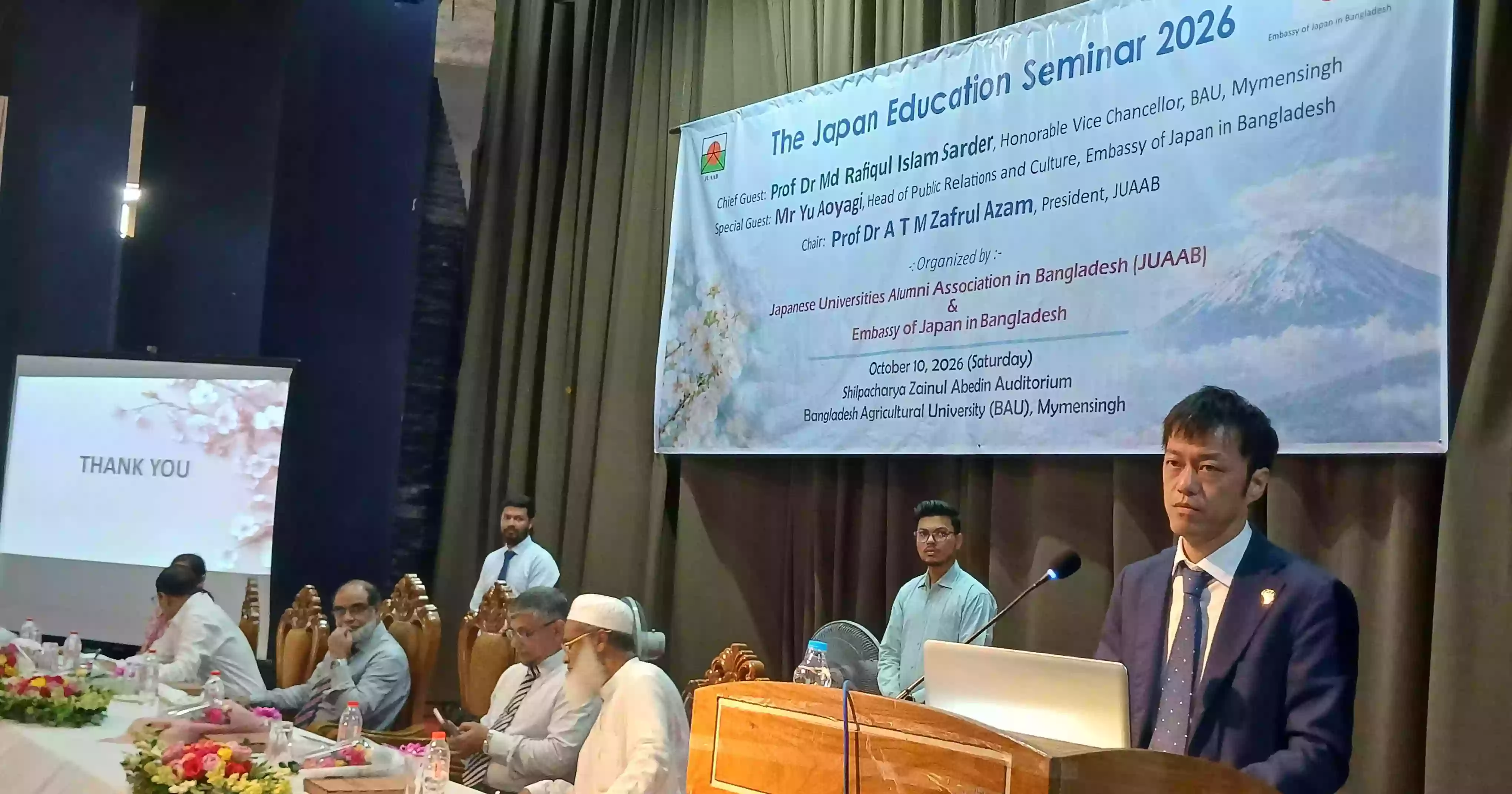
Matching a student's research field with that of the supervising professor improves the chances of securing the Monbukagakusho (MEXT) scholarship, Japan Embassy official Yu Aoyagi has said.
Mr. Aoyagi, head of the Public Relations and Culture Section at the Embassy of Japan in Bangladesh, made the remarks as a special guest at the "The Japan Education Seminar 2026" on Saturday morning.
He said seats for embassy recommendation are very few, usually around ten, making the opportunity extremely limited.
All students of the last three years were asked what the biggest factor behind their success in securing the MEXT scholarship was, he said. Most replied that their research topic matched the research field of their supervising professor.
"So we advise all students to find out which professor's research field matches their research topic," he said.
He added that "Navi Japan" can help in this regard. It will also help students understand which universities offer English-medium programmes and which universities they wish to apply to, he said.
The seminar was held at the Shilpacharya Zainul Abedin Auditorium of Bangladesh Agricultural University (BAU). It was jointly organised by the Japanese Universities Alumni Association in Bangladesh (JUAAB) and the Embassy of Japan in Bangladesh.
BAU Vice-Chancellor Prof. Dr. Md. Rafiqul Islam Sarder attended as chief guest, while JUAAB President Prof. Dr. ATM Zafrul Azam presided over the programme. Convener of the organising committee Prof Dr M Zulfikar Rahman was also present.
Prof. Azam said competition has increased as the quota for government scholarships in Japan has been somewhat reduced. However, opportunities for private scholarships and research funds are also growing, he said.
Under agreements with various universities, students are getting tuition fee waivers of 80 to 90 percent, he added.
Prof. Dr. Sarder said opportunities for higher education and research in Japan are expanding day by day. Institutional memorandums of understanding (MoUs) with various Japanese universities and a strengthening network of alumni of Japanese universities are making the path to higher education easier for Bangladeshi students, he said.
The vice-chancellor also said Japan offers diverse opportunities for higher education and research, including scholarships, at the master's, PhD and postdoctoral levels. Advanced research infrastructure, modern facilities and cultural similarities have made the country a promising destination for Bangladeshi students, he added.
He also said students should make use of opportunities to learn the Japanese language under the University Grants Commission's (UGC) third language policy. They should also increase communication with relevant teachers at Japanese universities, which will make it easier to avail higher education and research opportunities, he said.
Dr. Md. Imdadul Haque, Senior Scientific Officer of the Plant Breeding Division at the Bangladesh Institute of Nuclear Agriculture (BINA), and Dr. Md. Masud Rana, Associate Professor of the Department of Agricultural Extension Education at BAU, shared their experiences of higher education and research in Japan.
Admission requirements at different Japanese universities, the MEXT scholarship application process, preparation of research proposals, selection of supervisors, and post-study employment opportunities were discussed at the event.
Later, the speakers answered students' various queries in a question-answer session.