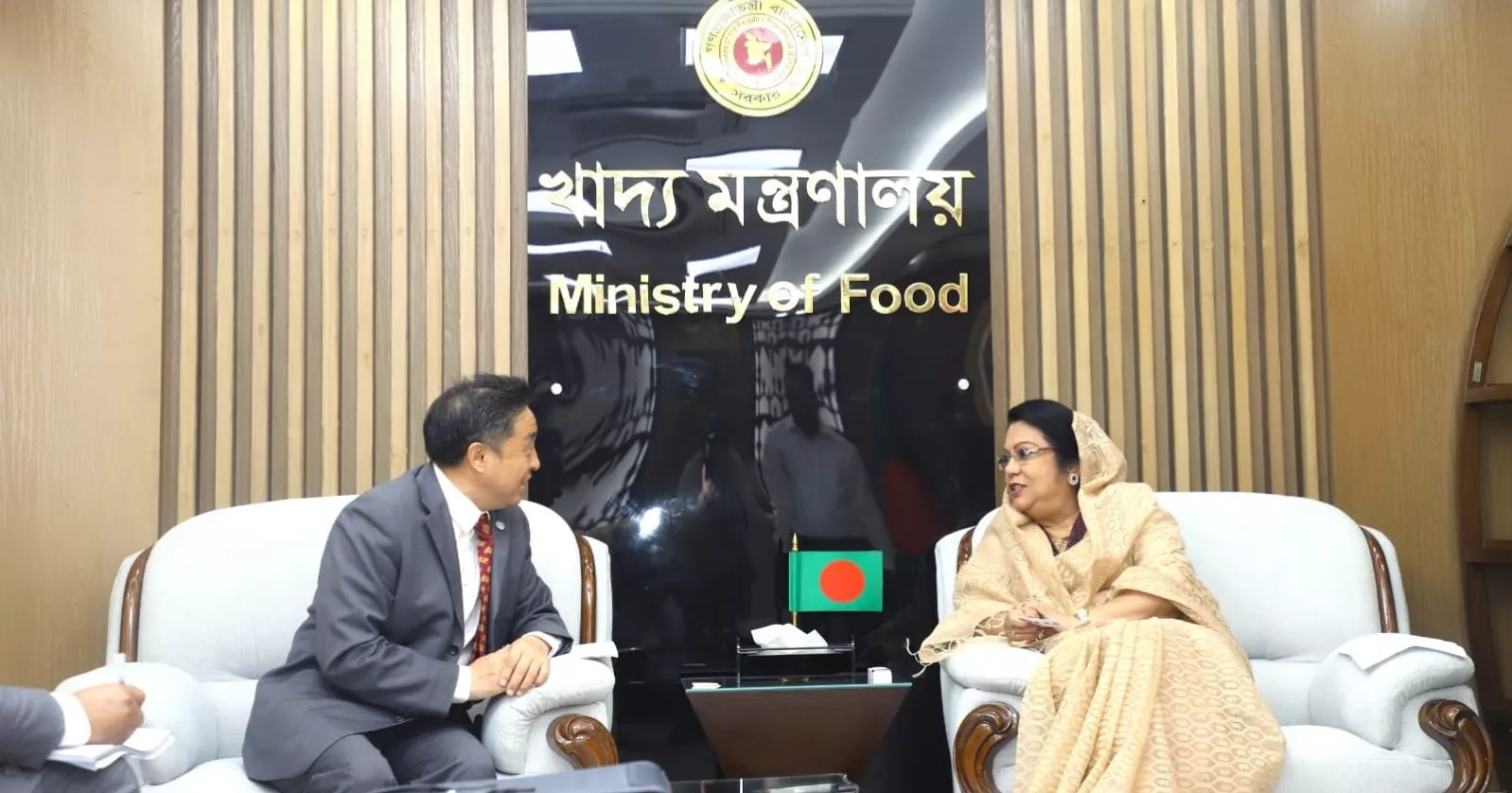
Food Minister Afroza Khanam on Tuesday sought technical and technological support from the UN Food and Agriculture Organization (FAO) to strengthen Bangladesh's food security and nutrition systems, saying climate change was making long-term storage of food grains increasingly difficult.
"Climatic adversities are making it difficult to store the country's food grains for a long time while maintaining quality. The risk of spoilage rises particularly when grains are stored for more than six months," she said when FAO Representative in Bangladesh Jiaoqun Shi and Assistant Representative (Programme) Imanun Nabi Khan met her at her office.
The FAO delegation briefed the minister on the organisation's ongoing activities in Bangladesh.
Afroza, in turn, sought details of how FAO could support the country in ensuring food security and safe food, particularly through technical assistance and the exchange of technological knowledge.
She urged the organisation to work closely with Bangladesh to safeguard the nutrition of marginalised groups, including women and children, who are most vulnerable to climate impacts.
The minister stressed strengthening the country's food security system through FAO's technical and technological support, research and exchange of experience.
Noting that climate change is increasingly challenging the food security of vulnerable groups, she asked whether FAO had any ongoing programmes in Bangladesh to protect their nutrition and food security, and what initiatives it planned in the future.
Afroza emphasised the need for special programmes focused on women and children.
She also asked FAO to share modern storage technologies, methods suited to long-term grain stockpiling, and international experience and technical know-how with Bangladesh.
Pointing out that Bangladesh has a large population relative to its land area, the minister said ensuring the availability of safe and nutritious food for a growing population was critically important.
She discussed what kind of technical and research-based cooperation FAO could offer in this regard.
Afroza also expressed hope for FAO's support in conducting research to assess the nutritional effectiveness of fortified rice and its actual impact on public health.
FAO Representative Jiaoqun Shi said the organisation was keen to work closely with Bangladesh to ensure food security and the availability of safe and nutritious food for its people.
He expressed interest in continuing to support Bangladesh by sharing the FAO's experience and technical expertise and implementing its ongoing programmes.